
 Worksheets
Quiz - Evidence of Evolution
Total questions: 10
Worksheet time: 14mins
Match the following

Fossil Evidence

Homologous Structures

Analogous Structure

Embryology

Biogeochemical Evidence
When looking at the fossil record, where are the older fossils found
more towards the surface
deeper within the crust
in the mantle
in the core
How do fossils help provide evidence for the Theory of Evolution?
fossils show how all organisms have the exact same DNA
fossils show that organisms had similar physical structures and how they have changed over time
Shows how the different structures of organisms come from different origins
fossils show how organisms may be related through DNA not structures

Serves no useful purpose in the modern organism but did in its ancestral form.
Analogous Structure
Vestigial Structure
Homologous Structure
Adaptation

Survival of the fittest. The organism that is best able to survive and passes on its genes in the gene pool.
Natural Selection
Evolution
Adaptation
Law of Superposition
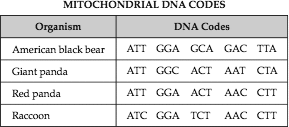
What conclusions can be made based on this table shown?
the American black bear and the giant panda are most closely related
the giant panda and the red panda are most closely related
the red panda and the racoon are the most closely related
the giant panda and the racoon are most closely related


Mutations are important because they bring about
death of the organism in which they develop
genetic variation needed for a population to evolve
benefits for the individual, not for the population
Hardey-Weinberg equilibrium within a population
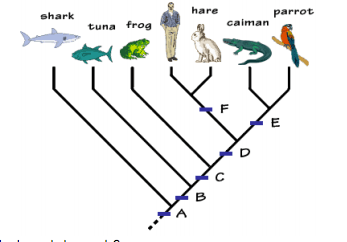
On the cladogram, which organism is the closest relative of the parrot?
Frog
Hare
Caiman
Parrot

The lizard has all these derived characteristics EXCEPT
Jaws
Lungs
Bipedal

