
 Worksheets
FINALS Reviewer -CPE10 (Mixed Signals and Sensors)
Total questions: 90
Worksheet time: 1hrs 23mins
It is an electronic component or device that can interrupt the electrical current in one or more circuits.
(a)
Basic Switch Function
To open and close a circuit.
Acts as control devices.
Does not consume power.
Made of a small piece of semiconductor.
Switch Action that are used to make contact for a brief period of time or as long as the button is pressed.
Momentary Action
Latch Action
Switch Action that maintains the contact until it is forced to the other position.
Momentary Action
Latch Action
Type of Switch that are physical, which must be activated by moving, pressing, releasing, or touching its contacts.
Mechanical Switches
Electronic Switches
Type of Switch that do not require any physical contact in order to control a circuit. It is activated by semiconductor action.
Mechanical Switches
Electronic Switches
Part of the switch where the switch armature is connected into.
Pole
Throw
The closed position of the switch.
Pole
Throw
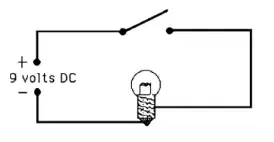
This is the basic ON and OFF switch consisting of one input contact and one output contact.
SPST
SPDT
DPST
DPDP
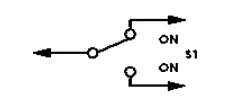
This switch has three terminals: one is input contact and remaining two are output contacts.
SPST
SPDT
DPST
DPDT

This switch consists of four terminals: two input contacts and two output contacts. It behaves like a two separate SPST configurations, operating at the same time.
SPST
SPDT
DPST
DPDT
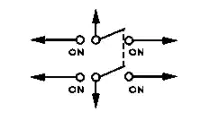
Two input contacts are connected to the one set of output contacts in one position and in another position, input contacts are connected to the other set of output contacts.
SPST
SPDT
DPST
DPDT
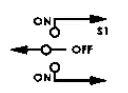
Select the type of switch.
SPDT (Center Off)
Single Pole. 2 Position
Single Pole. 5 Position
Two Pole. 4 Position
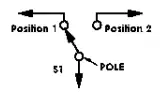
Select the type of switch.
SPDT (Center Off)
Single Pole. 2 Position
Two Pole. 4 Position
Single Pole. 5 Position

Select the type of switch.
SPDT (Center Off)
Single Pole. 2 Position
Two Pole, 4 Position
Single Pole, 5 Position
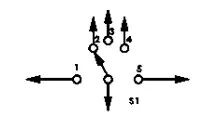
Select the type of Switch
SPDT (Center Off)
Single Pole, 2 Position
Two Pole, 4 Position
Single Pole, 5 Position
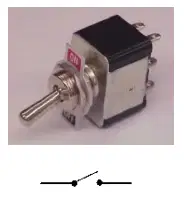
Style of Switch which is manually actuated (or pushed up or down) by a mechanical handle, lever or rocking mechanism. These are commonly used as light control switches.
Toggle
Slide
Rocker
Micro Switch
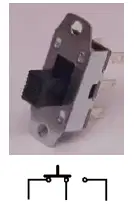
Select the STYLE of Switch
Toggle
Slide
Rocker
Limit
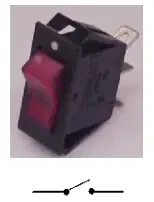
Select the STYLE of switch.
Toggle
Slide
Rocker
Micro
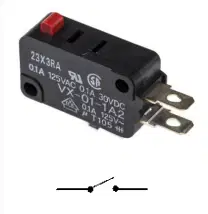
Select the STYLE of switch.
Toggle
Slide
Limit Switch
Micro Switch
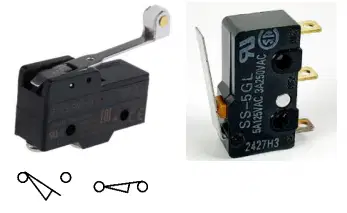
Operated by the presence of an object or by the absence of objects or by the motion of machine instead of human hand.
Push Button
Micro Switch
Limit Switch
Rocker
These switches consist of a bumper type of arm actuated by an object. When this bumper arm is actuated, it causes the switch contacts to change position.
Micro Switch
Float Switch
Limit Switch
Flow Switch
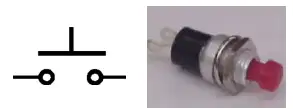
Select Style of Switch.
PBNO
PBNC
DIP
UNIVAC
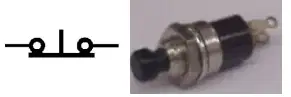
Select Style of Switch.
PBNO
PBNC
DIP
MOSFET
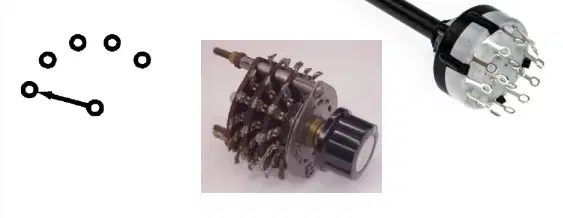
Style of Switch used for complex circuits. Commonly found on ceiling fans.
Push Button
Rotary Switch
Limit Switch
Toggle Switch
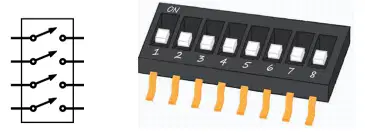
Style of Switch made up of a set of switches in a single unit, usually mounted on a PCB or Breadboard.
Micro Switch
Limit Switch
DIP Switch
Rotary Switch
A device that uses an electromagnet to provide the force to close or open switch contacts, hence, it is an electrically powered switch.
(a)
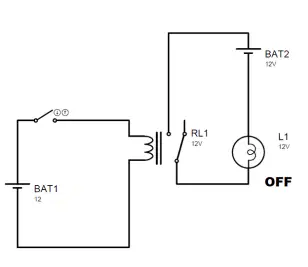
Switch is Normally Open, Coil is not Energized, Bulb is Off, Relay is _________.
Open
Closed
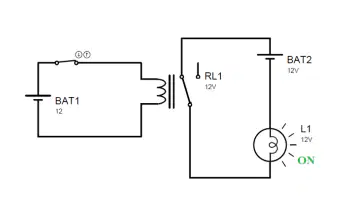
Switch is Normally Closed, Coil is ______________, Bulb is on, Relay is closed.
Energized
Not Energized
A device that detects a change in physical stimulus and turns it into a signal which can be measured or recorded.
(a)
It is any device that converts energy in one form to another. The majority either convert electrical energy to mechanical displacement or convert some non-electrical physical quantity, such as temperature, sound or light to an electrical signal.
(a)
Category of Transducer which requires an external power output is a measure of some variation, such as resistance and capacitance. (Ex. Condenser Microphone)
Passive Transducers
Self-Generating Transducers
Category of Transducer which does not require an external power and they produce analog voltage or current when stimulated by some physical form of energy. (Ex. Thermocouple).
Passive Transducers
Self-Generating Transducers
Give 6 Applications of Transducer used to measure continuous variables.
(Separate answer by comma).
(a)
Give Types of Transducer. (Separate answer by comma).
(a)
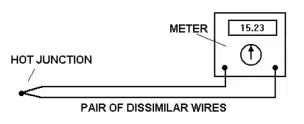
A kind of Temperature Transducer where when two wires with dissimilar electrical properties are joined at both ends and one junction is made hot and the other cold, a small electric current is produced proportional to the difference in the temperature.
Thermocouples
Thermistors
Liquid Expansion and Vapour Pressure Sensors
Bimetallic Types
A kind of Temperature Transducer where when two wires with dissimilar electrical properties are joined at both ends and one junction is made hot and the other cold, a small electric current is produced proportional to the difference in the temperature.
Thermocouples
Thermistors
Liquid Expansion and Vapour Pressure Sensors
Bimetallic Types
In a thermocouple, the relationship is nearly LINEAR over the operating range. The actual characteristic and suitable operating temperatures depends upon the metal used in the wires.
True
False
It is important that thermocouples are standard so that the same EMF will NEVER represent the same temperature.
True
False
Thermocouples come in several forms. They may be wires insulated from each other or plastic or fiber glass materials. For ___________________, the wire pairs are put inside a tube with mineral insulation.
HIGH TEMPERATURE WORK
INDUSTRIAL USES
For _________________ of thermocouples, the sensors comes in a metal enclosure such as stainless steel.
HIGH TEMPERATURE WORK
INDUSTRIAL USES
THERMOCOUPLE have a wide range of temperature from as low as 270°C up to as high as 2700 °C.
True
False
Magnitude of the thermal EMF depends on the WIRE materials used and on the temperature between the junctions.
True
False
Standard metals and pairs for thermocouple constructions known as type K
Chromel-Alumel
Iron-Constantan
Copper-Constantan
Platinum-Rhodium
Standard metals and pairs for thermocouple constructions known as type J
Chromel-Alumel
Iron-Constantan
Copper-Constantan
Platinum-Rhodium
Standard metals and pairs for thermocouple constructions known as type T
Chromel-Alumel
Iron-Constantan
Copper-Constantan
Platinum-Rhodium
Standard metals and pairs for thermocouple constructions known as type S, R & B
Chromel-Alumel
Iron-Constantan
Copper-Constantan
Platinum-Rhodium
A Thermocouple Alloy Composition consisting of 90% nickel and 10% chromium.
Chromel
Alumel
Constantan
Platinum
A Thermocouple Alloy Composition consisting of 95% nickel, 2% manganese, 2% aluminium and 1% silicon
Chromel
Alumel
Constantan
Platinum
A Thermocouple Alloy Composition consisting of 45% nickel and 55% copper
Chromel
Alumel
Constantan
Platinum
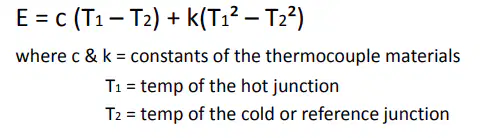
During experiments with a copper – constantan thermocouple, it was found that c = 3.75 x 10¯² mV/°C and k = 4.5 x 10¯⁵ mV/°C². if T1 = 100 °C and the cold junction, T2 is kept in ice. Compute for the resulting EMF.
4.2 mV
3.76 mV
375.0045 mV
None of the Choices
Suppose you have a copper–constantan thermocouple with the coefficients c=0.02mV/°C and k=0.0001mV/°C2. The hot junction (T1) is maintained at a temperature of 200°C and the resulting EMF is measured. Determine the temperature (T2) of the cold junction if the EMF generated by the thermocouple is 5mV.
T2=100°C, T2=-300°C
T2=-48.756
T2=199.37°C, T2=-199.38°C
None of the Choices
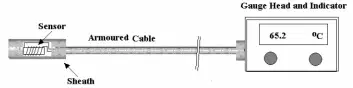
A type of temperature transducer that works on the principle that the electrical resistance of a conductor change with temperature.
Thermocouples
Resistance Type Sensors
Liquid Expansion and Vapour Pressure Sensors
Bimetallic Types
A special type of resistance sensor made from small piece of semiconductor material. It is made of oxides of nickel, manganese or cobalt platinum.
(a)
Temperature dependent semiconductor resistors. Resistance goes down when temp goes down.
(a)
Temperature dependent resistors manufactured from barium titanate and should be chosen when a drastic change in resistance is required at a specific temperature or current level. Resistance goes up when temp goes up.
(a)
Applications of NTC Thermistor (Select all that Apply)
Temperature Measurement and Control
Temperature Compensation
Surge Suppression
Fluid Flow Measurement
Switching of Temperature
Applications of PTC Thermistor (Select All that Apply).
Temperature Sensing
Switching of Temperature
Liquid Level Sensor
Fluid Flow Measurement
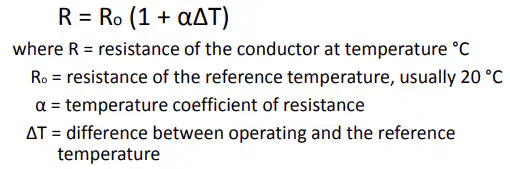
A platinum resistance thermometer has a resistance of 150 Ω at 20°C. Calculate its resistance at 50°C, if α20 = 0.00392
167.64 ohms
282.06 ohms
150.12 ohms
None of the Choices
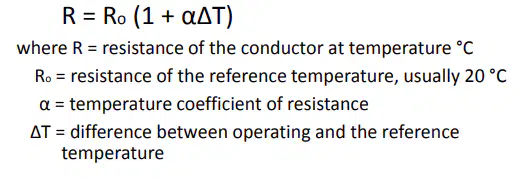
A platinum resistance thermometer has a resistance of 200 Ω at 25∘C. The temperature coefficient of resistance at 25∘C, denoted as αlpha(25), is 0.005 °C−1. Calculate the resistance of the thermometer at 40∘C.
215 ohms
4760 ohms
200.075 ohms
None of the Choices
These are thermometers filled with either a liquid such as mercury or an evaporating fluid such as used in refrigerators.
Thermocouples
Resistance Type Sensors
Liquid Expansion and Vapour Pressure Sensors
Bimetallic Types
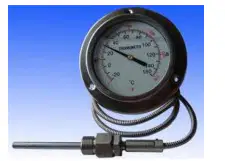
These Instruments are robust and used over a wide range. They can be fitted with electric switches to set off alarms.
Thermocouples
Thermistors
Liquid Expansion/Vapour Pressure Sensors
Bimetallic Types
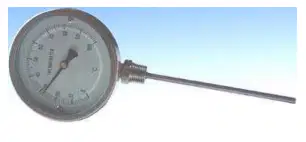
The strip is twisted into a long thin coil inside a tube. One end is fixed at the bottom of the tube and the other turns and moves a pointer on a dial.
Thermocouples
Bourdon Tube
Vapour Pressure Sensors
Bimetallic Types
It is a hollow tube with an elliptical cross section. When a pressure difference exists between the inside and outside, the tube tends to straighten out and the end moves.
Bourdon Tube
Piston Type
Bellows
Diaphragms
The movement is usually coupled to a needle on a dial to make a complete gauge. It can also be connected to a secondary device such as air nozzle to control air pressure or to a suitable transducer to convert it into an electric signal.
Bourdon Tube
Piston Type
Bellows
Diaphragms
A window in the outer case allows pressure to be indicated. This type is usually used in hydraulics where the ability to withstand shock, vibration and sudden pressure changes is needed (shock proof gauge).
Bourdon Tube
Piston Type
Bellows
Diaphragms
It is made of several capsules. These are hollow flattened structures made from thin metal plate. When pressurized, it expands and produces mechanical movement.
Bourdon Tube
Piston Type
Bellows
Diaphragms
These are similar in principle to the bellows, but is usually very thin and perhaps made of rubber. It expands when very small pressures are applied.
Bourdon Tube
Piston Type
Bellows
Diaphragms
If the bellows is encapsulated inside an INNER CONTAINER, the movement is proportional to the difference between the pressure on the inside and outside.
True
False
Examples of Pressure Transducers (Select all that Apply)
Bourdon Tube
Piston Type
Bellows
Diaphragms
Bimetallic Types
Kinds of Speed Transducers (Select All that Apply).
Optical Types
Magnetic Pick Ups
Tachometers
Piston Type
These Transducers use a light beam and a light sensitive cell. The beam is either reflected or interrupted so that pulses are produced for each revolution.
Optical Types
Magnetic Pick Ups
Tachometers
Bimetallic Types
Piston Type
It uses an inductive coil placed near to the rotating body. A small magnet on the body generates a pulse every time it passes the coil.
Optical Types
Magnetic Pick Ups
Tachometers
Diaphragms
Very often it is built into electric motors to measure their speed. The frequency of the voltage represents the speed of rotation. The frequency must be counted and processed.
Optical Types
Magnetic Pick Ups
Tachometers
Bellows
In a magnetic pick up, if the body is made of ferrous material, it will NOT WORK without a magnet.
TRUE
FALSE
In optical types, ELECTRONIC PROCESSING is required to time the pulses and turn the result into an analog or digital signal.
True
False
On magnetic pick ups, a discontinuity in the surface such as a NOTCH will cause change in the magnetic field and generate a pulse.
True
False
A type of transducer that is used to indicate the amount of liquid, gas, or vapor moving through a pipe or conduit by measuring linear, non-linear mass, or volumetric flow rates.
(a)
Type of flow meters that have a mechanical element that makes a shaft of the meter rotate once for an exact known quantity of fluid.
Positive Displacement Types
Inferential Types
Variable Area Types
Differential Pressure Types
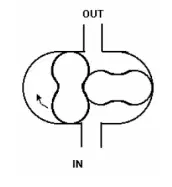
_______________ type consists of two rotors with lobes. When fluid is forced in, the rotors turn and operate the indicating system.
Meshing Motor
Rotating Vane
Rotary Shunt
Helical Turbine
The flow of the fluid is inferred from some effect produced by the flow. Usually this is a rotor which is made to spin and the speed of the rotor is sensed mechanically or electronically.
Positive Displacement Types
Inferential Types
Variable Area Types
Differential Pressure Types
This has an axial rotor which is made to spin by the fluid and the speed represents the flow rate. This may be sensed electrically by coupling the shaft to a small electric tachometer.
Turbine Rotor Types
Rotating Vane Types
Rotary Shunt Types
Helical Turbine Types
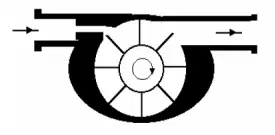
The jet of fluid spins around it and the speed of the rotor is measured mechanically or electronically.
Turbine Rotor Types
Rotating Vane Types
Rotary Shunt Types
Helical Turbine Types
Often this consists of a magnetic slug on the rotor which generates a pulse of electricity each time it passes the sensor.
Turbine Rotor Types
Rotating Vane Types
Rotary Shunt Types
Helical Turbine Types
In variable area types of flow meters, this is inside a tapered tube. The fluid goes through the annular gap around the edge of it.
Float Type
Tapered Plug Type
In a float type of variable flow meter, because the tube is tapered, the restriction is INCREASED as the float moves up. Eventually a level is reached where the restriction is just right to produce a pressure force that counteracts the weight of the float.
True
False
It is aligned inside a hole or orifice. A spring holds it in place. The flow is restricted as it passes through the gap and a force is produced which moves the plug.
FLOAT TYPE
TAPERED PLUG TYPE
Because it is tapered the restriction changes and the plug takes up a position where the pressure force just balances the spring force. The movement of the plug is transmitted WITH A MAGNET to an indicator on the outside.
True
False
The type of flow meter wherein the working principle is that something makes the velocity of the fluid change and this produces a change in the pressure so that a difference in pressure is created. It uses Orifice Meters, Venturi Meters, Nozzle Meters, or Pitot Tubes to convert flow rate.
Positive Displacement Types
Inferential Types
Variable Area Types
Differential Pressure Types
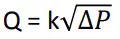
In a flow measurement system, the volume flow rate (Q) of a fluid is measured using a differential pressure (ΔP) across an orifice plate with a meter constant (k) of 0.025 m3/s. Calculate the volume flow rate when the Pressure changes from 100Pa to 300Pa.
0.35 Pa m^3/s
0.025 * 200i Pa m^3/s
3.53 Pa m^3/s
None of the Choices

