
 Worksheets
Earth's Spheres
Total questions: 15
Worksheet time: 8mins
Name
Class
Date
1.

Students in science class used computers to make models of Earth's spheres. All four of Earth's spheres needed to be labeled in the model. The picture below shows one student's model.
What sphere is the letter D in the student's model?
a)
atmosphere
b)
biosphere
c)
geosphere
d)
hydrosphere
2.

This diagram shows that when a mountain is located near a large body of water, moist air from the body of water travels up the mountain and causes precipitation as it expands and cools. The air dries out as it reaches the top of the mountain. It then moves down the other side of the mountain, where it is compressed and heated As a result, the side of the mountain near the water gets more precipitation than the side that faces away from the mountain.
Which of the following best describes how the Earth's spheres are interacting in this model?
a)
The mountain is part of the geosphere, and it interacts with water from the hydrosphere to cause predictable weather patterns in the atmosphere.
b)
The mountain is part of the atmosphere, and it interacts with water from the biosphere to cause predictable weather patterns in the geosphere.
c)
The mountain is part of the biosphere, and it interacts with water from the geosphere to cause predictable weather patterns in the hydrosphere.
d)
The mountain is part of the hydrosphere, and it interacts with water from the atmosphere to cause predictable weather patterns in the biosphere.
3.

The image below models the movement of air and water in a certain area.
What does the image show?
a)
Erosion can produce dry weather.
b)
Winds build up mountains.
c)
Landforms can affect climates.
d)
Weathering can produce rain.
4.
The lithosphere is within the geosphere. What layers of the Earth's geosphere make up the lithosphere?
a)
the crust and the top of the mantle
b)
the inner core and the crust
c)
the outer core and the crust
d)
the mantle and the outer core
5.
What are the 4 spheres that make up Earth?
a)
biosphere
b)
hydrosphere
c)
atmosphere
d)
geosphere
e)
thermosphere
6.
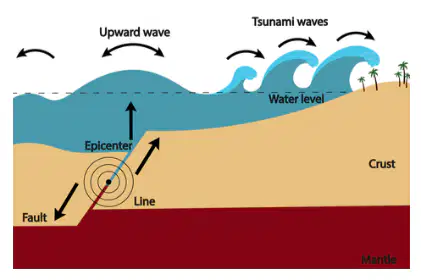
The image below models a tsunami. The tsunami is produced by an earthquake thousands of miles from the coast. The image is not drawn to scale.
What does this model show?
a)
Earthquakes thousands of miles away can produce volcanoes.
b)
Earthquakes have a large effect on the weather in areas far from the coast.
c)
Earthquakes thousands of miles away can affect land ecosystems.
d)
Earthquakes have a large effect on the climate in coastal areas.
7.
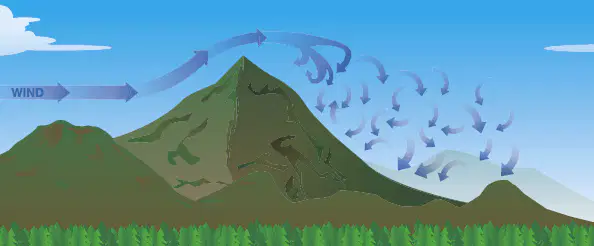
The image below shows a how wind patterns can be different on each side of a mountain range.
On one side the wind flows smoothly, but on the other side there are more wind currents in different directions. Which of Earth's spheres are interacting as the wind flows over the mountain?
a)
geosphere and atmosphere
b)
hydrosphere and atmosphere
c)
atmosphere and biosphere
d)
geosphere and biosphere
8.
The soil in some places has a lot of silt. This type of soil is useful for growing many types of plants. Areas with silt are often turned into farmland because the silt gives nutrients for crops to grow.
From this information, how do Earth's spheres interact?
a)
The atmosphere changes the hydrosphere.
b)
The hydrosphere combines with the geosphere.
c)
The biosphere depends on the atmosphere to survive.
d)
The geosphere supports life in the biosphere.
9.

Which sphere is represented by the diagram?
a)
biosphere
b)
atmosphere
c)
geosphere
d)
hydrosphere
10.
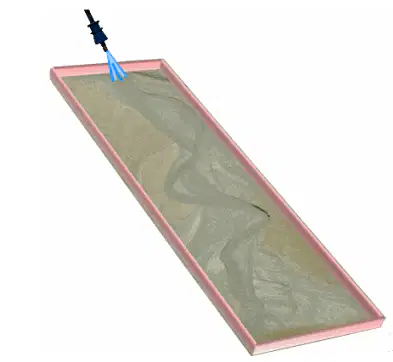
Jeffery used a stream table as a model to show how water erodes soil. As he sprayed water on the stream table, some of the soil was carried to the end of the table.
Jeffery used his stream table to model an interaction between which two spheres?
a)
biosphere and atmosphere
b)
hydrosphere and atmosphere
c)
geosphere and biosphere
d)
geosphere and hydrosphere
11.
Identify the 2 characteristics of the atmosphere.
a)
sky warming
b)
wind blowing
c)
river flowing
d)
insect on leaf
e)
sand on beach
12.
Identify the 2 characteristics of the hydrosphere.
a)
river flowing
b)
rain falling
c)
insect on leaf
d)
sky warming
e)
sand on beach
13.
Identify the 2 characteristics of the geosphere.
a)
sand on beach
b)
lava in a volcano
c)
river flowing
d)
insect on leaf
e)
sky warming
14.
Which choice lists parts of Earth's hydrosphere?
a)
seaweed and glaciers
b)
glaciers and ice caps
c)
rain clouds and air masses
d)
riverbeds and ocean basins
15.
Identify the 2 characteristics of the biosphere.
a)
insect on leaf
b)
tree growing
c)
river flowing
d)
sky warming
e)
sand on beach
100 %

