
 Worksheets
Reflection, Refraction and Ray Plotting
Total questions: 15
Worksheet time: 23mins
When light hits an area and bounces back it is called:
echo
refraction
reflection
absorbing
When light goes from one material(medium) to another it becomes bent, what term means bent?
reflected
refracted
absorbed
turned

What is the angle of reflection (θr) in the image?
56o
90o
124o
34o
Which of the following characteristics are correct for the image formed in a plane mirror?
I. Upright
II. Inverted
III. Real
IV. Same size as the object
V. Virtual
I, II, III
I, III, IV
I, IV, V
III, IV, V
Which of the following factors contributes to the bending of light?
Change of speed of light
Change of density of light
Change of colour of light
Change of energy of light
When the light passes out of the glass, back into the air
It bends away from the normal
It does not bend
It bends towards the normal
It continues to be the normal
Which figure represents the path light takes through a converging lens?
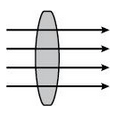
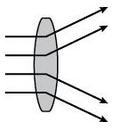
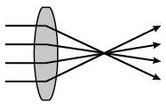
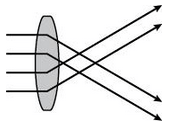
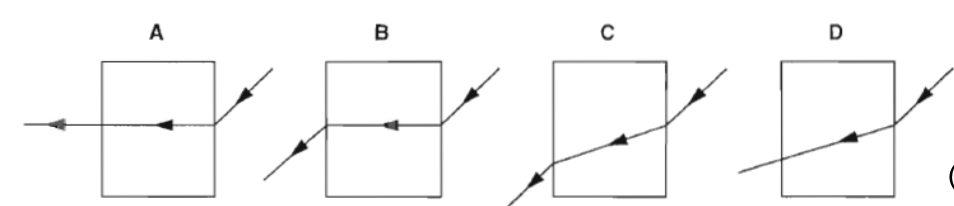
A ray of light travels from air into a glass block.
Which diagram correctly shows the path of the ray through the glass block?
A
B
C
D

What is the angle of incidence?
The angle at which light bends in water.
The angle at which light hits a surface.
The angle at which light is absorbed by an object.
The angle at which light bounces off a surface.
An object is placed at a distance of 0.25 m
in front of a plane mirror. The distance between the object and image will be
0.25m
1m
0.5m
0.125m
Objects that reflect well are
Matte surfaces
Smooth, shiny surfaces
Dark coloured surfaces
Medium coloured surfaces
The law of reflection states that
Angle of incidence = Angle of reflection
Angle of incidence = Angle of incidence
Angle of reflection = Angle of translucence
Angle of reflection = Angle of reflection
How does a concave lens differ from a convex lens?
A convex lens is another way to describe a plane mirror; a concave lens is curved
A concave lens is curved inward on both sides; a convex lens is on only one side
A convex lens has a thick center and thin edges, a concave lens has a thin center and thicker edges
A convex lens has a thin center and thick edges. a concave lens has a thick center and thinner edges
a real image is produced by...
the apparent intersection and can be projected on a screen
the actual intersection of rays and cannot be projected on a screen
the apparent intersection of rays and cannot be projected on a screen
the actual intersection of rays and can be projected on a screen
A virtual image is formed by...
the actual intersection of light rays, cannot be formed on a screen
the apparent intersection of light rays, cannot be formed on a screen
the actual intersection of light rays, can be formed on a screen
the apparent intersection of light rays, can be formed on a screen

