
Font size
 Worksheets
DistributedSystems-Distributed Part
Total questions: 97
Worksheet time: 1hrs 10mins
HPC
high performance computing
raw speed/ move 4 people
high throughput computinng
serve many requests simultaneosly
HTC
high performance computing
raw speed/ move 4 people
high throughput computinng
serve many requests simultaneosly
___ high performance computing – Raw speed – Move 4 people
HTC
HPC
___ high throughput computing – Serve many requests simultaneously – Move 160 people
HTC
HPC
Amdahl's Law
= _/(_-_)+(_/_)
(Left to right)
1,1,p,p,n
1,1,1,p,n
1,p,p,p,n
1,n,p,p,n

n
is the speedup of the part of the task that benefits from improved system resources
is the proportion of execution time that the part benefiting from improved resources originally occupied
is the theoretical speedup of the execution of the whole task
S_latency
is the speedup of the part of the task that benefits from improved system resources
is the proportion of execution time that the part benefiting from improved resources originally occupied
is the theoretical speedup of the execution of the whole task
p
is the speedup of the part of the task that benefits from improved system resources
is the proportion of execution time that the part benefiting from improved resources originally occupied
is the theoretical speedup of the execution of the whole task
What means XaaS
Cloud Services Models
Execution as a Service
Functions as a Service
Infrstructure as a Service
What means SaaS
Cloud Services Models
Software as a Service
Functions as a Service
Infrstructure as a Service
What means IaaS
Cloud Services Models
Software as a Service
Functions as a Service
Infrstructure as a Service
What means PaaS
Cloud Services Models
Software as a Service
Functions as a Service
Platform as a Service

Please fill in each the first 5 layer of the stack
1.
2.
3.
4.
5.
(a)
Please fill in each the last 4 layer of the stack
4.
5.
6.
7.
(a)
What are the two different ways for Client-Server Processes?
Application- (a) protocol
9 Communication and Naming 9.1 Client-Server Processes
Middleware-level solutions: client machine is used only as a (a) with no need for local storage, leading to an application-neutral solution
What are the different type of servers in a client-server process, besides Server clusters
(a)
What is a key characteristic of an Iterative server?
a. Handles multiple requests simultaneously
b. Handles requests before attending the next request s
c. Utilizes a dispatcher for request handling
d. Keeps track of client statu
Which type of server uses a dispatcher to manage incoming requests?
a. Iterative server
b. Stateless server
c. Concurrent server
d. Stateful server
What is a notable advantage of a Stateless server?
a. Faster performance
b. Reduced state inconsistencies
c. Keeps accurate client status
d. Tracks client status with local copies
What is a characteristic of a Stateful server?
a. Independent clients and servers
b. Loss of performance
c. Faster but less reliable
d. Reduced state inconsistencies
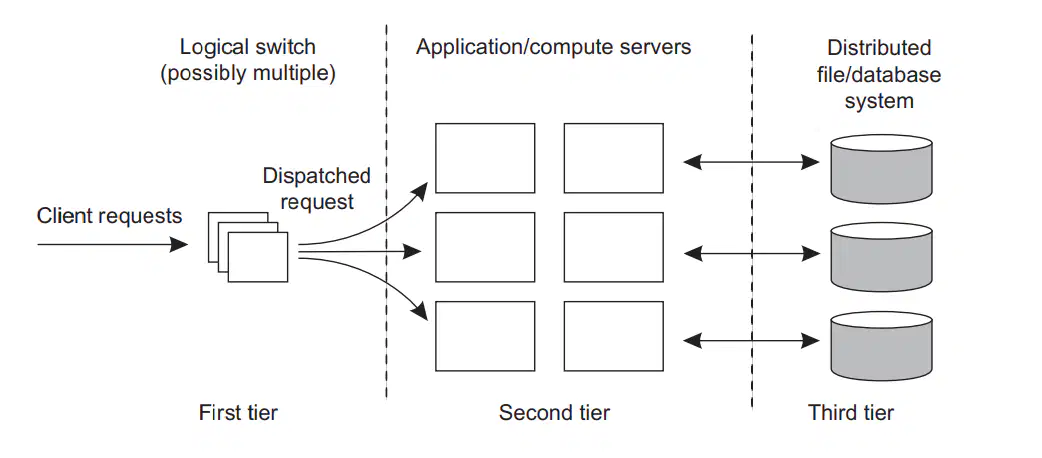
Which type of server in a client-server process is here described
Server clusters
Iterative Server
Stateful Server
Stateless Server
Client-Server Process
In transport-layer switching, what does the front end do with the TCP request?
a. Reads the content of the request
b. Selects the best server based on content
c. Passes the TCP request to one of the servers
d. Tracks client status
Client-Server Process
In content-aware distribution, what action does the front end take before selecting the best server?
a. Reads the content of the request
b. Passes the TCP request to one of the servers
c. Tracks client status
d. Considers performance metrics
What are the two widle-used models for communication?
(a)
What means RPC?
(a)
What means MOM?
(a)
Which point of the distributed transparency is violated in the OSI-Model
access
location
relocation
migration
concurrency
Communictaion
What is the the task of the Middleware layer
provide common _____ and _____
(a)
Which is true for transient communictaion
server discards message when it cannot be delivered at the next server, or at the receiver
: A message is stored at a communication server as long as it takes to deliver it
Sender continues immediately after it has submitted its message for transmission.
Sender is blocked until its request is known to be accepted.
Which is true for persistent communictaion
server discards message when it cannot be delivered at the next server, or at the receiver
: A message is stored at a communication server as long as it takes to deliver it
Sender continues immediately after it has submitted its message for transmission.
Sender is blocked until its request is known to be accepted.
Which is true for asynchronous communictaion
server discards message when it cannot be delivered at the next server, or at the receiver
: A message is stored at a communication server as long as it takes to deliver it
Sender continues immediately after it has submitted its message for transmission.
Sender is blocked until its request is known to be accepted.
Which is false for synchronous communictaion
server discards message when it cannot be delivered at the next server, or at the receiver
: A message is stored at a communication server as long as it takes to deliver it
Sender continues immediately after it has submitted its message for transmission.
Sender is blocked until its request is known to be accepted.
Client/Server computing is generally based on a model of (a) communictaions
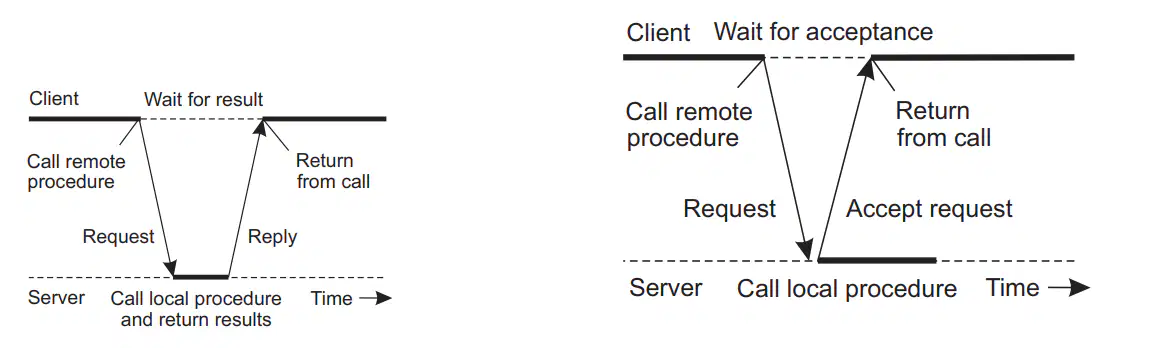
Left picture is synchronous RPC
Right picture is asynchronous RPC
Left picture is asynchronous RPC
Right picture is synchronous RPC
Message-oriented middleware Aims at
high-level persistent asynchronous communication:
high-level persistent synchronous communication:
high-level transient asynchronous communication:
high-level transient synchronous communication:
Example for meaasge-oriented transient communictaion:
(a)
Example for Message-oriented persistent communication
(a)
Communictaion
What is the problem with Application-level multicasting
Setting up Communictaion Path
to expensive
to slow

Consider a ALM overlay network
Wich nodes does a message from A to D needs to cross twice
(a)
How is the stretch defined when we consider an ALM path
(a)
Which is true for Flooding
Pros - Fastest to all destinations
Cons - Communication overhead
Cons - Communication effeciency
Pros- Slowest to all destinations

(a)
Which statements fits to Gosspi-based flooding
Randomly send/exchange data with some neighbors
Pros - Fast convergence
Cons - Reaching all nodes is not guaranteed
Pros - Reaching all nodes is guaranteed
What are two simple solutions for flat naming
(a)
What is the main idea behind Broadcasting, a simple solution for flat naming. Tick also the statements which are true for Broadcasting
Broadcast the ID, requesting the entity to return its current address
When an entity moves, it leaves behind a pointer to its next location
Can never scale beyond local-area networks (since only local networks offer efficient broadcasting facilities)
• Requires all processes to listen to incoming location requests
Dereferencing can be made entirely transparent to clients by simply following the chain of pointers
What is the main idea behind Forwarding Pointers, a simple solution for flat naming. Tick also the statements which are true for Forwarding Pointers
Geographical scalability problems
When an entity moves, it leaves behind a pointer to its next location
Update a client’s reference when present location is found
• Requires all processes to listen to incoming location requests
Dereferencing can be made entirely transparent to clients by simply following the chain of pointers
What other solutions, besides the simple solution, does exists for flat naming
3 Home-based approaches
4 Distributed hash tables (DHT)
5 Hierarchical approaches
Broadcasting
2 Forwarding pointers
Which statements fits to Home-based approaches:
Let a home keep track of where the entity is
Entity’s home address registered at a naming service
• The home registers the foreign address of the entity
• Client contacts the home first, and then continues with foreign location
• Good geographical scalability (entity may be next to client)
Which of the statements is true for Distributed hash tables: Chord
Each node is assigned a random m-bit identifier.
Every entity is assigned a unique m-bit key.
• Entity with key k falls under jurisdiction of node with smallest id ≥ k, called successor succ(k).
Each entity is assigned a random m-bit identifier.
• Entity with key k falls under jurisdiction of node with smallest id > k, called successor succ(k).
What is the formula for the finger table and how many entries has the table when the entity as a unique 2-bit key
(a)
Determine a case in which all entries in the finger table of a node are the same? Explain!
(a)
Determine a case in which all entries in the finger table of a node are different? Explain!
(a)

Which solution for flat naming is here described
(a)
How is the solution called for structured Naming and which subtypes exists?
Name resolution,Iterative name resolution,Recursive name resolution
Broadcasting,Multicasting
Flooding,Gosspi-based flooding
distributed hash tables,CHORD
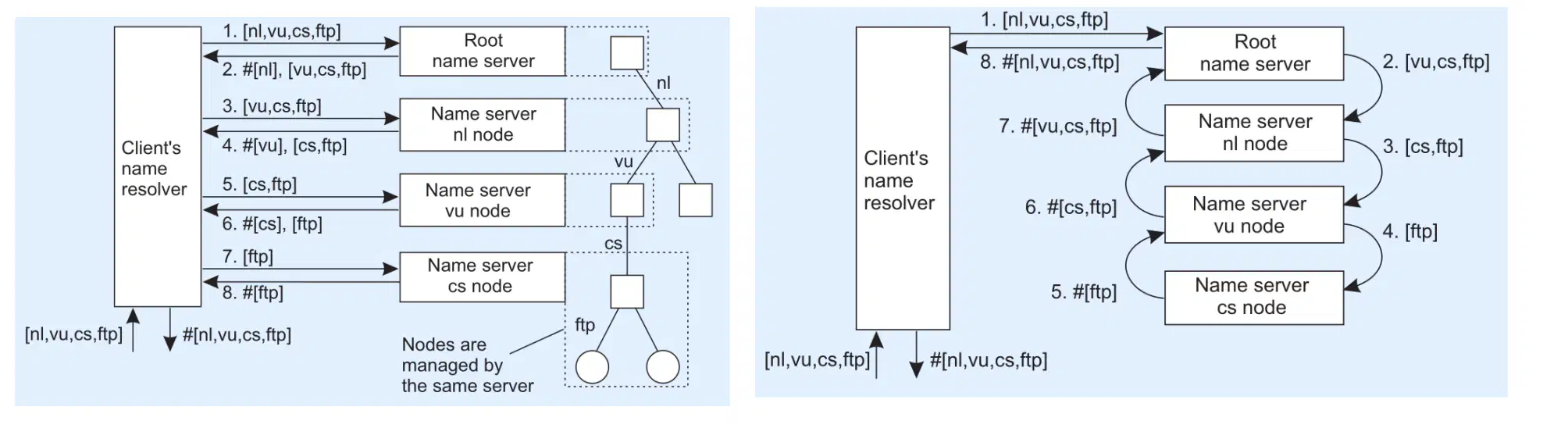
The left name resolution is ____
The right name resultion is ____
(a)
• Scalability issues
– Assume (at least at global and administrational level) that content of nodes hardly ever changes
– Apply extensive replication by mapping nodes to multiple servers, and start name resolution at the nearest server
– Apply less replication by mapping nodes to multiple servers, and start name resolution at the nearest server
– Assume (at least at local and administrational level) that content of nodes hardly ever changes
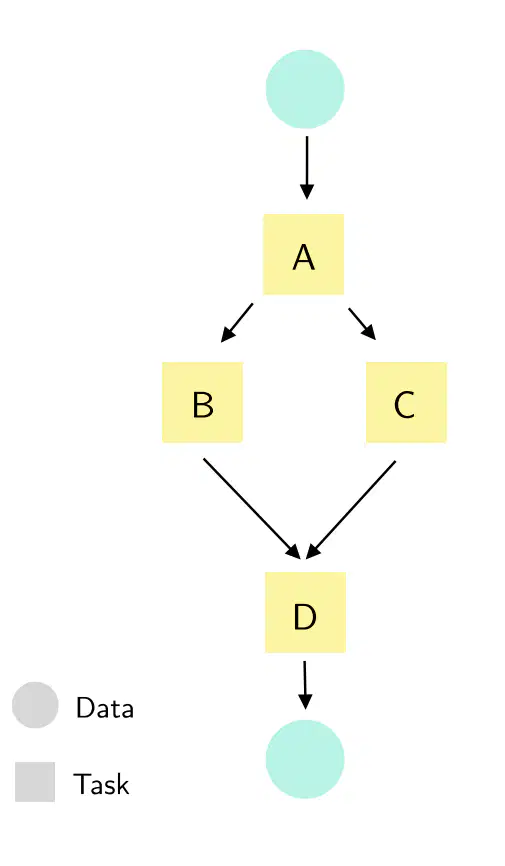
Which scheduling are possible
A,B,C,D
A,C,B,D
D,A,C,B
What characterizes preemptive scheduling?
a. Task runs until completion
b. Task is interrupted and resumed later
c. Task is assigned to multiple CPUs
d. Task is distributed across the network
In which context is preemptive scheduling often utilized?
a. Distributed systems
b. Operating systems
c. Real-time systems
d. Cloud computing environments
What happens in non-preemptive scheduling?
a. Task is interrupted and resumed later
b. Task runs until it is finished
c. Task is distributed across multiple nodes
d. Task is assigned to different CPUs
In which context is non-preemptive scheduling often utilized?
a. Distributed systems
b. Operating systems
. Real-time systems
d. Cloud computing environments
What is the difference between static and dynamic scheduling?
(static)The schedule is calculated before the start
(dynamic)During runtime
(dynamic)The schedule is calculated before the start
(static)During runtime
What are the common objectives of scheduling?
Makespan
Cost
Usability
Portability
What is EST
(a)

Which rank is this?
Upward Rank
Downward Rank
(b-rank
(t-rank
Formula for t-rank
(a)
Which rank is used in the Heft algorithm
Downward rank
t-rank
b-rank
none of them
Do you know two requirements related to dependability?
(a)
Which metric fits to:
The average time until a component fails
MTTF
MTTR
MTBF
Which metric fits to:
The average time needed to repair a component.
MTTF
MTTR
MTBF
Which metric fits to:
MTTF + MTTR.
MTTF
MTTR
MTBF
formula of MTTF:
_/_
(a)
formula of MTTR:
_/_
(a)
formula of MTBF:
_/_
(a)
Three identical servers s1, s2, and s3 :
• s1 failed after eight hours
• s2 failed after ten hours
• s3 failed after twelve hours
MTTF = _h
(a)
A server s fails three times per day:
• Repair 1: 40 min
• Repair 2: 5 min
• Repair 3: 15 min
MTTR = _ min
(a)
A server s fails three times per day:
• Repair 1: 40 min
• Repair 2: 5 min
• Repair 3: 15 min
MTBF = _ h
(a)
formmula of Reliabilty:
R(t) = e^( (a) )
How is the Availabilty calculated?
A =
(a)
How to improve Availabilty?
• Increase MTTF
• Reduce MTTR
• Reduce MTTF

How would you compute Availabilty
(a)
Which type of failure is characterized by Halts, but is working correctly until it halts
Crash failure
Omission failure
Timing failure
Arbitrary failure
Which type of failure is characterized by Fails to respond to incoming requests
Crash failure
Omission failure
Timing failure
Arbitrary failure
Which type of failure is characterized by Response lies outside a specified time interval
Crash failure
Omission failure
Timing failure
Arbitrary failure
Which type of failure is characterized by Response is incorrect
Crash failure
Omission failure
Timing failure
Arbitrary failure
Response failure
How large does a k-fault tolerant group need to be?
• With halting failures k+1
• With halting failures k
With arbitrary failures: we need k + 1
With arbitrary failures: we need 2k + 1
Which statement is true for this Byzantine agreement:
BA1:
Every nonfaulty backup process stores the same value.
If the primary is nonfaulty then every nonfaulty backup process stores exactly what the primary had sent.
Which statement is true for this Byzantine agreement:
BA2:
Every nonfaulty backup process stores the same value.
If the primary is nonfaulty then every nonfaulty backup process stores exactly what the primary had sent.
Which type of recovery is here described
Find a new state from which the system can continue operation
Forward error recovery
Backward error recovery
Which type of recovery is here described
Bring the system back into a previous error-free state
Forward error recovery
Backward error recovery
Which types of checkpointing is here described?
checkpoint, which stores the full state of the application or the virtual machine.
• Full checkpoint
Incremental checkpoint
Which types of checkpointing is here described?
checkpoint, which stores only the updated memory pages from the last checkpoint
• Full checkpoint
Incremental checkpoint
Is this true?
Reactive checkpointing is, when the system creates a checkpoint regularly and proactive checkpointing is, when e the system performs a checkpoint based on some specific events
No
Yes

Welche Recovery line ist nicht korrekt(von links aus gesehen)
2te
1te
Which points ar importan for the Design Goal Openness
Define services trough well defined interfaces
Interoperability
Extensible
Portability
Access
What are the Design Goals of a distributed System
Resource sharing,Distribution Transparency,Openness,Scalability
Resource sharing,Distribution Intransparency,Openness,Scalability
Resource sharing,Distribution Transparency,Open-Closed,Scalability

