
Font size
 Worksheets
Review States (IMFs & Solutions)
Total questions: 65
Worksheet time: 11hrs 50mins
Which state of matter have the weakest intermolecular forces (attraction between the different particles)?
solid
liquid
gas
What statement best explains the very high melting and boiling point of water?
All molecules have London forces between them, but some molecules can have additional types of intermolecular forces. Which of these molecules has ONLY London dispersion forces?
I2
Which substance would have the weakest intermolecular forces of attraction?
CH4
NaCl
H2O
MgF2

What is the strongest intermolecular force for NH3
Dispersion Force
Dipole dipole
Hydrogen bonding

What would be the strongest IMF between 2 of these molecules?
London Dispersion
London Dispersion
H2S has what kind of intermolecular force as its strongest IMF?
London dispersion
Which substance will have the highest vapor pressure?
(HINT High vapor pressure means the substance evaporates easily - like a volatile liquid.)
CH3CH2CH2CH2CH3
H2O
CH4
CH3F

What is the strongest IMF between molecules of this substance?

The strongest intermolecular force for CO2
Dispersion Force
Dipole dipole
Hydrogen bonding
Which substance has the weakest intermolecular forces?
Substance A, boiling point of 75 °C
Substance B, boiling point of 105 °C
Substance C, boiling point of 25 °C
Substance d, boiling point of 45 °C
chlorine has a lower boiling point than bromine (which is a liquid at room temperature) because chlorine has fewer polarizable electrons than bromine

Which of the following would have ion-dipole attractions?
Which of the following liquids experiences dipole-dipole intermolecular forces?
O2(l)
CCl4(l)
SO3(l)
CF2Cl2

Which of the following answer best describes the solubility of pyridine and benzene in water?
Pyridine, a polar molecule, can form strong dipole-dipole interactions with water, another polar molecule. Benzene, a non-polar molecule, cannot form strong intermolecular interactions with water. Therefore, pyridine is soluble in water while benzene is not.
Pyridine, a non-polar molecule, cannot form strong intermolecular interactions with water. Benzene, a polar molecule, can form strong dipole-dipole interactions with water, another polar molecule. Therefore, benzene is soluble in water while pyridine is not.
Pyridine, a non-polar molecule, cannot form strong intermolecular interactions with water. Benzene, a non-polar molecule, cannot form strong intermolecular interactions with water. Therefore, neither pyridine nor benzene are soluble in water.
Pyridine, a polar molecule, can form strong dipole-dipole interactions with water, another polar molecule. Benzene, a polar molecule, can form strong dipole-dipole interactions with water, another polar molecule. Therefore, both pyridine and benzene are soluble in water.
Which of the following will NOT have hydrogen bonding?


Which of the following will have the lowest melting point?


Which type of IMF is responsible for the attraction pictured above?
Dipole-Dipole Interaction
Ion-Dipole Interaction
Hydrogen Bonds
Covalent Bond
Ionic Bond
The polarity of a bond is determined by...
The sum of the electronegativities of the two atoms
The difference in the electronegativities of the two atoms
The charges of the atoms
The number of electrons shared in the bond
Which of the following molecules would dissolve in oil?
CHCl3
NH3
CCl4
HBr

Which type of IMF is responsible for the attraction pictured above?
Dipole-Dipole Interaction
Ion-Dipole Interaction
Hydrogen Bonds
Covalent Bond
Ionic Bond

Which type of IMF is responsible for the attraction pictured above?
Dipole-Dipole Interaction
Ion-Dipole Interaction
Hydrogen Bonds
Covalent Bond
Ionic Bond

What type of IMF's would occur in between molecules of Carbon Tetrachloride? You can choose more than one answer.
London Dispersion Force (LDF)
Dipole-Dipole
Hydrogen Bond
Ion-Dipole

What type of IMF's would occur in between molecules of Sulfur Dioxide? You can choose more than one answer.
London Dispersion Force (LDF)
Dipole-Dipole
Hydrogen Bond
Ion-Dipole

Which type of IMF's are present between molecules of butanol? Check all that apply
London Dispersion Force (LDF)
Dipole-Dipole
Hydrogen Bonding
Ion Dipole

What type of IMF's are in-between molecules of ethyl acetate? Check all that are correct
London Dispersion Forces (LDF)
Dipole-Dipole
Hydrogen Bonding
Ion Dipole

Which numbered arrow in the image above points to a hydrogen bond?
1
2
3
4
Propane is a gas at room temperature, while bromine is a liquid at room temperature. Which statement correctly explains these observations?
Bromine has weaker intermolecular forces than propane does
Bromine has greater molecular polarity than propane does
Bromine has weaker molecular polarity than propane does
Bromine has stronger intermolecular forces than propane does
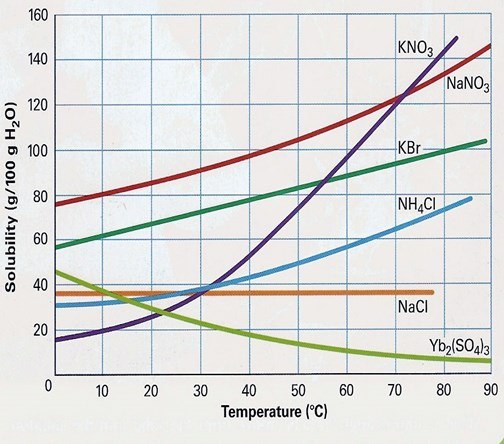
At 30'C, which substance has the lowest solubility?
KNO3
KBr
NaCl
Yb2(SO4)3
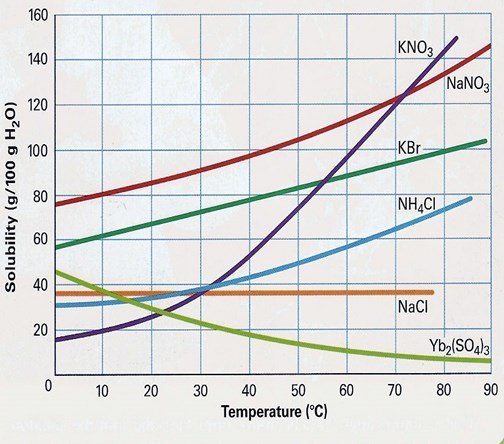
At which temperature do KBr and KNO3 have the same solubility?
60
55
50
Never
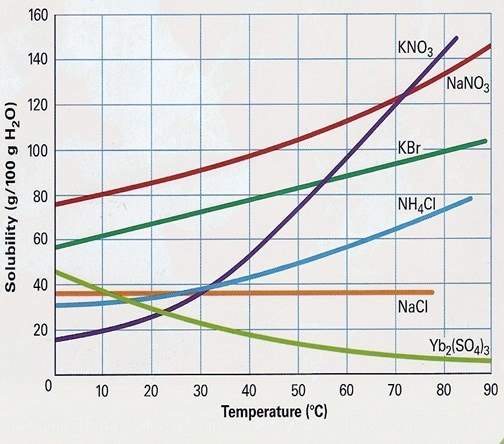
Determine the solubility for the substances at 55'C and arrange them in order from lowest to highest solubility.
NaCl, NH4Cl, KBr, NaNO3
NaCl, NH4Cl, NaNO3, KBr
NH4Cl, NaCl, NaNO3, KBr
NaNO3, KBr, NH4Cl, NaCl
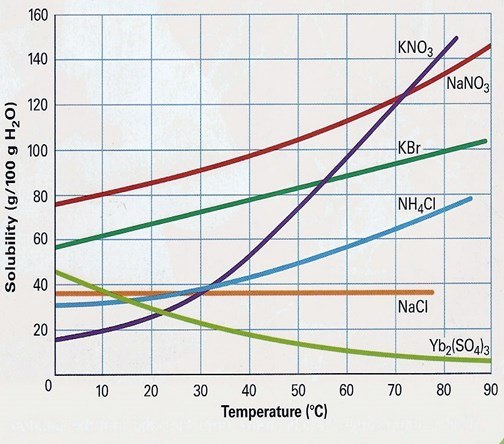
At 10'C, the solubility of NaNO3 is 80 g/100 g of H2O. Based on this information, what would the solubility be in 50 g of H2O.
40
80
160
16
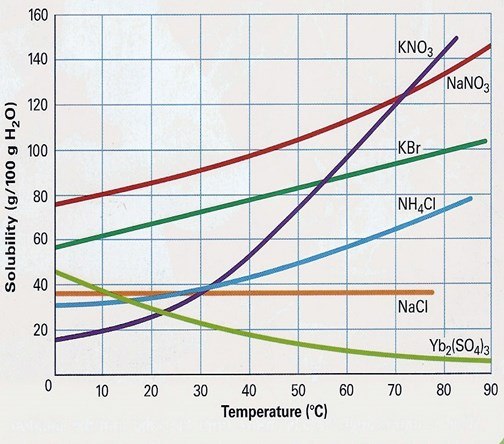
Identify if the following solution would be saturated, unsaturated, or supersaturated: 103 g KBr at 70'C.
Unsaturated
Saturated
Supersaturated
Identify a method to decrease the dissolving rate of a solution:
decrease the temperature
add KE
stir the solution
increase the temperature

What is the concentration of nitrate ions in a 2.00 M Al(NO3)3 solution?
2.00 M NO3-1
4.00 M NO3-1
6.00 M NO3-1
8.00 M NO3-1
A student is preparing solutions for a laboratory experiment by dissolving solid solutes in liquid solvents. Which action will increase the rate of solubility of the solute in the solvent?
lowering the temperature of the solvent
stirring the solute in the solution
increasing the pressure on the solution
increasing the particle size of the solute
What is the molarity of a 0.500L sample of a solution that contains 60.0 g of sodium hydroxide (NaOH)
0.8 M
1.5M
3.0M
6.0M
What is the molarity of a solution that contains 125 g NaCl in 4.00 L of solution?
If 400 mL of a 8.0 M solution is diluted to a molarity of 5.3M, about how much solvent volume was added?
200 mL
600 mL
400 mL
180 mL

Ethanol is a polar solvent. Which of the following statements is true?
Water will dissolve into ethanol because water is polar too.
Water will dissolve into ethanol because water is nonpolar.
Oil will dissolve into ethanol because oil is polar too.
Oil will dissolve into ethanol because oil is nonpolar.

Table salt (NaCl) dissolves into water because...
table salt is polar and water is polar too.
table salt is ionic and water is polar.
table salt is nonpolar and water is nonpolar too.
table salt is ionic and water is nonpolar.
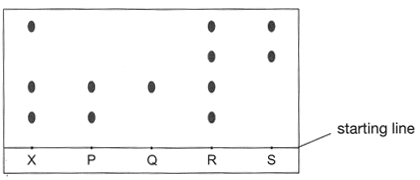
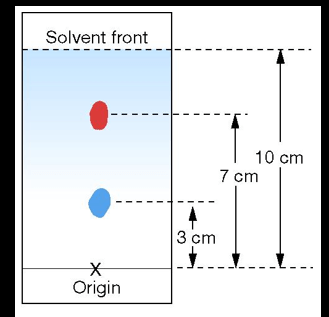
In paper chromatography, the LEAST soluble solute ____.
does not move from the start point
stays closest to the start point
travels furthest away from the start point
can be found in the middle of the chromatogram

The diagram above represents a particle in aqueous solution. Which of the following statements about the particle is correct?
The particle must be a cation because the negative end of each water molecule is pointed toward it.
The particle must be an anion because the positive end of each water molecule is pointed toward it.
The charge of the particle cannot be determined because water molecules have no net charge.
The charge of the particle cannot be determined because the water molecules are arranged symmetrically and their partial charges cancel.

A student obtains a mixture of the liquids hexane and octane, which are miscible in all proportions. Which of the following techniques would be best for separating the two components of the mixture, and why?
Filtration, because the different densities of the liquids would allow one to pass through the filter paper while the other would not.
Paper chromatography, because the liquids would move along the stationary phase at different rates owing to the difference in polarity of their molecules.
Column chromatography, because the higher molar mass of octane would cause it to move down the column faster than hexane.
Distillation, because the liquids would boil at different temperatures owing to the difference in strength of their intermolecular forces.
50 ml of a 1 M solution is diluted until the final volume is 80ml. How much water was added?
50 ml
1.3 ml
30 ml
130 ml

