
 Worksheets
AlgGeo Pre-Skills Unit 6
Total questions: 44
Worksheet time: 31mins
Which of the following angles is an acute angle?
45 degrees
90 degrees
120 degrees
180 degrees
Identify the obtuse angle from the options below.
80 degrees
100 degrees
90 degrees
60 degrees
Which of the following pairs of angles are supplementary?
60 degrees and 120 degrees
45 degrees and 45 degrees
90 degrees and 80 degrees
100 degrees and 100 degrees
Which of the following is NOT an acute angle?
30 degrees
75 degrees
90 degrees
10 degrees
Identify the angle that is obtuse.
170 degrees
45 degrees
90 degrees
89 degrees
What type of angle is exactly 180 degrees?
Acute
Right
Obtuse
Straight
If two angles are supplementary and one angle is 70 degrees, what is the measure of the other angle?
20 degrees
110 degrees
100 degrees
180 degrees
What is a five-sided polygon called?
Hexagon
Pentagon
Octagon
Quadrilateral
Which of the following is NOT a polygon?
Circle
Triangle
Square
Rectangle
A polygon with all sides are the same length and angles are the same measure is known as what?
Regular polygon
Irregular polygon
Symmetric polygon
Asymmetric polygon
How many sides does a nonagon have?
7
8
9
10
Which of the following polygons is irregular?
Equilateral triangle
Square
Rectangle with different side lengths
Rhombus
What is the minimum number of sides a polygon must have?
2
3
4
5
A polygon with 12 sides is called what?
Decagon
Dodecagon
Hexagon
Octagon
Which of the following statements is true for all regular polygons?
All sides are of different lengths.
All angles are of different measures.
All sides are of equal length.
They have at least one obtuse angle.
What is the first step in using a protractor to measure an angle?
Place the protractor's center hole over the vertex of the angle.
Align the protractor's base with one arm of the angle.
Guess the approximate measurement and then use the protractor to confirm.
Mark the point where the two arms of the angle intersect on the protractor.
How do you know which number to read on a protractor when measuring an angle?
Always read the smaller number.
Always read the larger number.
Determine if the angle is smaller than 90° if it is use the smaller numbers and read the number where the angle´s arm crosses the protractor´s scale.
Read the number where the angle's arm crosses the protractor's scale.
If you measure an angle and find that the arm crosses the protractor's scale at the number 145, what type of angle have you measured?
Acute angle
Right angle
Obtuse angle
Straight angle
When measuring an angle, why is it important to ensure the base of the protractor is parallel to one arm of the angle?
To make sure the measurement is as accurate as possible.
It is not important; the protractor can be placed in any direction.
To ensure that the angle looks aesthetically pleasing.
To make the angle easier to draw.
What is the maximum angle that can be measured using a protractor?
90 degrees
180 degrees
270 degrees
360 degrees
What type of angle is measured if the arm crosses the protractor's scale at the number 90?
Acute angle
Right angle
Obtuse angle
Straight angle
Given the points A, B, and C on a straight line, which of the following correctly represents the straight angle at point B?
∠ABC
∠CBA
∠BAC
∠CAB
If point D is in the interior of ∠ABC, which of the following represents the adjacent angles formed?
∠ABD, ∠CBD
∠ABC, ∠CBD
∠ABC, ∠ABD
∠ABD, ∠ADC
In a pair of adjacent angles ∠JKL and ∠LKM, which letter represents the vertex of both angles?
J
K
L
M
In a triangle PQR, if the angle at Q is the largest, which of the following represents this angle?
∠PQR
∠QPR
∠PRQ
∠RPQ
In the notation of an angle such as ∠YZX, which point is at the vertex of the angle?
Point Y
Point Z
Point X
Points Y and X

Name the polygon using the vertices.
GHIDEF
GDEHFI
GIEHDF
GEHFID
GFHIDE

Which name is NOT correct for the polygon?
PQRST
PTSRQ
TSRQP
QRSTP
SPRTQ

linear pair
vertical angles
complementary angles

Match each object or measure in the first row with its appropriate description in the second row.
∠AEC
Acute
∠DFE
Right
∠AED
Obtuse
m∠DFE
90°

∠ 1 and ∠ 2 are (a) angles because they share a vertex and a side. Because they form a right angle they are (b) angles.
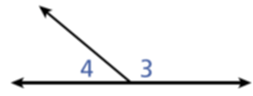
What type of angles are these? (select 3)
Adjacent Angles
Linear Pair
Complementary Angles
Supplementary Angles
Vertical Angles
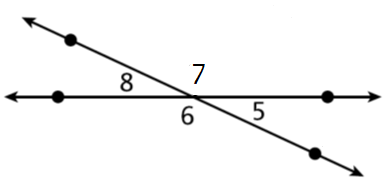
Which angles are vertical angles?
∠8 & ∠7
∠8 & ∠6
∠8 & ∠5
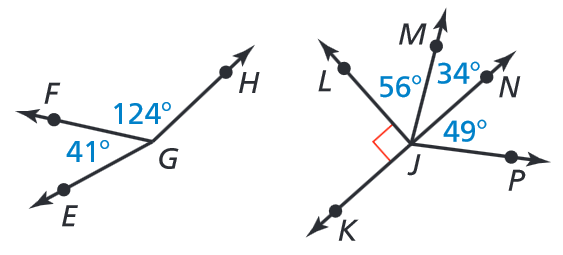
Which angle is complementary to ∠LJM
∠MJN
∠NJP
∠FGE
∠LJK
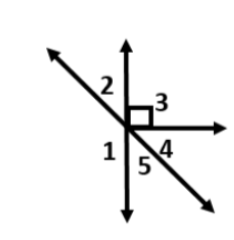
What angle is vertical to angle 2?
∠4
∠1
∠2
∠5

∠7 and ∠8 are _______________
Vertical
Nothing
Adjacent
Supplementary

Find the angle indicated.
If the measure of ∠ADC is
50 degrees, then what is the measure of ∠BDC?
17.3 degrees
32.7 degrees
∠ADC = 50 degrees


∠1 and ∠2 are complementary angles. The measure of ∠1 is 30°.
The measure of ∠2 is 4x°. Find the value of x. The figure is not drawn to scale.

Conventional or Nonconventional?
Conventional
Nonconventional


