
 Worksheets
Small Intestine - Jones - GI Exam 2
Total questions: 38
Worksheet time: 30mins
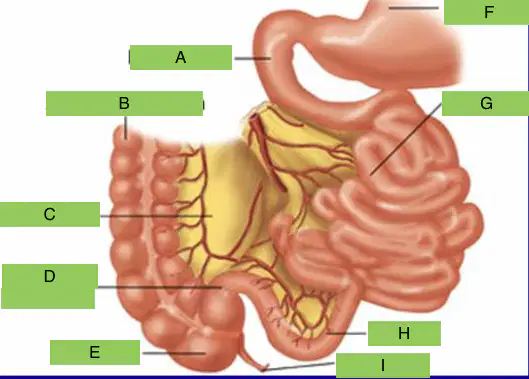
Match the following letters to their anatomical names
F
Stomach
B
Ascending colon
I
Appendix
C
Mesentery
E
Cecum
Match the following letters to their anatomical names
H
Ileum
A
Duodenum
D
Ileocecal junction
G
Jejunum
Select all of the following letters that are divisions of the small intestin
H
A
D
G
C
Select all of the following functions of the small intestine
Location for most chemical digestion
Epithelial cells transport digested nutrients
Movement of food down intestine and mixing
Secretion of mucous, electrolytes, hormones and fluids
Secretion of zymogens, Bicarbonate, and acid
If fluid reabsorption in the small intestine isn't working what does it lead to (Two apply)
Hypotension
HTN
Constipation
How much saliva do we secrete in a day
1500 mL
8000 mL
2000 mL
7000 mL
800 mL
All of the secretion (Ex: saliva, bile, stomach pancreas intestines etc) is how much in mL
1500 mL
8000 mL
2000 mL
7000 mL
800 mL
Where are brunner glands located?
In the stomach
In the duodenum
In the large intestine
What is the function of Brunner's glands
To secrete mucus to protect the lining of the duodenum
Select all of the following stimuli of Brunner's glands
Distention
Sympathetics
Secretin
Irritation
Vagus activity
Which of the following inhibitor of Brunner's glands
Distention
Sympathetics
Secretin
Irritation
Vagus activity
Match the following villi and crypt cells with their descriptions
Cells involved in absorbing nutrients and water that have been digested
Absorptive cells
Mucous secreating
Goblet cells
S,I, and K cells that secrete their hormones into bloodstream
Endocrine cells
Defensive and apart of the immune system
Paneth cells
Secrete water and electrolytes
Secretary cells
Select all of the following cells found in the intestinal villi cells
Absorptive cells
Endocrine cells
Mucous secreting cells
Secretory cells
Dividing stem cells
Select all of the following cells found in the intestinal crypt cells
Goblet cells
Paneth Cells
Mucous secreting cells
Secretory cells
Dividing stem cells
Progression and differentiation of stem cells move up to the tip of the villi in 10-12 days before getting lopped off into the lumen and digested before fecal removal
True
False

Match the following Intestinal villi and crypt cells with their letter
J
Paneth cell
B
Absorptive cells
H
Venule
I
Arteriole and lymphatic vessel
A
Villi
Match the following Intestinal villi and crypt cells with their letter
D
Capillary network
G
Intestinal crypt
C
Brush border of microvilli
F
Lacteal
E
Goblet cell
Reorder the following to show the cycle of stem cells starting from the lower region of the crypt
Stem cells
Secretory cells
Absorptive cells
Tip of the villus
Sloughed off and digested
Which of the following are primary secretions of crypt cells (SATA)
NaCl
Water
CCK
Secretin
Mucous
Regardng the Crypt cell secretion model, the NKCC transporter is what type of transport? (active, passive etc?)
Active transport
Passive transport
Secondary tranporter
Facilitated diffusion
Regarding the crypt cell model, what is the function of the CFTR channel?
Potassium channel to remove potassium from the cell
Chloride channel that pumps Cl into the lumen
Secondary transport allowing Na, K, and Cl into the cell
Active transport requiring ATP to pump Na against it's concentration gradient
Which of the following activate the CFTR Channel
cAMP
Ca2+
DAG
IP3
ATP
As a result of chloride being secreted into the lumen by the CFTR channel what occurs?
The Na+ makes the lumen slightly negative which helps draw in Cl- that is attracted to the charge and is able to enter the lumen via paracellular (in-between) cells.
The Cl- makes the lumen slightly negative which helps draw in Na+ that is attracted to the charge and is able to enter the lumen via paracellular (in-between) cells.
The Cl- makes the lumen slightly positive which helps draw in Na+ that is attracted to the charge and is able to enter the lumen via paracellular (in-between) cells.
The Na+ makes the lumen slightly positive which helps draw in Cl- that is attracted to the charge and is able to enter the lumen via paracellular (in-between) cells.
Select the pathologies that can affect crypt secretion model
Cholera
E. Coli
Enterobacteria
H. Pylori
E. Coli leads to which of the following effects due to the over activation of the CFTR channel
Diarrhea
Constipation
Bloting
Edema
Gas build up
After the movement of NaCl in the small intestine water moves via facilitated diffusion
True
False
Match the following secretions with the enteroendocrine cells of the duodenum
Secrete CCK
I cells
Secrete Secretin
S Cells
Secrete GIP
K cells
Match the following enteroendocrine cells with their stimulus in the duodenum
Fatty acids, peptides, and amino acids
I cells
Low pH
S Cells
Glucose, amino acids, and fats
K cells
Match the following enteroendocrine cells with their actions in the duodenum
Stimulate digestion and motility which inhibits gastric emptying
I cells
Stimulates bicarbonate secretion from ducts. decrease gastric HCl secretion, decrease intestinal motility
S Cells
Stimulates insulin release and inhibits gastric HCl
K cells
Which of the following is the motility of contraction of smooth muscle behind and relaxation upstream pushes food bolus down. Repeats down the intestine propelling food bolus down.
Peristasis
Segmentation
Migrating myoelectric complex
Retropulsion
Which of the following moves chyme towards the colon and cleans out secretions during fasting
Peristasis
Segmentation
Migrating myoelectric complex
Retropulsion
Which of the following stimulate peristalsis in the small intestine (SATA)
CCK
Gastrin
Motilin
Secretin
Which of the following inhibit peristalsis in the small intestine
CCK
Gastrin
Motilin
Secretin
In the small intestine, are there more or less contractile rings when eating?
More
Less
Doesn't change
How does the migrating myoelectric complex work
About ever 90 minutes while eating sends a peristaltic wave
About every 90 minutes during fasting sends a peristaltic wave
About every 30 minutes during fasting sends a peristaltic wave
About every 30 minutes during fasting sends a peristaltic wave
Which of the following activate the migrating myoelectic complex
CCK
Motilin
Secretin
Gastrin
Motilin is released from which cells
I Cells
S cells
M cells
K cells
What will turn off motilin
Fasting
Gastrin
CCK
Secretin

