
 Worksheets
Unit 2 Assessment 1 M
Total questions: 27
Worksheet time: 14mins
in electronics, any of various devices that accept signals, such as waves, and convert them into a useful form.
Amplitude
Receiver
Pitch
The speaker moves _________ when it is making sound.
does not move
moves backward but not forward
moves back and forth
3.to bend or change shape
deform
loudness
amplitude
4.Movement of an object back and forth past its starting position.
vibration
loudness
pitch
5.The speaker and instruments moving back and forth in different patterns ___________ the type of sound they produce.
is related to
is NOT related to
6.For an instrument to vibrate or make sounds; a force ________ be applied to a part of that instrument.
can NOT
must
only sometimes has to be
When a force is applied to a part of an object - like an instrument; ___________is transferred to the object.
Energy
Light
Music
When the force is removed from the object, that part of the object springs back _________ its starting position.
but stays below
and stops exactly at
and overshoots or goes beyond
9.Refers to how large the amplitude of the sound wave is
deform
loudness
frequency
All solid objects move back and forth (vibrate) when making sounds, even a rock.
True
False
11.Objects vibrate less,(deform less) when _____.
an equal force is applied
a lesser force is applied
a greater force is applied
12.a louder sound is created when….
an equal force is applied
a lesser force is applied
a greater force is applied
13.The distance from the starting position to a peak or valley
Amplitude
Frequency
Force
14.The topmost point of a wave
Frequency
Peak
Valley
15.The bottommost point of a wave
Frequency
Peak
Valley
16.The more we deform (push) a stick, the _________ the peaks and ______the valleys of the graph of motion.
lower; higher
higher; lower
higher; higher
17.Motion graphs of louder sounds have _______amplitude; softer sounds have ________ amplitude.
lower; higher
higher; lower
18.The number of peaks and valleys in one second; measured in Hertz (Hz)
Amplitude
Frequency
Loudness
19.The highness or lowness of a sound.
Amplitude
Pitch
Loudness
In our lab, shorter sticks should have produced _______compared to a longer stick
lower frequency, lower pitch
higher frequency; higher pitch
the same frequency; the same pitch
The original position of the sound source before it starts to vibrate
starting position
closing position
ending position
22.Smaller amplitude results in
lower pitch
louder volume
softer volume
Greater amplitude results in
higher pitch
louder volume
softer volume
Smaller frequency results in
higher pitch
lower pitch
softer volume
Higher frequency results in ..
higher pitch
lower pitch
louder volume
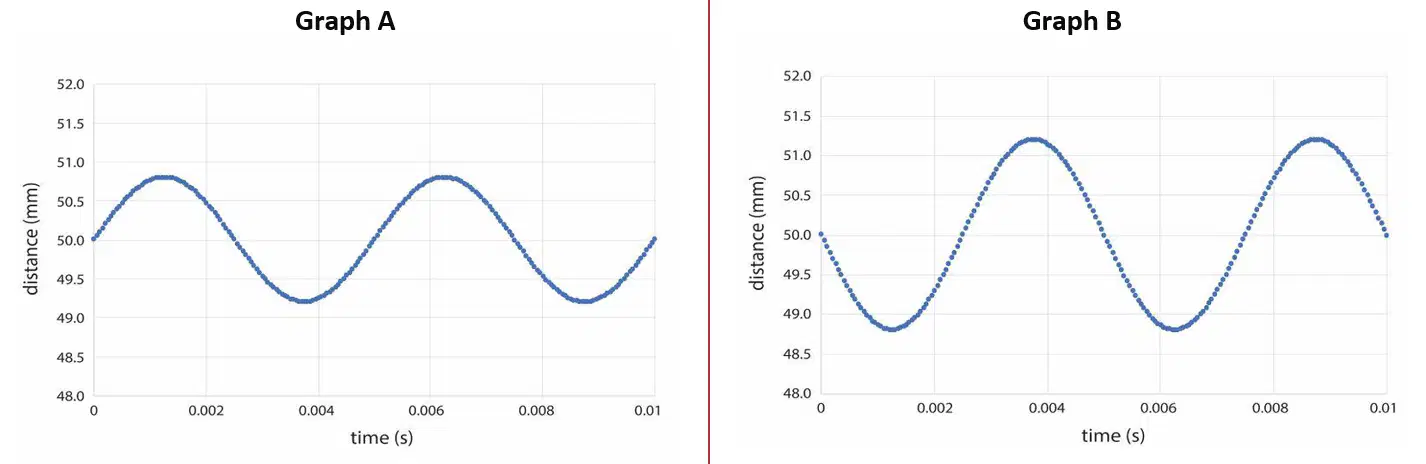
Which graph shows a louder wave?
A
B
They are the same
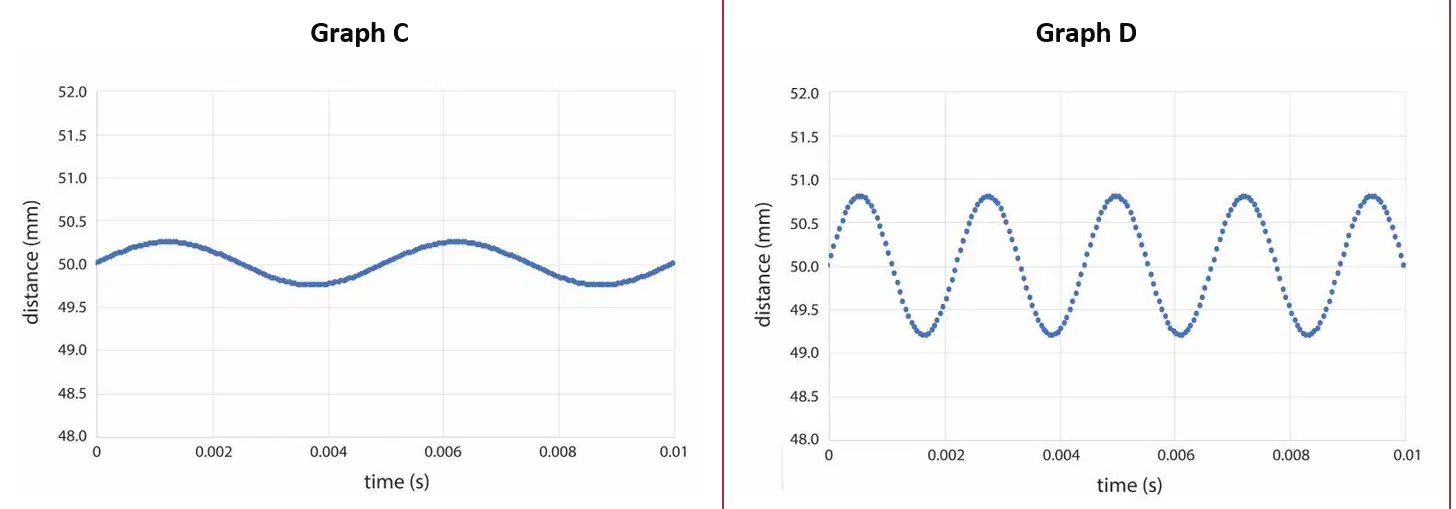
Which graph shows a lower pitch?
C
D
They are both the same

