Worksheets
Linear Motion Concepts
Total questions: 50
Worksheet time: 59mins
Distance
Which one of the following quantities is NOT a speed?
10 mi/hr
10 mi/hr/sec
35 m/s
20 m/s
If a person runs 100 meters in 10 seconds, what is their average speed?
1 m/s
2 m/s
5 m/s
10 m/s
What is the unit of measurement used in physics for speed?
seconds
seconds per meter
meters
meters per second
A boat can move at a constant velocity of 8 km/h in still water. How long will it take for the boat to move 24 km?
2 h
3 h
4 h
6 h
A toy car moves 8 m in 4 s at the constant velocity. What is the car’s velocity?
1 m/s
2 m/s
3 m/s
4 m/s
Velocity is to speed as displacement is to
acceleration
mass
time
distance
The speedometer in a car does not measure the car’s velocity because velocity is a
vector quantity and has a direction associated with it
vector quantity and does not have a direction associated with it
scalar quantity and has a direction associated with it
scalar quantity and does not have a direction associated with it
What is the average speed of an object that travels 6.00 meters north in 2.00 seconds and then travels 3.00 meters east in 1.00 second?
9.00 m/s
4.24 m/s
3.00 m/s
0.333 m/s
A student walks 3 blocks south, 4 blocks west, and 3 blocks north. What is the displacement of the
student?
4 blocks east
4 blocks west
10 blocks west
10 blocks east

Look at the distance - time graph. What is the correct description of this object?
object at rest
object move with constant speed
object move with constant acceleration
object move with non-uniform acceleration

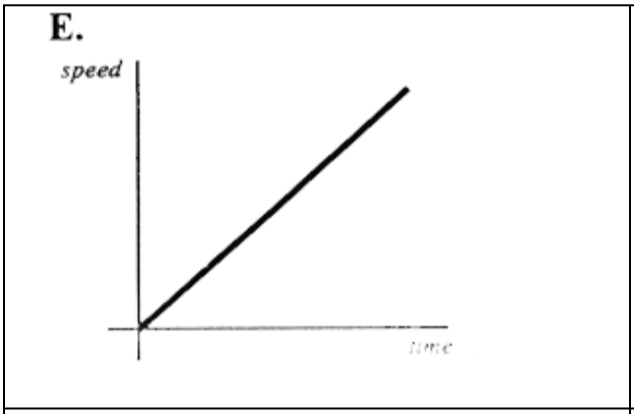
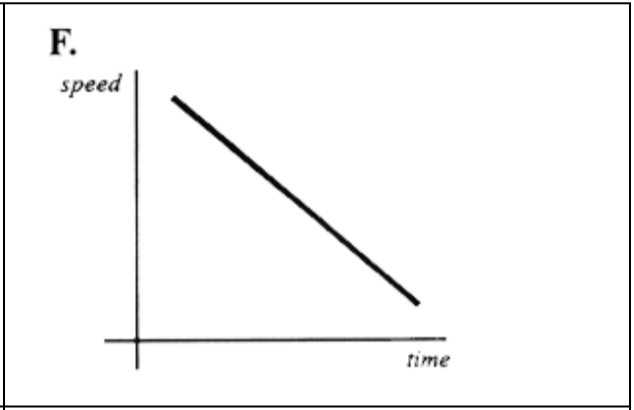
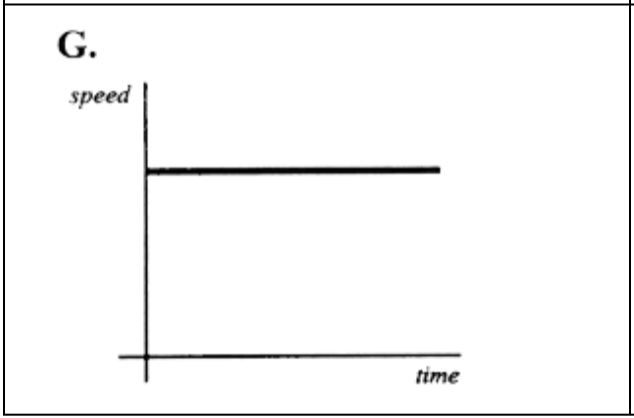
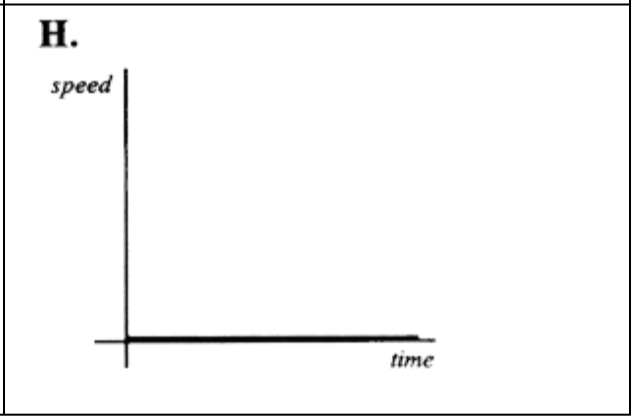
Look at the speed - time graph! The graph represent that object move with . . .
constant speed
constant acceleration
constant deceleration
non-uniform acceleration

Look at the distance - time graph! The graph shows that object move with . . .
constant speed
constant acceleration
constant deceleration
non-uniform acceleration

The movement of object is represented at the speed - time graph above! What is the correct description of the object . . .
object at rest
object move with constant speed
object move with constant acceleration
object move with constant deceleration
The length of a path between two points
displacement
distance
inertia
slope
What is measured in ms-2?
Time
Acceleration
Speed/velocity
Distance
The distance traveled by an object per unit time is called
acceleration
gravity
force
speed
Velocity is ...
Same as force
Same acceleration
speed with a direction
same as force
An object is _____ if its position changes relative to another object.
in motion
at dynamic interference
frame of reference
dependent
Which of the following is a measurement of velocity?
20 m east
12.5 m/s south
60 mph
25 m/s2
What are examples of acceleration? Choose all that are correct.
a car slowing down to a stop
a car going around a curve in the road at constant speed
a car going over a speed bump
a car moving at a constant 80 mph down a straight road
gunning the gas from rest when the light turns green
direction
The standard unit for length or distance is

Describe the object's motion from A to B (TWO Answers):
Speeding Up
Slowing Down
Constant Speed
Not Moving
Describe the object's motion from B to C:
Speeding Up
Slowing Down
Constant Speed
Not Moving
Describe the object's motion from D to E:
Speeding Up
Slowing Down
Constant Speed
Not Moving
Describe the object's motion from E to F (TWO Answers):
Speeding Up
Slowing Down
Constant Speed
Not Moving

Describe the motion in the graph:
Constant Speed (positive slope)
Stopped (at rest)
Acceleration (increasing speed)
Return Home (negative slope)

Describe the motion in the graph:
Constant Speed (positive slope)
Stopped (at rest)
Acceleration (increasing speed)
Return Home (negative slope)
A negative acceleration means that your object is _____.
doing nothing
moving in circles
speeding up
slowing down
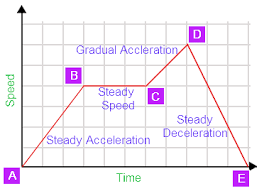
At what point is the speed the greatest?
C-D
B-C
A-B
D-E

What is happening during point A to B?
not moving
increasing speed at a constant rate
moving at a constant speed
moving at 10 m/s2 acceleration

What is happening during point C to D?
not moving
increasing speed at a constant rate
moving at a constant speed
moving at 0 m/s2 acceleration

A, B, and D
Match the graph to the description:
"The car is slowing down."