
 Worksheets
Domain 3 Full Review
Total questions: 30
Worksheet time: 15mins
Which of the following American companies had a monopoly in the late 1800s?
Standard Oil Company
Deere and Company
Ford Motor Company
What effect did the development of the railroad system have on the steel industry?
Railroads reduced the need for steel.
It increased production and demand for steel.
It made steel a rare substance.
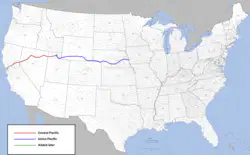
What is shown by this map?
The Lewis and Clark Expedition
The Trail of Tears
The Transcontinental Railroad
Why did the government slaughter buffalo in the late 1800s?
To weaken Native Americans
To feed new immigrants
To improve the accuracy of new rifles
How did the government reduce Native American land?
They sold land to Native americans
The government forced Native Americans from their land and moved them to reservations.
The government invited the Spanish to colonize North america.
What was driven into the ground at Promontory Summit to complete the Transcontinental Railroad?
a golden spike
A time capsule
Bison skulls
The American Federation of Labor (AFL) was led by
Thomas Jefferson
John D. Rockefeller
Samuel Gompers
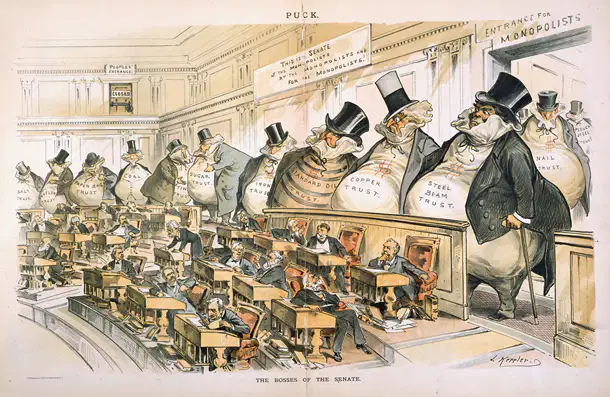
How does this cartoon show the importance of federal regulations to control businesses in the late 19th century?
Monopolies had too much power and political influence.
Businesses were too poor to pay their workers.
Labor unions made it difficult for businesses to find employees.

The artist of this cartoon wants to show
Businesses need government help to survive
Monopolies and trusts are gaining too much political influence and power.
Workers have too much political influence and power.
Growing industrialization cause what demographic change in the U.S.?
The population of immigrants increased significantly in the cities.
The population of immigrants increased significantly in rural areas
The population of immigrants increased significantly in the wilderness areas of coastal cities.
The consequence was to interrupt the normal, biological rhythms of life and to alter our schedules for work and leisure. Industrial plants could operate in shifts around-the-clock, for example, and the concept of "the city that never sleeps" became a reality.—Smithsonian Museum of National History
What invention is referred to in the above quote?
The typewriter
The telephone
The electric light bulb
The factory
Labor unions used collective bargaining as a tactic to improve working conditions. What does this tactic involve?
Negotiation
striking
embargos
refusing to use company products until the owners give in to their demands.
How did Henry Bessemer contribute to the
industrialization of the United States in the late
1800s?
by inventing railroads
by inventing canals
by inventing a better way to make steel
by writing a thesis that developed the modern concept of economics
Why would businesses form horizontally integrated companies?
To better serve their customers
to reduce competition and increase profits
to control all of the steps in production
Vertical integration involves
controlling all of the steps of production
Taking over the competition by buying all businesses just like yours
raising prices by reducing corporate taxes
The primary goal of the National Association for the Advancement of Colored People (NAACP) is to achieve
a reduction in child labor
racial equality
voting rights for women
an end to slavery
1906 Pure Food and Druct Act
1906 Federal Meat Inspection Act
Whose work resulted in the laws above?
Jacob Riis
Upton Sinclair
Jane Addams
Mick E. Mouse
As a result of improved farming technologies and techniques, Western settlers
wanted more land from Native Americans
were afraid to move west
learned how to live peacefully with the Native Americans
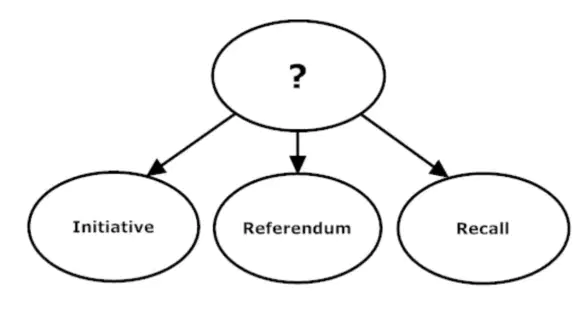
Which answer best fills the top circle?
women's suffrage
Reconstruction
Progressive Era voting reforms
Muckrakers
Who expanded the National Park System?
Teddy Roosevelt
Jane Addams
Smokey the Bear
The King of England
In which Supreme Court decision did the Court uphold the policy of "separate but equal," which allowed racial discrimination?
Plessy v. Ferguson
The 13th Amendment
Dred Scott v. Sanford
The Roosevelt Corollary
prevented interference by European nations in the Americas
was designed to increase production of steel
got rid of the Monroe Doctrine
endangered American children in factories
Which of the following did the United States control through imperialist policy around the turn of the 20th century?
China
India
France
The Philippines
What reason did President Roosevelt give that the United States was responsible for policing the Western Hemisphere?
American Doctrine prevents other nations from being involved in the Americas
The U.S. needs to stay out of foreign wars
Our navy needs something important to do
American policy has always welcomed other nations to trade freely in all parts of the Americas.
What was an economic reason for The Spanish-American War?
To sell more goods in Africa
To charge tariffs on foreign goods
To protect American business interests in Cuba
To acquire pineapple plantations in Hawaii

Which item below is an outcome of building the Panama Canal
Trade with Asia was reduced.
The U.S. gained influence in Latin America.
The federal government went into deep debt.
What was the ultimate motivation behind the Transcontinental Railroad?
To increase Indian access to federal services
to realize Manifest Destiny by connecting eastern and western U.S.
to help immigrants learn English
to decrease trade with Africa

Based on this cartoon illustrating William
Randolph Hearst and Joseph Pulitzer, artist Leon
Barritt was critical of
the yellow journalism that pushed the U.S. into war with Spain
the war in Europe
The role that children played in unsafe factory conditions and the selling of newspapers on the street
muckrakers
Hull House
served Native American children
served orphans of Civil War soldiers
was the best place to get meat that was not moldy
provided services to newly arrived immigrants

What invention made it possible to make children work all night long in a factory?
Smaller shoes
the light bulb
video games
school
the Bessemer Steel Process

