
 Worksheets
Now I Know My A, B, C, Ds Lesson Review
Total questions: 35
Worksheet time: 2hrs 45mins
g(x) = -2(x+3) -6
Given g(x)=5x
Write a function that is reflected over the x-axis and translated 4 units to the left.
f(x)= -5x-4
f(x)= -5x+4
f(x)= 5(x-4)
f(x)= 5-(x-4)

y = 2x+2 + 1
right 2, up 1
left 2, up 1
right 2, up 1
right 1, up 2

What is the asymptote of the graph?
x=2
y=-2
y=0
y=-1
How has the function 7(3)x−5 been transformed from the parent function 7(3)x ?
Shifted up 5
Shifted down 5
Reflection over the x-axis
Reflection over the y-axis
How has the function −5(3)x been transformed from the parent function 5(3)x ?
Shifted up 5
Shifted down 5
Reflection over the x-axis
Reflection over the y-axis
f(x)=3x and g(x)=5(3)x
What transformation has taken place from the parent function to g(x)
Vertical Stretch
Vertical Compression
Translation up 5 units
Reflection across the x-axis

Which graph best represents
y=2x−4


What is the y-intercept of the function y=4(5)x?
(0, 0)
(0, 4)
(0, 5)
Identify the y-intercept of the function −3(3)x+4
y-intercept at (0, -3)
y-intercept at (0, 1)
y-intercept at (0, -7)
What is the initial value in y=4(2)x
4
2
x
Which of the following is an exponential function?
y = x2
f(x) = 3x3
y = x3
f(x) = 3x
What is the common ratio for the function f(x) = 25 (4)x
25
4
The parent function f(x) is translated right 2 units resulting in g(x).
g(x) is equal to what?
g(x)= f(x) + 2
g(x)= f(x) - 2
g(x) = f(x + 2)
g(x) = f(x - 2)

The parent function f(x)=3x is shown in red and is translated. What is the equation of the green graph?
g(x)=3x+5
g(x)=3x−5
g(x)=3x−5
g(x)=3x+5

The parent function f(x)=3x is shown in red and is translated. What is the equation of the green graph?
g(x)=3x+2
g(x)=3x−2
g(x)=3x−2
g(x)=3x+2
If the parent function f(x)=2x is translated left 8 units, what would the equation of the resulting function be?
g(x)=2x−8
g(x)=2x+8
g(x)=2x+8
g(x)=2x−8
What transformation maps f(x)=7x to g(x)=7x−4
Translates left 4 units
Translates right 4 units
Translates up 7 units
Translates down 4 units
GIven a parent function like f(x)=5x , how does the h in g(x)=5x−h affect the parent function?
Translates the parent function horizontally (left or right)
Translates the parent function vertically (up or down)

Write the function for the following table:
f(x) = 5x + .08
f(x)= 5x + 2
f(x) = .08(5)x
f(x)= 2(5)x
What type of pattern do exponential functions have?
Adds or subtracts by the same number every time
Multiplies or divides by the same number every time
Square roots all the inputs
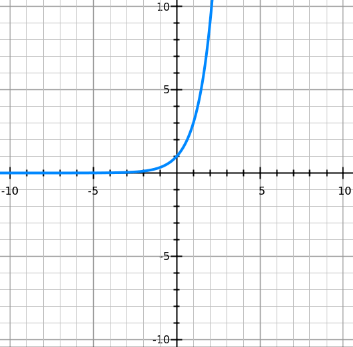
What is the common ratio(multiplier) for the sequence:
3, 15, 75...
12
1/5
5
What is the common ratio(multiplier) for the sequence:
28, 14, 7, 3.5...
2
1/2
-14
-7
The domain of exponential functions is not affected by translations or dilations.
True
False
Key characteristics of basic exponential functions include a domain of non-negative numbers, a range of real numbers, and a vertical asymptote at y = 0.
True
False
Vertical translations affect the range and the horizontal asymptote of exponential functions.
True
False
Horizontal dilations affect the range and the horizontal asymptote of exponential functions.
True
False
Vertical dilations do not affect the range and the horizontal asymptote of exponential functions.
True
False
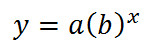
Identify A, C, and D of the exponential function by telling how each letter changes the function.
Dilates
Left or right
Up or down

