
NEW
Font size
 Worksheets
Hydraulic Principle
Total questions: 20
Worksheet time: 10mins

Which of the following related to force and pressure ?
Archimedes's Principle
Parallel Circuit
Pascal's Principle
Series Circuit
Which object involving pascal principle


The diagram shows a hydraulic pump. Which comparison is true?
The force, F is the same as the weight of the load
The force, F is greater than the weight of the load
The pressure on piston P is the same as the pressure on piston Q
The pressure on piston P is smaller than the pressure on piston Q
One application of Pascal's principle is
a hydraulic car lift
the flight of an airplane
a speedboat's bottom slapping against the waves
the buoyancy shown by ducks and other waterfowl
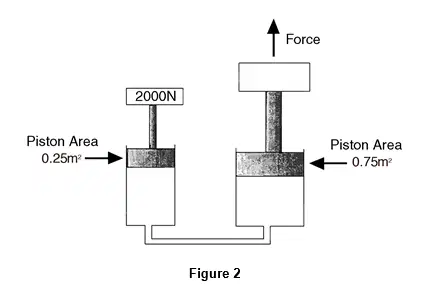
Using the information contained in Figure 2, calculate the system pressure.
Formula : P= F/A
P = 8 Pascals
P = 80 Pascals
P = 800 Pascals
P = 8000 Pascals
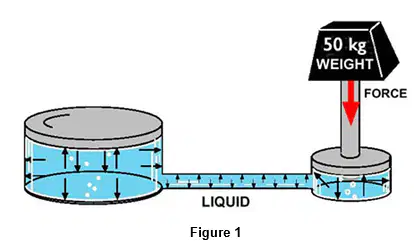
Describe what happens to a liquid when it is confined and placed under pressure (Figure 1)?
It will exert the same force on the entire container, but its volume will almost stay the same.
It will exert a force on the container, but its volume will change significantly.
Force will be in relation to atmospheric pressure only.
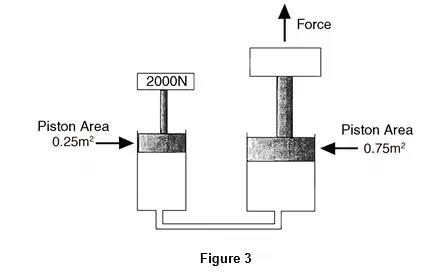
Using the information contained in Figure 3, calculate the force against the large piston.
Formula : F = P x A
F = 6N
F = 60N
F = 600N
F = 6000N

Bernoulli's Principle states....
A fluids energy changes when cross sectional area changes
If theres no pressure gradient over distance, no flow occurs
Pressure applied to a fluid is transmitted in all directions
A fluids Potential Energy is Mass x Velocity

Kinetic Energy is....
the energy in a system in the form of Pressure
the energy in a system due to Velocity
the energy in a system due to Mass
the energy in a system due to Force

Laminar flow...
is the average speed of a fluids particles past a given point in time
is the measure of volume of fluid passing a given point in time
is when fluid moves in straight lines at low velocity
is when velocity changes due to a pipes cross sectional area changing

Turbulent Flow...
increases the fluids viscosity
is the preferred flow when flushing hydraulic systems
is a high velocity flow where particles move smoothly
decreases leakage rate

Flow Rate is measured in
Mass and Velocity
Centistokes and Viscosity
Metres per second
Gallons per minute

Water, as a hydraulic medium, ...
has good lubricating properties
is not easily filtered
is corrosive to metal
does not have a constant viscosity

Viscosity...
is a measure of a fluids resistance to flow
index range is from 0 - 100
which is too high results in an increase in leakage rate
is measured in m/s
Which substance does not obey Bernoulli’s principle?
Bahan yang manakah tidak mematuhi prinsip Bernoulli?
solid
pepejal
liquid
cecair
gas
gas
fluid
bendalir

