
 Worksheets
HHMI Stickleback Evolution Quiz
Total questions: 13
Worksheet time: 7mins
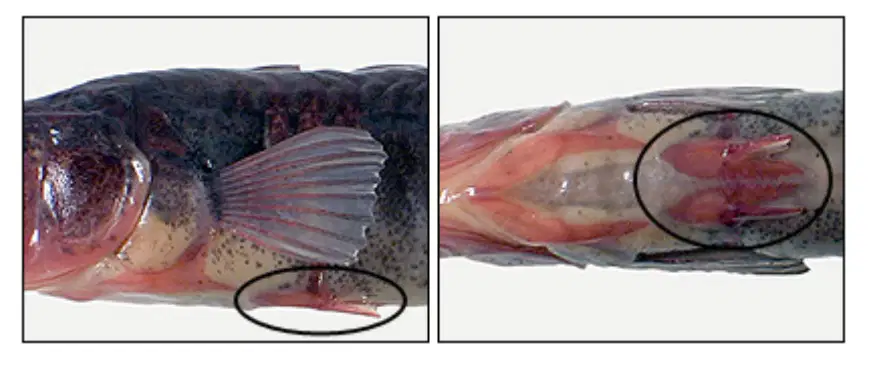
Score the fish provided
Complete
Reduced
Absent
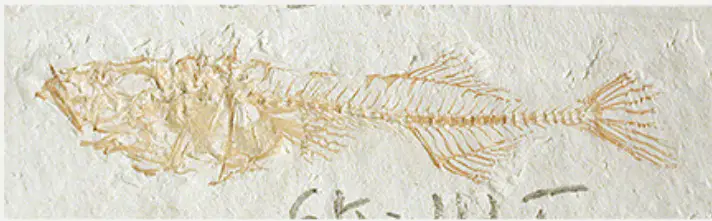
Score the fossil of a fish.
Complete
Reduced
Absent

What conclusions can you draw from your graph in Experiment 1?
The graph indicates that Bear Paw Lake has more fish than Frog Lake.
The data suggest that fish in Bear Paw Lake are bigger than those in Frog Lake.
The graph suggests that all fish in Bear Paw Lake lack pelvic spines and all fish in Frog Lake have pelvic spines.
The data suggest that the fish in Frog Lake vary widely in pelvic structures.

In this experiment, you examined only 20 fish from each lake. In 1990, Dr. Michael Bell and colleagues examined 210 fish from Bear Paw Lake and 192 fish from Frog Lake. They found that 100% of sticklebacks in Frog Lake had a complete phenotype. Most sticklebacks from Bear Paw Lake had a reduced phenotype and the rest an absent phenotype. Are your results consistent with Dr. Bell's?
Yes
No
Based on what you have learned so far about threespine stickleback fish, which of the following statements is most accurate?
The stickleback population in Bear Paw Lake is more similar to marine and sea-run stickleback populations in terms of pelvic morphology than it is to the Frog Lake stickleback population.
The stickleback populations in Bear Paw Lake and Frog Lake are both freshwater populations; thus, they are more similar to one another in pelvic morphology than they are to marine and sea-run stickleback populations.
The stickleback population in Frog Lake is more similar to marine and sea-run stickleback populations in terms of pelvic morphology than it is to the Bear Paw Lake stickleback population.
There is a lot of variation in pelvic morphology within each population of threespine stickleback fish.
Bear Paw Lake and Frog Lake were likely populated by the same sea-run population of stickleback at the end of the last ice age. Which of the following statements is the most reasonable explanation for what might have happened to the stickleback in each lake since colonization?
Over many generations, stickleback in Bear Paw Lake have lost their pelvic spines, while those in Frog Lake have retained full pelvises.
Over many generations the pelvic structures in Bear Paw Lake stickleback have remained the same, and the stickleback in Frog Lake have gained their pelvic spines.
Stickleback in Frog Lake will lose their pelvic spines before the next ice age.
The ancestral marine population of stickleback must have lacked pelvic spines.
It takes energy and resources for a stickleback to develop spines. Thus, over time pelvic spines would not be retained in stickleback populations unless they provide some kind of selective advantage. Using this knowledge, would you agree with the following statement: "In Bear Paw Lake having pelvic spines does not seem to provide the same selective advantage as it does to stickleback living in the ocean."
Agree
Disagree
One of the functions of pelvic spines in the ocean is to protect stickleback from larger fish predators. Based on this knowledge, which statement might be a possible explanation for the differences in pelvic spines between Bear Paw Lake and Frog Lake sticklebacks?
Frog Lake has no native predatory fishes such as trout.
Frog Lake likely has native predatory fishes, but they do not prey on stickleback fish.
The food webs that characterize organisms in Bear Paw Lake and Frog Lake are virtually identical.
Bear Paw Lake has no native predatory fishes.
Like Bear Paw Lake, nearby Kalmbach Lake is an Alaskan lake that historically had no native predatory fish. The Alaska Department of Fish and Game started introducing rainbow trout into Kalmbach Lake in 1982. Prior to these introductions, pelvic reduction was common in this stickleback population. The rainbow trout is known to prey on stickleback. What would you hypothesize has happened to the stickleback population in the more than 30 generations that have elapsed since the trout was introduced?
All the stickleback fish in Kalmbach Lake perished.
The population size of stickleback fish dropped dramatically, leaving only a few survivors, all of which have the absent pelvic phenotype.
Most stickleback fish in Kalmbach Lake now have pelvic spines.
Kalmbach Lake has no native predatory fishes.
Which statement below best represents the relationship between age and position of sediment layers in the Nevada lake quarry?
The top layer of sediment was the first to be deposited, and therefore, it must be the oldest.
The oldest layer analyzed from this ancient lake occurs in the middle of the strata as a consequence of uplift due to an earthquake roughly 10 million years ago.
The lowest layer of sediment is the oldest.
Of the six layers of fossils analyzed, we only know that the top layer is the youngest because layers below it were deposited randomly without any systematic pattern.
What can we infer from the stickleback fossil record about evolutionary processes occurring today?
Evolutionary patterns observed in the fossil record are consistent with evolutionary processes occurring today.
The fossil record provides insights into the ecological mechanisms that result in the evolution of pelvic reduction, while study of living populations tells us more about the rate of evolutionary change of this trait.
Analysis of the fossil record indicates that natural selection was an evolutionary process at work in the past but it no longer occurs today.
Analysis of fossil stickleback shows us that threespine stickleback living millions of years ago looked strikingly different from those living today.
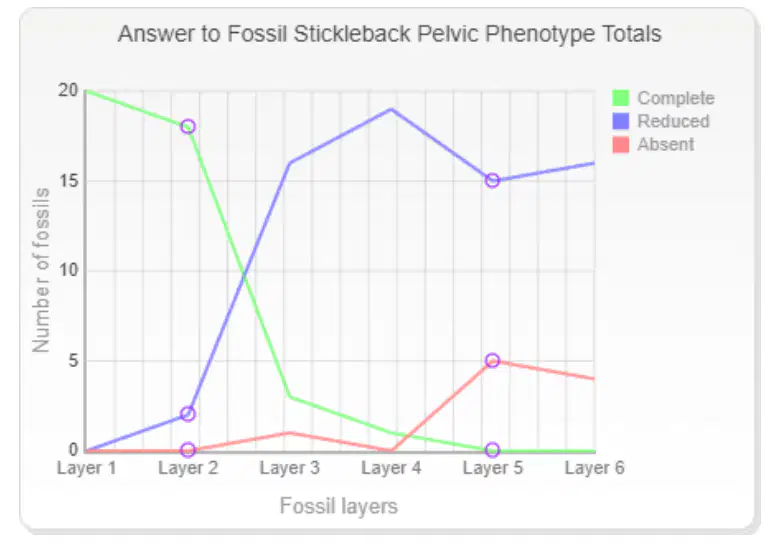
Which statement below best describes what happened to the stickleback population in the ancient lake that is now the Truckee Formation?
The frequencies of reduced and complete pelvic phenotypes fluctuate from layer to layer, but overall, there is no trend in gain or loss of either trait in the population.
Initially, the stickleback population in the lake consisted mostly of fish with pelvic spines, but over 15,000 years the population changed to fish without pelvic spines.
Initially, very few fossil stickleback sampled had the complete pelvic phenotype, but in the following 15,000 years, the frequency of this phenotype in the population increased significantly.
The frequencies of absent and reduced pelvic phenotypes are roughly equal throughout the 15,000-year time span studied because the lake became flooded at one point, which allowed trout to enter the lake from other areas.
Studies of living stickleback populations indicate that pelvic spines are an effective defense against large predatory fish such as trout. What can we infer based on the data from Experiment 2?
The lake in Nevada was initially populated by stickleback that had complete pelvises, and because the lake did not contain large predatory fish, the frequency of stickleback with pelvic spines decreased over time.
The lake in Nevada was initially populated by stickleback without pelvic spines, and because the lake had no large predatory fish, the frequency of stickleback with pelvic spines increased over time.
The lake in Nevada was initially populated by stickleback fish with complete pelvises, and because the lake was already inhabited by large predatory fish, the frequency of stickleback with pelvic spines decreased rapidly.
The lake in Nevada was originally populated by stickleback with pelvic spines, but large predatory fishes outcompeted these stickleback for food, which almost drove the stickleback population to extinction.

