
 Worksheets
Unit 4 Force & Motion
Total questions: 163
Worksheet time: 3hrs 48mins
A force that one object can apply to another object without touching is?
Gravity
Noncontact Force
Friction
Contact Force
Does attraction increase or decrease if the mass increases?
Decreases if one or both masses increase
Increases if only one mass increases
Decreases if only one mass increases
Increase if one or both masses increase
Does attraction between objects increase or decrease with increasing distance?
Increase
Decrease
Is gravity a contact or noncontact force?
(a)
Astronauts on the Moon can jump higher than if they were on Earth. This is because
the astronauts are less massive on the Moon.
there is no friction on the Moon.
Newton's laws of motion do not apply to the Moon.
the Moon is less massive than the Earth

According to the law of universal gravitation, any two objects are attracted to each other. The strength of the gravitational force depends on the masses of the objects and their distance from each other. Many stars have planets around them. If there were no gravity attracting a planet to its star, the planet's motion would carry it away from the star. However, when this motion is balanced by the gravitational attraction to the star, the planet orbits the star. Two solar systems each have a planet the same distance from the star. The planets have the same mass, but Planet A orbits a more massive star than Planet B. Which of the following statements is true about the planets?
Planet A orbits its star faster than Planet B.
Planet A has a longer year than Planet B.
Planet B is more attracted to its star than Planet A.
Planet B will keep orbiting its star longer than Planet A
Which of the following exists around every object that has mass?
magnetic poles
electric charges
a magnetic field
a gravitational field
Which of the following is true of Earth's gravity?
It pulls objects toward the Earth's surface without touching them.
It only has an effect on objects farther than ten meters from the Earth's surface.
It pushes objects away from the Earth's surface without touching them.
It only has an effect on the Moon and the Sun.

The data above were collected by scientists testing the force of gravity between two objects. What does the data in the table support?
The force of gravity only depends on the object with less mass.
The force of gravity only depends on the distance between the objects interacting.
The force of gravity depends on the masses of the objects interacting.
The force of gravity only depends on the object with more mass.
Which of the following statements explains why the Earth has a gravitational field?
It is revolving around the Sun.
It is rotating on its axis.
It has mass.
It has an electric charge.
In which situation is the gravitational force between two objects hard to detect?
if the mass of each object is very small
if the mass of both objects is very great
if the mass of one of the objects is very great
if the objects are very close together
Why does the Sun gravitationally dominate all other objects in the Solar System?
The Sun is by far the brightest object in the Solar System.
The Sun is by far the most massive object in the Solar System.
The Sun moves at a greater speed than any of the other objects in the Solar System.
The Sun is the closest object to planet Earth.

When a scale is used to weigh an object on Earth, it measures the gravitational force that pulls on the object. The unit for the force of gravity pulling on an object is the newton (N). A student uses a scale to measure the force of gravity on 5 different objects, each with a mass of 20, 40, 60, 80, and 100 grams. She plotted her data on the graph shown above. What does the data show?
The greater the mass of an object, the greater the gravitational pull exerted on it by Earth.
An object gains mass when the gravitational force on Earth remains the same.
The smaller the mass of an object, the greater the gravitational pull exerted on it by Earth.
An object loses mass when the gravitational force on Earth remains the same.

Scientists are observing and recording data for two different planets, planet X and planet Y. Each planet orbits a different star. The planets have the same mass. The scientists record the following data. Which of the following statements is most likely true?
The star close to planet Y has less mass.
The star close to planet Y is hotter.
The star close to planet Y is cooler.
The star close to planet Y has more mass.
Emma hits a baseball into the air. While the ball is flying through the air, which of the following objects is pulling on it with a gravitational force?
the Sun
the bat
the Earth
all of these
Which of the following statements is true?
Only objects that are very close together exert gravitational forces on each other.
Objects can only exert gravitational forces if they are at least as dense as water.
Any object with mass exerts a gravitational force on all other objects.
Only objects that are as large as planets exert gravitational forces on other objects.
__________ is the attractive pull between any two objects
Atmospheric pressure
Gravity
Inertia
Friction
Gravity keeps
the planet Mars in orbit around the Sun.
moons in orbit around the planet Saturn.
the Moon in orbit around Earth.
all of these
Which statement best describes two objects experiencing a gravitational interaction?
The objects can only attract each other and the force depends on their masses.
The objects can attract and repel each other and the force does not depend on their masses.
The objects can attract and repel each other and the force depends on their masses.
The objects can only repel each other and the force does not depend on their masses.
Which of the following exerts gravity?
only planets, moons, and stars
any object with mass
only objects on Earth
only the Earth
Which of the following best describes a gravitational force?
It can attract or repel two objects.
It only repels two objects.
It does not require objects to have mass.
It only attracts two objects.

A scientist observes and records data for the force of gravity between the Sun and a few different-sized planets. The different-sized planets are placed at the same distance from the Sun. Based on the above scenario, which graph best represents the gravity between the different-sized planets and the Sun?
Z
Y
X
W

Scientists and engineers are testing three different satellites orbiting Earth. The scientists are able to use sensors to determine the gravitational force experienced by each satellite. Some of the data from each of the orbiting satellites is shown in the table above. Which statement best summarizes the information given?
The gravitational force on the satellite depends only on the distance from Earth at which it is traveling.
The satellite with the least amount of mass is able to exert greater gravitational force on Earth than the others.
The gravitational force exerted by Earth changes the mass of each of the satellites.
The gravitational force exerted by Earth on the satellite depends on the satellite's mass.
All objects anywhere on or near the Earth are
pulled toward Earth by the force of gravity.
held in place by several forces pushing and pulling on them.
pushed away from Earth by the force of repulsion.
spun in a counterclockwise direction by magnetic forces.
When placed at equal distances apart, the greatest gravitational attraction will be between two
skateboards
bowling balls
school buses
Which is needed to determine the amount of gravitational force between two objects?
distance and mass
weight and time
area and weight
The gravitational force exerted by an object depends on its
volume
mass
weight
A student drops a bowling ball and an apple from a third-story window. Both objects hit the ground at the same time. From the experiment, the student should conclude that
the apple weighs more than the bowling ball
more air friction is acting on the apple than on the bowling ball
gravity pulls on both objects, causing them to fall at the same time.
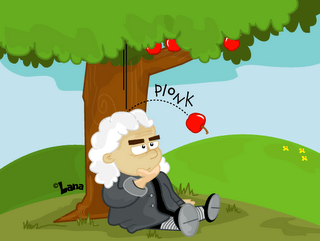

What is the relationship between mass and gravitational pull?
Higer mass creates higher gravitational pull
Lower mass creates higher gravitational pull
Lower gravitational pull creates more mass
Which of the following data would support the claim that the gravitational force between objects depends on mass?
A rocket can escape Earth’s gravity by traveling at high speed.
Gravitational force is stronger on more massive planets.
The further a planet is away from the sun, the smaller the gravitational force.
An object’s weight can change depending where it is on Earth.
Which of the following does not affect the gravitational force between the earth and the sun?
The net electrical charge of the earth
The distance between the earth and the sun
The mass of the sun
The mass of the earth
An astronaut way out in space is considered to be “weightless". This is because–
his mass is so small relative to the earth that gravity doesn’t affect him.
gravitational force decreases greatly over long distances.
gravitational force pushes objects away from each other at long distances.
objects far away from the earth have less mass.
Which statement is true?
All objects with mass exert a gravitational force.
Only celestial objects exert a gravitational force.
Gravity can both push and pull objects.
Only Earth exerts a gravitational force.
The push or pull between two objects
attract
mass
force
gravitational force
The matter in an object, which affects gravitational forces
attract
mass
gravitational force
force
Objects being pulled together
gravitational force
attract
mass
force
The force between two masses
gravitational force
force
mass
attract
A change in an object's position, direction or location
Position
Force
Motion
Inertia
A measurement of distance over time
speed
acceleration
force
distance
The measurement of speed and direction of an object
speed
velocity
acceleration
average speed
a change in an objects speed or direction
speed
velocity
acceleration
motion
What is the speed formula?
d = s*t
s= time/distance
d= speed/time
s = distance/time
What is force?
a push or a pull
motion
acceleration
interaction
An object at rest stay at rest and an object in motion stays in motion until acted upon by an unbalanced force.
Newton's 3rd Law
Force
Newton's 2nd Law
Newton's 1st Law
The acceleration of an object as produced by net force. F = m*a
Newton's 1st Law
Motion
Newton's 2nd Law
Newton's 3rd Law
For every action there is an equal and opposite reaction.
Newton's 2nd Law
Newton's 1st Law
Newton's 3rd Law
None of the above
What units is Force measured in?
Grams
Miles
Hours
Newtons
Equal forces that do not cause a change in an objects motion
Unbalance force
Push or a pull
Balanced force
Average speed
Are unequal forces that cause a change in the motion of an object
Balanced forces
Unbalanced forces
Inertia
Gravity
The overall force exerted on an object; measured in Newtons.
Balanced forces
Unbalanced forces
Net forces
Newtons
The overall speed of an object during the entire course of a trip
Velocity
Average speed
Acceleration
Gravity
The force that attracts objects to the center of the Earth
Friction
Air resistance
Motion
Gravity
What is the definition of motion?
The amount of gravity depends on two things.
A change in the position of an object over time.
The force of attraction between all objects.
The attractive or repulsive force between any two charged objects.
How do you know something is in motion or has moved?
By the weight of the object.
By the force of push or pull.
By the roughness of the surface.
By using a reference point.
What causes an object to move?
The force of attraction between all objects.
The amount of gravity depends on two things.
A push or a pull.
The attractive or repulsive force between any two charged objects.
What is a force?
A push or a pull.
The attractive or repulsive force between any two charged objects.
The amount of gravity depends on two things.
The force of attraction between all objects.
Can more than one force act on an object at the same time?
Yes, because the roughness of the surface affects the amount of force.
Yes, because the total combination of the forces acting on an object is called net force.
Yes, because the force of push or pull affects the amount of force.
Yes, because the weight of the object affects the amount of force.
What is a balanced force?
A force in which the net force equals zero.
A force that opposes the motion of an object.
A force in which the net force is greater than zero.
A force that causes a change in speed or direction.
What is an unbalanced force?
A force in which the net force equals zero.
A force that opposes the motion of an object.
A force that causes a change in speed or direction.
A force in which the net force is greater than zero.
What is the 1st Law of Motion according to Newton?
The force of attraction between all objects.
The law of inertia.
The force of push or pull.
The force of friction.
What is inertia?
The force that opposes the motion of an object.
The force of push or pull.
The tendency of objects to resist a change in motion.
The force of attraction between all objects.
What is friction?
The tendency of objects to resist a change in motion.
A force that opposes the motion of an object.
The force of push or pull.
The force of attraction between all objects.
What is Newton's First Law of Motion?
Every action has an equal and opposit reaction
Objects in motion stay in motion/Objects at rest stay at rest until an outside force acts on it
A force is required to accelerate an object with a known mass
What is Newton's Second Law of Motion?
Every action has an equal and opposite reaction
Objects in motion stay in motion/objects at rest stay at rest until an outside force acts on it
A force is required to accelerate an object with a known mass
What is Newton's Third Law of Motion?
Every action has an equal and opposite reaction
Objects in motion stay in motion/objects at rest stay at rest until an outside force acts on it
A force is required to accelerate an object with a known mass
A frog pushes his legs down on a lily pad, but yet the direction he travels is upwards. Which law explains this?
Newton's First Law
Newton's Second Law
Newton's Third Law
The Swimmer moves her hand down and to the left and her body moves forward and to the right
Newton's first law
Newton's Second Law
Newton's Third Law
A person in a car slides to the right when going through a very sharp left turn on the highway
Newton's First Law
Newton's Second Law
Newton's Third Law
A car is placed in neutral and on flat ground not moving. The car weighs 800 pounds. If a force of 40 N is applied to the front of the car and a force of 30 N is applied to the back of the car, what will happen?
The car will not move
The car will move forward
The car will move backwards
The car will flip over
The speed and direction of an object is it's ___________.
Momentum
Velocity
acceleration
Inertia
Anything that turns or changes it's direction (including things in orbit) is ___________.
Going a constant speed
moving
accelerating
decelerating
If the forces acting on an object are unbalanced, then the object must be ____________.
balanced
at rest
accelerating
momentum
Which of Newton's laws explains why an object in space will stay in motion once it starts moving?
Newton's first law
Newton's second law
Newton's third law
A person’s body is thrown outward as a car rounds a curve on a highway.
Newton's 1st Law
Newton's 2nd Law
Newton's 3rd Law
None of them
Force is measured in _______________
Newtons
Kg
m/s2
A sports car speeds up much faster than a dump truck when a traffic light turns from red to green. Which law is this?
Law 1
Law 2
Law 3
A rocket pushes burning gases DOWN which causes the rocket to launch UP. Which law is this?
Law 1
Law 2
Law 3
Newton's Second Law States: That Acceleration is equal to the net force on an object divided by the object's _________
mass
time
speed
force
Newton's Third Law States: For every action, there is an opposite and equal reaction.
False
True
The list describes six different situations.
1. A pendulum moving back and forth
2. A toy car rolling down a ramp
3. An airplane traveling at a constant velocity of 500 km/h north
4. A raindrop falling on a leaf
5. A marble sitting on a table
6. A hockey puck sliding across the ice at constant velocity
Which objects in the list are experiencing balanced forces?
The pendulum, the toy car, and the hockey puck
The airplane, the marble, and the hockey puck
The toy car, the raindrop, and the marble
The pendulum, the toy car, and the raindrop
Which of the following could occur when the net force acting on a car is zero?
The car changes speed from 0 m/s to 20 m/s
The car slows down while turning a corner
The car travels at a constant speed of 20 m/s
The car changes speed from 20 m/s to 0 m/s

Are the forces acting on the object balanced or unbalanced? The man does a flip on the fly board.
(a)

How will this object move?
It will not move
It will move in both directions
It will move to the right
It will move to the left

How will this object move?
It will not move
It will move in both directions
It will move to the right
It will move to the left
Shadell pushes a box 35 N to the right. Nazai pushes the box 25 N in the same direction. What is the net force?
(a)

What is net force?
(a)

Balanced or Unbalanced
(a)

What is the net force?
(a)
Which of the answer choices is not a characteristic of a balanced force?
no change in motion
moving at a constant speed
causes a change in motion
net force of zero

If an object is not moving the forces acting upon it are (a)

A (a) is a push or a pull on an object.
Balanced forces causes
speed of an object
change in motion
no change in motion
no friction on object
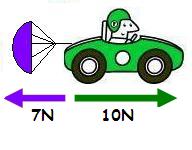


Calculate the net force shown in the diagram?
(a)
What causes the feeling of your stomach churning when you lift up from your seat on a roller coaster?
Magnetism
Friction
Gravity
Inertia
What is the force that pulls us down toward the center of the earth?
Magnetism
Friction
Buoyancy
Gravity
What is the property by which an object at rest tends to stay at rest until a force acts upon it?
Velocity
Inertia
Acceleration
Momentum
At what G force may a person suffer a nose bleed?
2 Gs
5 Gs
4 Gs
3 Gs
What do amusement park ride engineers make sure of when designing rides?
Maximum duration
Maximum speed
Maximum height
Maximum G force
What do astronauts experience when they finally exit Earth's atmosphere?
Quadruple gravity
Triple gravity
Double gravity
Zero gravity
What force are astronauts put through during training for space?
Buoyancy force
G force
Magnetic force
Friction force
What is the force of gravity on an object on Earth?
4 G
3 G
2 G
1 G
What is the force that causes the man's face to be lifted up and back in the wind tunnel experiment?
Magnetism
Buoyancy
Friction
G force
What is the force that causes the man's skin to be pulled up against his bones in the wind tunnel experiment?
Inertia
G force
Acceleration
Momentum
The Law of Conservation of Energy states:
Energy can created or destroyed but not transformed
Energy cannot be created or destroyed, it can only transformed from one form to another form
Energy can't be created, destroyed or transformed
All the above

Energy can not be created nor destroyed.
Newton's Laws of Motion
Big Bang Theory
The Law of Conservation of Momentum
The Law of Conservation of Energy
The Law of Conservation of Energy is also known as:
First Law of Thermodynamics
Second Law of Thermodynamics
Third Law of Thermodynamics
None of the above
Which type of energy has to do with objects in motion?
Potential
Kinetic

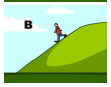
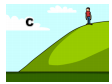
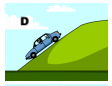
Which of these has the most potential energy.
A
B
C
D
If a football player wants to become better at tackling by increasing his or her kinetic energy, how can the player do this?
Increase his/her height
Increase his/her speed
Increase his/her mass
Decrease his/her speed
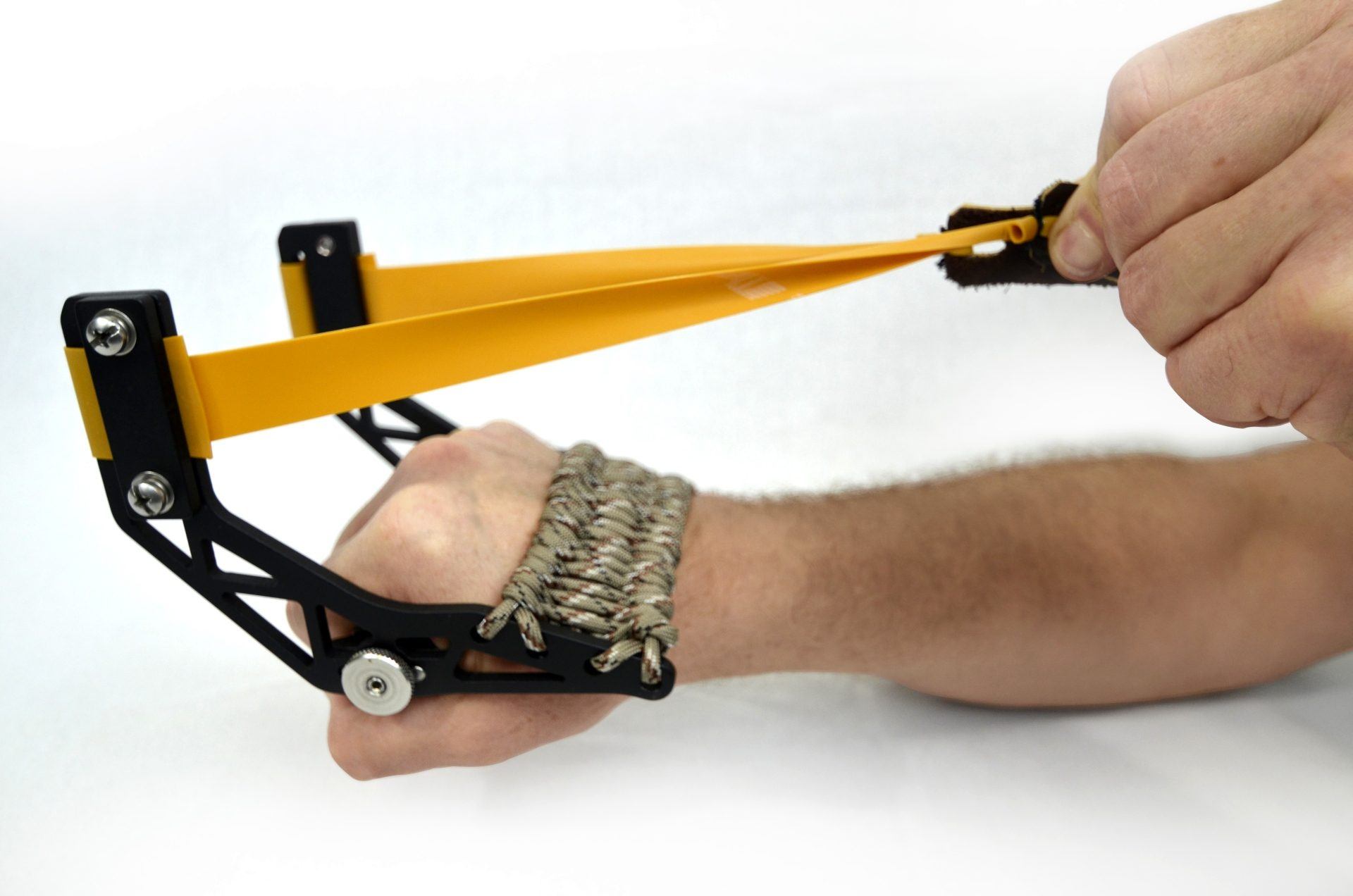


When you compress a spring, you are storing __________ energy.
sound
elastic
light
chemical


Which passenger has the most potential energy?
A
B
C
D

The formula for calculating the gravitational potential energy in an object is shown above. Which object will have the largest value for its GPE
If these are all moving at the same speed, the vehicle with the greatest KE would be
(Think about their sizes)


Determine whether the following example is Potential Energy (PE) or Kinetic Energy (KE):
flashlight turned off
Potential Energy
Kinetic Energy

Calculate the speed of a car that travels 200 meters in 20 seconds.
5 m/s
15 m/s
10 m/s
25 m/s
A train travels 500 meters in 25 seconds. What is its speed?
30 meters per second
10 meters per second
20 meters per second
50 meters per second
Graph the distance versus time for a car that travels 100 meters in 10 seconds.
A vertical line at 10 s
A straight line with a slope of 10 m/s
A horizontal line at 100 m
A curved line with a slope of 5 m/s
Draw a distance-time graph for a bicycle that covers 300 meters in 30 seconds.
A curved line with a slope of 5 meters per second
A straight line with a slope of 10 meters per second
A horizontal line with a slope of 0 meters per second
A zigzag line with a slope of 15 meters per second
Interpret the distance-time graph where the line is horizontal.
The object is moving in a circular path
The object is not moving
The object is moving at a constant speed
The object is accelerating
Explain the meaning of a steep slope on a distance-time graph.
Slow speed or rate of change in distance over time
No movement or change in distance over time
Negative speed or rate of change in distance over time
Fast speed or rate of change in distance over time
What is the average speed of a runner who covers 400 meters in 50 seconds?
5 meters per second
40 meters per second
8 meters per second
10 meters per second
Calculate the average speed of a boat that travels 600 meters in 120 seconds.
5 m/s
10 m/s
3 m/s
8 m/s
What is the difference between velocity and speed?
Velocity is a measure of distance, while speed is a measure of time.
Velocity is always constant, while speed can vary.
Velocity includes direction, while speed does not.
Velocity is used for objects in motion, while speed is used for stationary objects.
A car travels at a speed of 60 km/h. How long will it take to cover a distance of 180 km?
2.5 hours
3 hours
5 hours
4 hours

