
 Worksheets
Sci 202 (1stQuiz)
Total questions: 40
Worksheet time: 13mins
1. In the basic components of the framework, all imply that science involves action or doing. Which is NOT emphasized in the learning of science?
Memorizing facts, concepts, principles and theories.
Understanding and Applying scientific Knowledge
Developing and Demonstrating Scientific Attitude and Values
Performing Scientific Inquiry Skills.
As future science teacher, what is the ultimate goal of science in the framework that each learner should achieve?
21st Century Literacy
Science and Technology Literacy
Science, Technology and Society
Develop innovators and inventors
Science as a subject in the elementary grades should stand alone. This statement is
Supportive of the approaches in science teaching
Contrary to science as multi-disciplinary and integrated
Advocated in the theories that support science learning
Acceptable based on the science framework
4. There is no single way of learning science, hence there is no angle method that would fit every learner. This belief supports the theory of
Constructivism
Social Cognition
Learning Style
Hands-On, Minds On
Creative, critical thinker, innovative, informed decision maker. These are the characteristics of
Pure and applied scientist
Science and Technology Literates
Digital natives
None of the A, B, C
6. Science in the elementary level in the K to 12 curriculum include
Chemistry and Biology
Chemistry, Biology and Physics
Chemistry, Biology, Physics and Earth Science
None of the A, B. C, D
7. As the content of science progress in a spiral, the difficulty of topics
decrease
increase
maintains
static
In order to teach science effectively in the elementary level, a teacher should do one of the following.
Must have comprehensive knowledge of only one discipline of science in the curriculum
Must have comprehensive knowledge of at least two discipline of science in the curriculum
Must have comprehensive knowledge of the four discipline of science in the curriculum
Must have comprehensive knowledge of all branches of science.
9. Spiral progression in science means that grade three pupils learn simpler content than grade four
This statement is true.
This statement is false
This statement is partly true.
This statement is doubtful.
10. Which statement is TRUE about teaching science in the elementary grade level for K to 12
All elementary grades teachers should be equipped with contents and process of science.
Only those who will teach science should learn the different branches of science in college
Learning what to teach and not how to teach science is a universal principle.
None above
11. Which of the following Is not an Integrated Science process?
Formulating hypothesis
Defining Operationally
Predicting
Experimenting
12. Which of the following Basic science skills is the ability to state the outcomes of a future event based on a pattern of evidence.
Inferring
Predicting
Measuring
Experimenting
13. Which of the following Integrated Science process is the ability to identify variables that can affect an experimental outcome, keeping most constant while manipulating only the independent variables?
Defining Operationally
Formulating models
Interpreting Data
Controlling Variables
14. Which of the following is not a component of the 4A’s of teaching Science?
Activity
Application
Analysis
Acquisition
15. Which of the following is described as the usage of senses to gather information about an object or event?
Communicating
Classifying
Observing
Formulating Models
16. It is often referred to as the scope and horizontal integration that is concerned with the arrangement of curriculum components at any point in time.
Vertical organization
parallel organization
horizontal organization
unilateral organization
17. It focuses on the spiral progression of curriculum contents.
Vertical organization
parallel organization
horizontal organization
unilateral organization
18. This is traditionally applied to disciplines like Math, Language, Science or Music. The topics are arranged in a progressive-spiral sequence.
increasing abstraction
chronology
simple to complex
whole-to-part learning
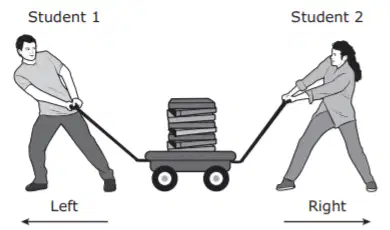
19. Students fill a cart with books. The cart has a handle on each end.
Which actions will make moving the cart in one direction easiest for the students?
Student 1 pulls the cart to the left while Student 2 pull the cart to the right.
Student 1 pushes the cart to the right while Student 2 pushes the cart downward.
Student 1 pulls the cart to the left while Student 2 pushes the cart to the left.
Student 1 pushes the cart to the right while Student 2 pull the cart upward.
Which of the following statements is NOT true?
A teacher must present science as a way of finding out rather than as a body of facts to be memorized.
Teachers must adapt science experiences to the learners’ developmental levels
In teaching, learning by doing must be emphasized.
A teacher must use only one approach/strategy in teaching science
The 5-E Learning Cycle is a model that promotes scientific inquiry. Each “E” represents part of the process of helping students sequence their learning experiences to develop a connection between prior knowledge and new concepts. Which of the following s the correct sequence of the 5 E's?
Engage, Explore, Elaborate, Explain, Evaluate
Engage, Explore, Explain, Elaborate, Evaluate
Engage, Explain, Explore, Elaborate, Evaluate
Engage, Explain, Elaborate, Explore, Evaluate
22. All of the following are in the science conceptual framework, EXCEPT:
Critical/Creative Problem Thinker
Innovative and Inventive Thinker
Informed decision maker
Equate communicator
23. All of the following are the goals of science curriculum framework, EXCEPT:
Scientific Literacy
Technological Literacy
Environmental Literacy
Responsible Steward Literacy
24. It is an act that states that the curriculum shall use the spiral progression approach to ensure mastery of knowledge and skills after each level.
RA 10533
RA 10622
RA 10454
RA 10534
25. A basic process skill which uses the senses to gather information about the object or event.
Observing
Measuring
Classifying
Communicating
26. Placing Objects as to Plants or Animals.
Observing
Measuring
Classifying
Communicating
27. Using a Mater stick (standard) to measure the length of a piece of cloth is an example of what basic process skill?
Observing
Measuring
Classifying
Communicating
28. If the soil is fertilized, then mongo seeds will grow with leaves greener, this is an example of
Formulating Hypothesis
Experimenting
Formulating Models
Interpreting Data
29. Which of the following is TRUE about science spiral curriculum?
key concepts are presented repeatedly but with deepening layers of complexity
key concepts are presented repeatedly from complex to simple
key concepts are presented unrepeatedly
key concepts are not presented
30. Science as discipline will enable learners to create and innovate something simple for humanity. They will become scientists and inventors of the future
informed decision maker
responsible steward of nature
effective communicator
innovative and inventive thinker
31. A book falls off a desk. What moves the book towards the floor?
friction
air resistance
mass
gravity
32. Which best explains why a bicycle slows down when it brakes are applied?
The brakes heat the rubber on the bicycle tires
the brakes cause frictional forces on the wheels of the bicycle
the brakes add energy to the bicycle
the brakes increase the force of gravity on the bicycle
33. A soccer ball is kicked and rolls along a flat field of grass until it comes to a stop. What is MOST responsible for the ball coming to a stop?
air
friction
mass
gravity
34. A child rides a sled down the snowy hill. Which force is MOST responsible for causing the sled to slow down and stop?
air
friction
mass
gravity
35. A wagon is pushed in a straight line. How would an increase in friction on the wagon wheels affect the wagon?
It would cause the wagon to move faster.
It would cause the wagon to change direction.
It would cause the wagon to change mass.
It would cause the wagon to slow down
36. A cup sitting on the table has what type of force?
unbalanced force
friction
gravity only
balanced force
37. A water bottle tipping over on your desk has what type of force?
unbalanced force
friction
gravity only
balanced force
38. What law of physics says anything in motion stays in motion unless a force acts upon it.
inertia
friction
gravity
motion
39. What is the difference between mass and weight?
mass is how much matter is in an object, and weight is the gravitational pull on that object
weight affects how much mass is in an object
mass and weight are the same
weight is determined by how many atoms make up an object
40. What does force allow a ball player to do?
To swing a baseball bat and hit a ball in a same direction
To swing a baseball raquet and hit a ball in a new direction
To swing a baseball bat and drop a ball in a new direction

