
 Worksheets
Cell Division Test Prep
Total questions: 20
Worksheet time: 30mins
Which of the following phrases best describes cancer?
absence of mutations in the DNA
multiple gene mutations on a chromosome of DNA
uncontrolled cell growth caused by mutations in genes that control the cell cycle
presence of genetic defects caused by hereditary disorders
Arnold just returned from his physician's office with the news that he has a tumor. What went wrong in the cell cycle leading to the tumor
The cell skipped the S phase
The cell skipped the G1 phase
The checkpoints failed, slowing cell reproduction
The checkpoints failed leading to uncontrolled cell growth

Enzymes are special proteins that help the body perform necessary tasks. The table below describes different enzymes and their functions.
If a mutation occurred to cause cancer, what enzyme was most likely affected?
Enzyme A
Enzyme B
Enzyme C
Enzyme D
What are the 3 parts of Interphase
What are the two parts of the cell cycle?
Where does the cell spend most of it's time in?
What happens during S phase ?

What phase of the cell cycle condenses DNA.
What phase of mitosis leads to the formation of the nuclear envelope?
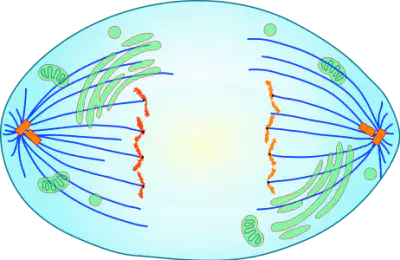
What phase of mitosis separates the sister chromatids
What phase of mitosis align chromosomes in the middle.
What is the correct order of phases in mitosis
How many cells are at the end of meiosis?
2
4
3
1
What is crossing over in meiosis?
What is fertilization?

Which row in the chart below indicates the correct process for each event indicated?
1
2
3
4
Mitosis vs Meiosis
Asexual
Cell division
Identical daughter cells
Occurs in somatic cells
Results in two diploid cells
Occurs in growth and repair
No genetic variation
Mitosis and meiosis are processes involved in cellular reproduction. Which of the following describes an event that results from mitosis but NOT meiosis?
Mitosis has two stages of cell division, meiosis does not
Replication of cellular genetic material occurs only in mitosis
Identical daughter cells are produced in mitosis but not in meiosis
Four daughter cells are produced in mitosis, only two cells are produced in meiosis

Using the chart below which of the following statements best describes a cell from one of the organisms after mitosis and meiosis?
After mitosis a fruit fly would have 4 chromosomes in a somatic cell.
After meiosis they would have 8 chromosomes in a gamete.
After mitosis a pea would have 28 chromosomes in a somatic cell.
After meiosis they would have 8 chromosomes in a sex cell.
After mitosis a human would have 46 chromosomes in a somatic cell.
After meiosis they would have 23 chromosomes in a gamete.
After mitosis a gold fish would have 94 chromosomes in a sex cell.
After meiosis a gold fish would have 94 chromosomes in a somatic cell.
What is the difference between prokaryotic and eukaryotic cells

