
 Worksheets
Earth's Systems Test Part I
Total questions: 26
Worksheet time: 13mins
Name
Class
Date
1.
1. a volcano which has not erupted in a long time but there is a possibility it can erupt in the future
a)
tectonic plates
b)
continental drift
c)
volcano
d)
lava
e)
dormant
2.
2. hot, liquefied rock that flows from a volcano or other opening in the surface of Earth.
a)
tectonic plates
b)
continental drift
c)
volcano
d)
lava
e)
dormant
3.
3. The theory of ____________________ proposes that the continents are drifting away from each other because they are located on tectonic plates, or sections that make up the Earth's crust, the outermost rigid layer of the Earth.
a)
tectonic plates
b)
continental drift
c)
volcano
d)
lava
e)
dormant
4.
4. parts of the lithosphere that breakup into huge rock slabs, or crustal plates
a)
tectonic plates
b)
continental drift
c)
volcano
d)
magma
e)
active
5.
5. a mountain that opens downward to a pool of molten rock below the surface of the earth.
a)
tectonic plates
b)
continental drift
c)
volcano
d)
magma
e)
active
6.
6. molten, or hot liquefied, rock located deep below the Earth's surface
a)
tectonic plates
b)
continental drift
c)
volcano
d)
magma
e)
active
7.
7. a volcano which has recently erupted and there is a possibility that it may erupt soon
a)
tectonic plates
b)
continental drift
c)
volcano
d)
magma
e)
active
8.
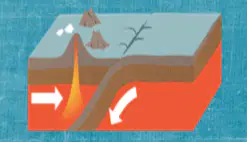
8.
a)
Transform
b)
Divergent
c)
Convergent
9.

9.
a)
Transform
b)
Divergent
c)
Convergent
10.

10.
a)
Transform
b)
Divergent
c)
Convergent
11.

11. Which systems is pictured below?
a)
Hydrosphere
b)
Atmosphere
c)
Geosphere
d)
Biosphere
12.

12. Which systems is pictured below?
a)
Hydrosphere
b)
Atmosphere
c)
Geosphere
d)
Biosphere
13.

13. Which systems is pictured below?
a)
Hydrosphere
b)
Atmosphere
c)
Geosphere
d)
Biosphere
14.

14. Which systems is pictured below?
a)
Hydrosphere
b)
Atmosphere
c)
Geosphere
d)
Biosphere
15.

15. The ______________________ is the outermost layer of the Earth.
a)
Crust
b)
Mantle
c)
Outer Core
d)
Inner Core
16.
16. Earth has four _______________ .
a)
parts
b)
layers
c)
crusts
d)
weathers
17.
17. The ______________________ is between the crust and the core.
a)
mantle
b)
crust
c)
lava
d)
air
18.
18. Earth's crust is made up of interlocking pieces called
a)
jigsaws
b)
crusts
c)
tectonic plates
d)
pieces
19.
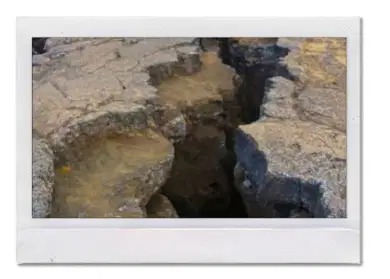
19. What type of plate boundary caused these results?
a)
divergent
b)
convergent
c)
transform
d)
none
20.

20. Ocean trenches are the deepest parts of the ocean floor. They are shown as blue lines on the map below. The area where frequent volcanic activity takes place around the Pacific Ocean is known as the Ring of Fire. This area is highlighted on the map.
What does the map show about the locations of the trenches and volcanoes?
a)
Trenches occur only in oceans, but volcanoes never occur in oceans.
b)
Trenches occur only in the Southern Hemisphere, and volcanoes occur in the Northern Hemisphere.
c)
Trenches and volcanoes occur around the same locations.
d)
Trenches and volcanoes occur in the Northern Hemisphere only.
21.
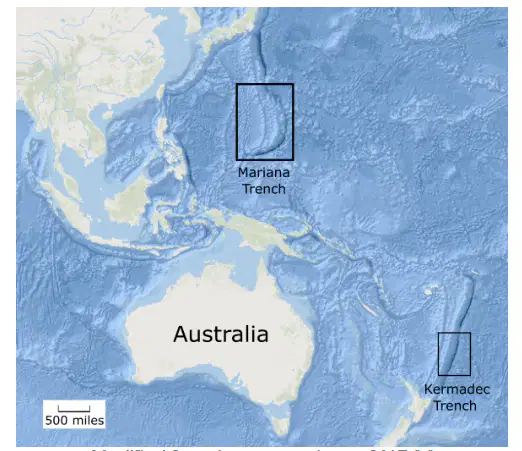
21. Ocean trenches are like valleys that are on the ocean floor. The map below shows two ocean trenches that are located in the Pacific Ocean.
What does the map show about ocean trenches?
a)
They are located in the middle of continents.
b)
They are hundreds of miles long.
c)
They connect two different continents together.
d)
They are always located several thousands of miles from land.
22.

22. The image below shows where minor earthquakes happened during a 24-hour period. The larger dots represent stronger earthquakes.
What does the map show about earthquakes and their locations?
a)
Most earthquakes happen close to where a continent meets an ocean.
b)
Most earthquakes happen anywhere on Earth with no pattern.
c)
Most earthquakes happen in the middle of continents.
d)
Most earthquakes happen close to the middle of oceans.
23.

22. This layer of the Earth allows the crust to move, and is also the thickest layer.
a)
crust
b)
mantle
c)
core
24.
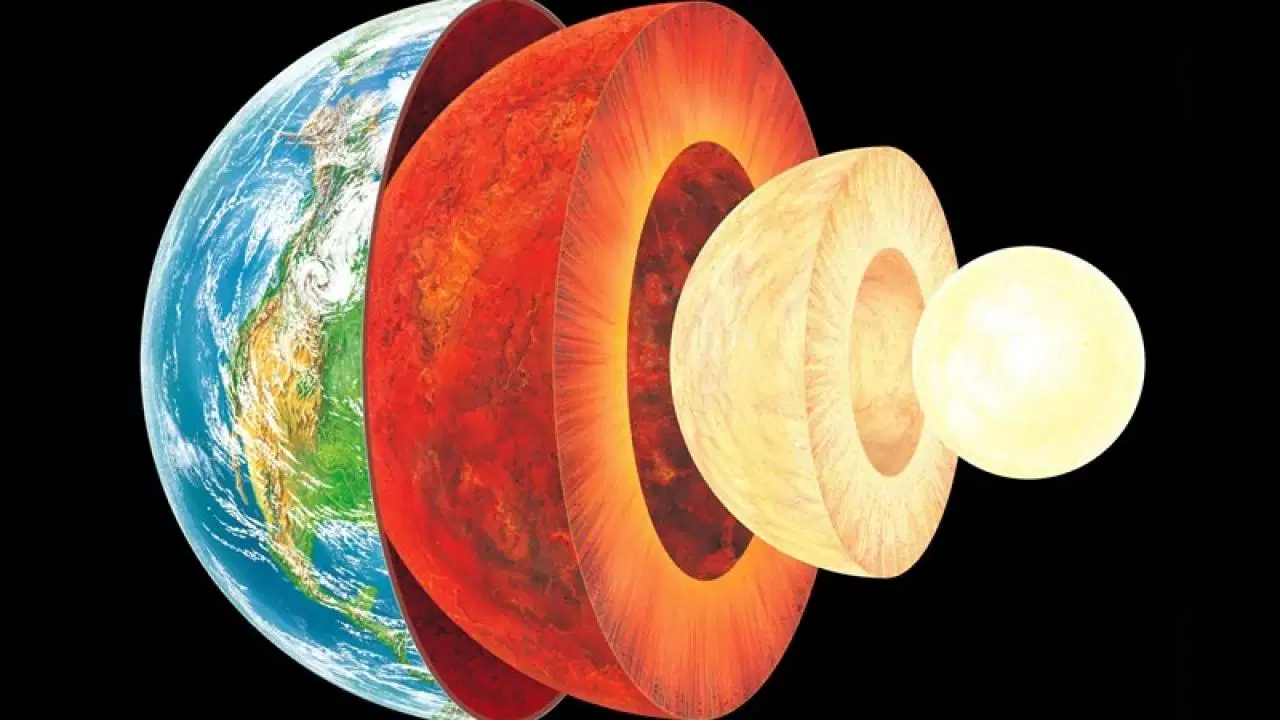
23. This layer of the Earth is the layer we live on, it is also the thinnest layer.
a)
crust
b)
mantle
c)
core
25.
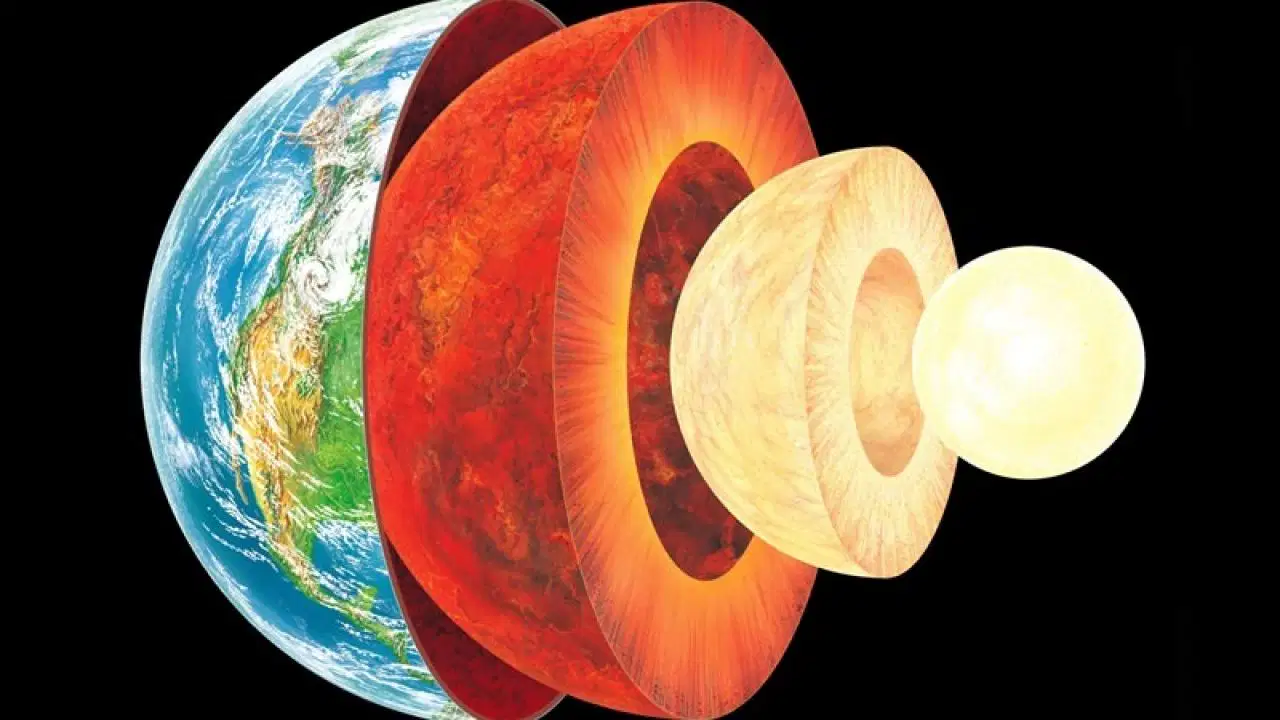
24. This layer of the Earth is the hottest and can be divided into two parts.
a)
crust
b)
mantle
c)
core
26.

25. This layer is made up of soil, water, and rock.
a)
crust
b)
mantle
c)
core
100 %

