

wayground logo

Free Printable Worksheets

Font size

S
M
L
XL
Worksheets

Practice Quiz: Voting, Elections, and Political Parties

Total questions: 24

Worksheet time: 55mins

Name
Class
Date
1.

How is the President of the United States elected?

a)
By appointment from the previous President
b)

Chosen by the House of Representatives
c)
By popular vote
d)
Through the Electoral College system
2.
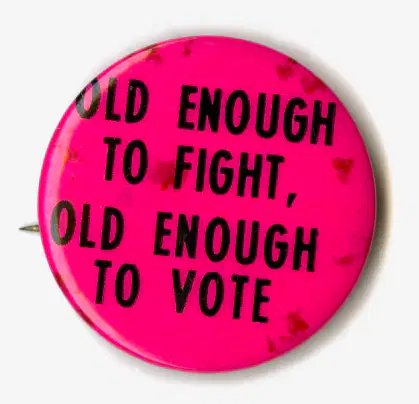
What was the impact of the 26th Amendment to the US Constitution on the American political process?
a)
Women were allowed to vote in elections in all states.
b)
Citizens who were 18 years or older were allowed to vote in elections.
c)
Those who could not afford to pay poll taxes could still vote in elections.
d)
Restaurants and hotels could not practice discrimination against Vietnam veterans.
3.

What is a political party convention?

a)

A gathering of delegates from a political party to select a presidential candidate to run in a general election.

b)
A meeting to discuss the latest fashion trends
c)
A festival to celebrate the party's achievements
d)
A gathering to watch movies and socialize
4.

What did the 12th Amendment do?

a)
Established the official language of the United States
b)

President and Vice President run together on a ticket

c)
Abolished the electoral college
d)
Lowered the voting age to 18
5.

What were the origins of the Democratic Party?

a)

Andrew Jackson- expanded democracy by giving more political power to ordinary citizens "the common man"

b)

Benjamin Franklin and John Adams- more political power to landowners

c)

George Washington and Alexander Hamilton- wanted strong federal government

d)

Abraham Lincoln and John F. Kennedy- started by abolitionists

6.
"I like Ike, you like Ike, everybody likes Ike!" This message, in a 1952 presidential campaign ad, is using what strategy?
a)
Bandwagon
b)
Card stacking
c)
Fear
d)
Glittering Generalities
7.
Shown below is a group of Democrats in 2020 debating in what sort of election?
a)
General
b)
Midterm
c)
Offyear
d)
Primary
8.
Which amendment eliminated poll taxes?
a)
15th Amendment
b)
19th Amendment
c)
24th Amendment
d)
26th Amendment
9.

Those in favor of the 19th Amendment believed the national government should play a key role in determining voting qualifications. Those against said only states should have the power to regulate voting. The argument is over the division of powers between different levels of government. What is this concept called?

a)
Suffrage
b)
Federalism
c)
19th Amendment
d)
Democracy
10.
Which amendment extended the right to vote to all American males regardless of their race or whether they had been enslaved?
a)
19th Amendment
b)
15th Amendment
c)
24th Amendment
d)
26th Amendment
11.
Which legislative act echoed the 15th and 24th Amendments by prohibiting discriminatory practices such literacy tests and grandfather clauses?
a)
Voting RIghts Act of 1965
b)
Ratification of the 26th Amendment
c)
Immigration Act of 1965
d)
Civil Rights Act of 1964
12.
Which statement identifies a positive impact of political parties on American political life?
a)
Parties divide Americans into hostile groups.
b)
Parties encourage people to vote in elections.
c)
Parties often present voters with one-sided, biased information.
d)
Parties raise so much campaign money that they make it hard for independent candidates to compete.
13.
What has been a negative impact of political parties on American government?
a)
Political parties offer alternatives and encourage debate.
b)
Political parties offer opportunities for civic participation.
c)
Partisan politics often prevent government from getting things done.
d)
Political parties act as watchdogs over the actions of each other.
14.
How do individual interest groups differ from political parties?
a)
They do not raise money from their supporters.
b)
They encourage public participation in government.
c)
They can influence the legislative process.
d)
They do not run candidates for elected office.
15.
The graph below reflects which fact about American voters?
a)
Independent voters help decide elections.
b)
Business owners vote for Republicans.
c)
Political identification helps voters choose candidates.
d)
Teachers vote for Democrats.
16.

What the origins of the Republican Party?

a)

Stems form Thomas Jefferson's Democratic-Republicans. Founded by Andrew Jackson and Martin Van Buren; popular in the Southern states-party of the "common man"

b)

Formed in 1854; Split from Democrats-Republicans from those who wanted to support the Antislavery movement. Abraham Lincoln was this party's first president.

17.
After primaries and caucuses are over, the political parties have what kind of meeting to choose the one candidate to represent the party in the general election?
a)
Regional convention
b)
National convention
c)
National seminar
d)
Regional Seminar
18.
People who join together to pursue a common interest in influencing legislation are known as what?
a)
Political Action Committees (PAC's)
b)
Public Opinion
c)
Mass Media
d)
Interest Groups
19.

What is a general election?

a)
A general election is a type of local meeting for community discussions.
b)
A general election is a private gathering of political leaders to make decisions.
c)
A general election is when voters decide on a national holiday.
d)
A general election is a political event where voters elect representatives to governmental positions.
20.

Why are free and fair elections important to maintain our Constitutional Republic?

a)

Free and fair elections are essential for representing the people's will and maintaining trust in the government.

b)
Fair elections are unnecessary in a Constitutional Republic.
c)
Free elections can lead to chaos and instability.
d)
Elections are only important for political parties.
21.

Which level of government is in charge of elections?

a)

State and local government, with federal oversight

b)
Private companies
c)
International organizations
d)
Federal government
22.

What did the voting rights amendments to the Constitution accomplish?

a)
They restricted voting rights for certain groups.
b)
They established a national voting age of 21.
c)
They mandated voter ID laws in all states.
d)
They expanded voting rights and eliminated discrimination in voting.
23.

What is the role of media in governmental processes?

a)
The media primarily serves to entertain the public.
b)
Media has no significant impact on government decisions.
c)
The media plays a crucial role in promoting transparency, accountability, and public engagement in governmental processes.
d)
The media's role is to promote government propaganda.
24.

Which term describes this process:

States are awarded a number of votes equal to congressional representation, and a majority of these electors select the executive.

a)

Federalism

b)
Popular Vote
c)
Electoral College
d)

Electing members of Congress
