
NEW
Font size
 Worksheets
Unit 7 Review
Total questions: 45
Worksheet time: 23mins
Why were the delegates at the Secession Convention in favor of Texas leaving the Union?
They wanted Abraham Lincoln as president.
They considered slavery vital to the economy.
They disagreed with paying high federal taxes.
They thought the national government was influenced by Britain.
Fought along the Rio Grande River
Took place after the surrender of the Confederacy
Last military conflict associated with American Civil War
Which battle is being described above?
Battle of Galveston
Battle of Sabine Pass
Battle of Palmito Ranch
Battle of Monett's Ferry
What Texas governor joined the confederate army and did not seek reelection?
Sam Houston
Mirabeau Lamar
Edward Clark
Francis R. Lubbock
"After the sacrifice of countless millions of treasure and hundreds of thousands of lives you may win Southern independence, but I doubt it. The North is determined to preserve this Union. They are not a fiery, impulsive people as you are, for they live in colder climates. But when they begin to move in a given direction, they move with the steady momentum and perseverance of a mighty avalache."
-Governor Sam Houston
According to the excerpt, what was Governor Sam Houston's belief about Texas secession?
He opposed secession and did not believe the South could win the Civil War.
He supported secession but had doubts about the South's ability to win the Civil War.
He believed secession was a haste decision but Texas would be able to help the Confederacy win the Civil War.
He did not want to partake in any discussion about secession.
What did the Confederate victory at Galveston mean for the Confederacy?
protected Texas's busiest seaport
created a blockade to Union supplies
hurt the Union Navy
weakened the Confederacy
Why was the Battle of Sabine Pass an important victory for the Confederacy?
Mexico's navy helped Texas
The Union army surrendered
Texans seceded from the Confederacy
the Union changed its mind about attacking Texas
The Effects of the Civil War
Over 620,000 Americans lost their lives in the Civil War, making it one of the deadliest conflicts in U.S. history. Thousands of Texans served in the war where many soldiers were killed or wounded. Although there were few battles fought in the state, many business felt the effects of the war. The cotton trade nearly came to a halt. The deaths of many Texas soldiers placed a hardship on businesses and farms. Some leaders fled to Mexico at the end of the war, causing the government to collapse. No one seemed to know who was in charge. It took time before Union forces could move in and restore order.
From the excerpt above, which sentence illustrates how the Texas economy was affected by the war?
Government leaders fled to Mexico leaving a feeling of not knowing who was in charge for Texans.
As General Sherman led a march through the state, his army destroyed the land and everything in its path.
About 620,000 Americans lost their lives in the Civil War, making it the deadliest conflict in U.S. history.
The cotton trade declined and many Texas businesses suffered hardship.
Which event led to the increased production of corn and wheat in Texas during the years of the American Civil War?
Texas farms began using new fertilizers and pesticides.
Enslaved people stopped working on the cotton plantations.
A need to feed soldiers increased demand for these products.
Confederate officials sent money to Texas farmers to buy land.
Headquarters, District of Texas,
Galveston, Texas, June 19, 1865
General Orders, No. 3 The people of Texas are informed that, in accordance with a proclamation from the Executive of the United States, all slaves are free. This involves an absolute equality of personal rights and rights of property between former masters and slaves, and the connection heretofore existing between them becomes that between employer and hired labor. The freedmen are advised to remain quietly at their present homes and work for wages. They are informed that they will not be allowed to collect at military posts and that they will not be supported in idleness either there or elsewhere.
—Major-General Gordon Granger, U.S. Army
Which Texas holiday celebrates this announcement by the U.S. Army?
Juneteenth
Veteran's Day
Thanksgiving Day
Texas Independence Day
Following the American Civil War most former enslaved African Americans in Texas began making a living as —
ranchers
cowboys
sharecroppers
railroad porters
The purpose of the Freedmen's Bureau was to —
encourage the slaves to join the Union army
provide assistance to the newly freed slaves
encourage the newly freed slaves to leave Texas
promote settlement of the newly freed slaves to Mexico
Which Texan was the postmaster general under the Confederate President Jefferson Davis?
John H. Reagan
Alexander H. Stephens
Sam Houston
Edward Clark
Even though the Civil War had officially ended, another battle took place at ______ on May 13, 1865 because the news had not yet reached Texas.
Appomattox Courthouse
Palmito Ranch
San Antonio
Fort Sumter
Why did the enslaved Texans begin celebrating their freedom on June 19, 1865?
Because of distance and the war, many had not learned of the Emancipation Proclamation of 1863
Texas was fighting Mexico for its independence and did not know about the Emancipation Proclamation
Mexico did not recognize laws passed by the United States government
Texas was an independent nation and did not recognize laws passed by the United States government
The period from 1865 to 1873 during which Texas was brought back into the Union is called
Secession
Readmission
Annexation
Reconstruction
Members of the Legislature, and all officers of the State of Texas, before they enter upon the duties of their offices, shall take the following oath or affirmation:
I, [name] do solemnly swear (or affirm) that I will faithfully and impartially discharge and perform all the duties incumbent on me as [governor] according to the best of my skill and ability, agreeably to the Constitution and laws of the State of Texas, and also to the Constitution and laws of the Confederate States of America, so long as the State of Texas shall remain a member of that Confederacy.
—Article VII, Section 1 of the Constitution of the State of Texas, 1861
What was the effect of Sam Houston's refusal to swear this oath?
Texas did not secede from the Union.
Sam Houston was removed as governor.
Sam Houston was made a general in the Union army.
Texas amended the state constitution to eliminate the oath.
Both the U.S. Constitution and the Texas Constitution include —
a list of the rights guaranteed to citizens
an explanation for declaring independence
descriptions of the responsibilities of citizens
an amendment granting equality for all citizens
One way that the Texas Constitution and the U.S. Constitution are similar is that both establish a government divided into —
counties
several states
three branches
federal districts
Which of the following is one way the Texas Constitution differs from the U.S. Constitution?
The Texas Constitution gives the governor more power than that of the U.S. president.
The Texas Constitution limits the governor's power more than the U.S. president's powers.
The Texas Constitution restricts the governor to serving a shorter term than the U.S. president.
The Texas Constitution requires the governor be a native Texan and the president can be from anywhere.
Both the U.S. Constitution and the Texas Constitution act to protect individual rights by —
listing specific rights in amendments
limiting the power of the executive branch
allowing for the election of representatives
giving Congress the power to pass legislation
How is republicanism reflected in the provisions of both the U.S. and the Texas constitutions?
Both include a bill of rights to specify the rights citizens are guaranteed.
Both outline how powers are separated between the branches of government.
Both provide a framework of how representatives are elected to the legislature.
Both detail how power is shared between lower and higher levels of government.
Slavery, state's rights, and the tariff issue were all factors in Texas' decision to
join Mexico in fighting against the United States
stay part of the Union (North)
secede from the United States
start trading with Canada
ARTICLE VI
Sec. 2. QUALIFIED VOTER; REGISTRATION; ABSENTEE VOTING. (a) Every person subject to none of the disqualifications provided by Section 1 of this article or by a law enacted under that section who is a citizen of the United States and who is a resident of this State shall be deemed a qualified voter;
—Texas Constitution, 1876
The right of the people protected by Article VI in the Texas Constitution reflects the constitutional principle of —
federalism
reserved power
popular sovereignty
unlimited government
The inclusion of a Bill of Rights with the Texas Constitution reflects a commitment to —
republicanism
individual rights
separation of powers
checks and balances
All free male citizens of this State, as defined in the preceding section, over the age of twenty-one years, who shall have resided in this State one year next preceding an election, and the last six months in the district, county, city or town in which they offer to vote, shall be deemed qualified electors.
—Article III, Section 2 of the Texas Constitution of 1861
Every male person... who shall have attained the age of twenty-one years, and who shall be a citizen of the United States, and who shall have resided in this State one year next preceding an election, and the last six months within the district or county in which he offers to vote, shall be deemed a qualified elector.
—Article VI, Section 2 of the Texas Constitution of 1876
How did the Constitution of 1876 expand voting rights in Texas after the Civil War?
Women were allowed to vote.
All men, regardless of race, were allowed to vote.
All people were allowed to vote at the age of 21.
New citizens to the state could now vote sooner.
The political division that occurred between regions in the U.S. prior to the war is known as...
States Rights
Sectionalism
Political Rivalry
Slavery
Which of the following battles occurred after the Confederate surrender?
Battle at Galveston
Battle at Sabine Pass
Battle of Gettysburg
Battle of Palmito Ranch
Who was the President of the Confederate States of America?
Abraham Lincoln
Jefferson Davis
James K. Polk
Sam Houston
Who was President of the United States of America during the Civil War?
Abraham Lincoln
Jefferson Davis
James K. Polk
Sam Houston
Who was the Confederate commander that saw many of the major Civil War battles: Manassas, Fredericksburg, Gettysburg, and Atlanta?
John Bell Hood
John B. Magruder
Francis Lubbock
General Raddus
T/F: Thomas Green led troops at the Battle of Galveston aboard one of the South’s “cotton clad” ships.
True
False
What caused South Carolina to secede?
Publishing of Uncle Tom's Cabin
Election of Abraham Lincoln
Resignation of Sam Houston as governor
Tariff of Abominations
What battle was where the first shots of the Civil War were fired?
Fort Sumter
Antietam
Gettysburg
Vicksburg
What was the turning point of the Civil War and the bloodiest BATTLE in American history?
Fort Sumter
Gettysburg
Vicksburg
Appomattox
Who was the Confederate general that surrendered at Appomattox Court House?
Ulysses S. Grant
Jefferson Davis
Robert E. Lee
Abraham Lincoln
What Texas battle was fought on "cottonclad" ships and temporarily disrupted the blockade of the coast?
Sabine Pass
Palmito Ranch
Gettysburg
Galveston
Dred Scott decision said
slaves were citizens
new states must be free
the Missouri Compromise upheld
slaves were considered property
Eleven states secede and form the
Confederate States of America
Union
United States of Secession
Confederacy of Eleven
The idea that the state can determine whether or not to follow law is called
manifest destiny
sectionalism
states rights
annextion
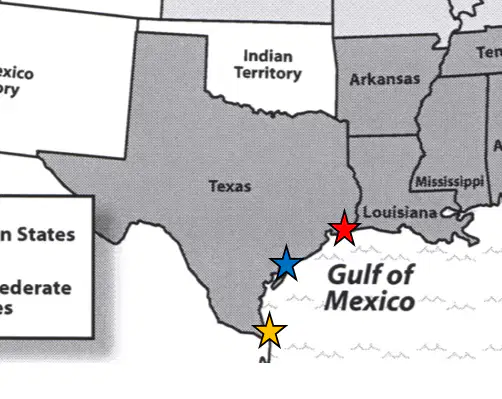
What battle took place where the red star is located
The Battle of the Sabine Pass
The Battle of Palmito Ranch
The Battel of Galveston
The Battle of Corpus Christi
What battle took place where the blue star is located
The Battle of the Alamo
The Battle of Palmito Ranch
The Battel of Galveston
The Battle of Corpus Christi
What battle took place where the orange star is located
The Battle of the Alamo
The Battle of Palmito Ranch
The Battel of Gonzales
The Battle of Corpus Christi

The Confederacy was pro-slavery?
True
False

The Southerners worked on farms or were plantation owners
The southerners were lumberjacks and fishermen.
The Southerners worked in factories, banks, or fiance.
The Southerners worked in fields and growing cotton.
What does secede mean?
to officially leave or separate from a group
a tax paid on goods
a group of soldiers
a large farm

