
 Worksheets
Chapter 13 - Light - Part 4
Total questions: 30
Worksheet time: 23mins
a real image is produced by...
the apparent intersection and can be projected on a screen
the actual intersection of rays and cannot be projected on a screen
the apparent intersection of rays and cannot be projected on a screen
the actual intersection of rays and can be projected on a screen

The point where the rays meet is known as....
Fire
the focus
refraction
Plane of the lens
When an object is placed between the focus and the convex lens, the image produced is ___.
real, diminished, and inverted
real, magnified, and inverted
virtual, magnified, and upright
virtual, diminished, and upright
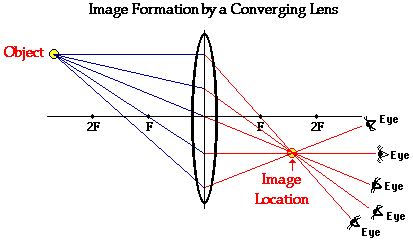
When light waves move from passing through air to passing through a glass lens when happens to them?
They slow down and change direction
They speed up and change direction
They maintain the same speed and change direction
They maintain their same speed and direction
What type of lens do you have in your eye?
Concave
Prismatic
Objective
Convex

What type of image is formed?
virtual and inverted
virtual and upright
real and upright
real and inverted
A ____ lens is sometimes called a converging lens because it_____.
convex; makes parallel light rays curve outward or diverge
concave; makes parallel light rays travel at a faster speed than before they encountered the lens
convex, makes parallel light rays passing through it bend inward and meet (converge) at a spot just beyond the lens known as the focal point.
concave; makes parallel light rays passing through it bend inward and meet (converge) at a spot just beyond the lend known as the focal point.
The focal length is...
the distance from the light source to the image.
the distance from the object to the centre of the lens.
the distance from the image to the centre of the lens.
the distance from the focal point to the centre of the lens.
Which of the following is true?
The image distance obtained from a far away object is the focal length of the convex lens.
The images obtained from a convex lens always lie on the focal point.
The images obtained by a convex lens are always real.
The images obtained by a convex lens are always inverted.

What are the characteristics of the image produced?
virtual
enlarged
inverted
upright
real
Why does light refract when it encounters the glass in a lens?
because it speeds up, which causes it to bend
because it slows down, which causes it to bend
because it hits a dense medium, which causes it to bounce off
because it gets absorbed, which causes it to lessen in intensity
What do a prism, a magnifying glass, a microscope, and eyeglasses ALL have in common.
They are opaque
They refract light
They reflect light
That are translucent
Eyeglasses bend light to help the image form properly on the retina. The bending of light as it passes from one medium to another is called
diffraction
interference
reflection
refraction
Chiếu một chùm tia sáng tới song song với trục chính của thấu kính hội tụ. Chùm tia sáng ló ra khỏi thấu kính là chùm sáng
hội tụ tại tiêu điểm của thấu kính.
phân kì.
hội tụ tại tiêu cự của thấu kính.
chùm sáng song song với trục chính.
Khi nói về đường truyền của tia sáng qua thấu kính hội tụ, câu trả lời không đúng là
Tia tới qua quang tâm thì tia ló truyền thẳng.
Tia tới song song với trục chính thì tia ló đi qua tiêu điểm.
Tia tới qua tiêu điểm thì tia ló truyền thẳng.
Tia tới đi qua tiêu điểm thì tia ló song song với trục chính.
Chỉ ra câu sai. Chiếu một chùm tia sáng song song vào một thấu kính hội tụ, phương vuông góc với mặt của thấu kính thì chùm tia khúc xạ ra khỏi thấu kính sẽ
loe rộng dần ra.
thu nhỏ dần lại.
bị thắt lại.
gặp nhau tại một điểm.
Thấu kính hội tụ có đặc điểm và tác dụng nào dưới đây?
Có phần giữa mỏng hơn phần rìa và cho phép thu được ảnh của Mặt Trời.
Có phần giữa mỏng hơn phần rìa và không cho phép thu được ảnh của Mặt Trời.
Có phần giữa dày hơn phần rìa và cho phép thu được ảnh của Mặt Trời.
Có phần giữa dày hơn phần rìa và không cho phép thu được ảnh của Mặt Trời.
Chiếu một tia sáng vào một thấu kính hội tụ. Tia ló ra khỏi thấu kính sẽ qua tiêu điểm, nếu:
Tia tới đi qua quang tâm mà không trùng với trục chính.
Tia tới song song với trục chính.
Tia tới đi qua tiêu điểm nằm ở trước thấu kính.
Tia tới bất kì.
Chiếu một tia sáng vào một thấu kính hội tụ. Tia ló ra khỏi thấu kính sẽ song song với trục chính, nếu:
Tia tới đi qua quang tâm mà không trùng với trục chính.
Tia tới song song với trục chính.
Tia tới đi qua tiêu điểm nằm ở trước thấu kính.
Tia tới bất kì.
Chiếu một tia sáng vào một thấu kình hội tụ. Tia ló ra khỏi thấu kính sẽ truyền thẳng theo phương của tia tới, nếu
tia tới đi qua quang tâm.
tia tới đi qua tiêu điểm nằm ở trước thấu kính.
tia tới song song với trục chính.
tia tới bất kì.
Nhận xét nào sau đây về tác dụng của thấu kính hội tụ là đúng?
Có thể tạo ra chùm sáng song song từ chùm sáng hội tụ.
Có thể tạo ra chùm sáng phân kì từ chùm sáng song song.
Có thể tạo ra chùm sáng hội tụ từ chùm sáng song song.
Có thể tạo ra chùm sáng song song từ chùm sáng phân kỳ.
Câu nào sau đây phát biểu không đúng về thấu kính hội tụ:
Thấu kính hội tụ chỉ được làm bằng thuỷ tinh.
Thấu kính hội tụ có hai tiêu điểm ở hai bên nằm đối xứng với quang tâm.
Trừ tia qua quang tâm các tia sáng còn lại qua thấu kính hội tụ luôn bị bẻ gãy về phía trục chính.
Thấu kính hội tụ bằng thuỷ tinh luôn có ít nhất một mặt lồi.
Chất liệu nào sau đây không thể dùng làm TKHT?
Nhựa trong suốt.
Thủy tinh.
Inox.
Nước đá

