wayground logo

Free Printable Worksheets

Font size

S
M
L
XL
Worksheets

Fossils, Age, Geologic Time Quizizz

Total questions: 54

Worksheet time: 1hrs 4mins

Name
Class
Date
1.

A _____________________ is the remains or evidence of an ancient organism.

a)

paleontologist

b)

preserved

c)

fossil

d)

extinct

2.

Which Rock type would be best to find fossils?

a)

Igneous rock

b)

Metamorphic Rock

c)

Sedimentary Rock

3.

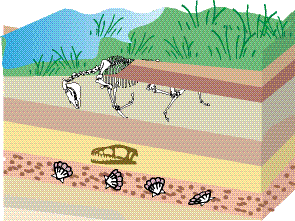
Click to enlarge. Study this carefully. Which fossil in the oldest?

a)

Fossil 1

b)

Fossil 2

c)

fossil 3

4.

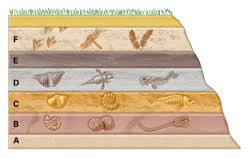
Which layer is the oldest?

a)

A

b)

F

c)

Can not be determined

d)

They are all the same age.

5.

Which layer is the youngest?

a)

A

b)

F

c)

Can not tell

d)

They are all the same age.

6.

What can fossils tell us about the past? (check all that apply)

a)

Which organisms used to live on Earth and what they looked like

b)

How the environment has changed

c)

How organisms alive today have changed and adapted over time

d)

How to make a taco

7.
Fossil of thin layer of carbon atoms and molecules 
a)
original remains 
b)
carbon film
c)
trace fossil
8.
Formed when original material in skeletal remains are replaced by minerals 
a)
original remains 
b)
fossil
c)
permineralized remains 
9.
Cavity in a rock made when an organism decayed
a)
cast
b)
mold 
c)
original remains
10.
Produced when sediments fill in a cavity made when an object decayed 
a)
cast
b)
mold
c)
original remains
11.

What replaces the wood of a once-living thing to form petrified wood?

a)

amber

b)

cast

c)

mold

d)

minerals

12.

This type of fossil is tree sap hardened and replaced by minerals.

a)

Petrified wood

b)

Imprint

c)

Amber

d)

Mold

13.

What type of fossil is pictured here?

a)

Mold fossil

b)

Trace fossil

c)

Cast fossil

d)

Body fossil

14.

What type of fossil is pictured here?

a)

Forest fossil

b)

Trace fossil

c)

Cast fossil

d)

Body fossil

15.

What type of fossil is pictured here?

a)

Mold fossil

b)

Trace fossil

c)

Cast fossil

d)

Body fossil

16.

A fossil formed when minerals replace all or part of an organism is called a

a)

mold   

b)

petrified fossil

c)

cast

d)

trace fossil

17.
According to the law of superposition, the oldest fossils are found 
a)
At the top of the rock layers
b)
Near the bottom of the rock layers
c)
In the middle of the rock layers
d)
Somewhat near the surface
18.
Which rock layer in the diagram seems to be the oldest?
a)
F
b)
E
c)
B
d)
A
19.
Which of the following is the oldest?
a)
Layer L
b)
Intrusion D
c)
Intrusion H
d)
Layer E
20.
Which of the following correctly lists the layers in order from oldest to youngest?
a)
A, B, C, D, E
b)
E, B, C, D, A
c)
E, D, C, B, A
d)
C, B, A, D, E
21.
Which Rock layer or intrusion is the youngest?
a)
A
b)
B
c)
C
d)
D
22.

Which layer is OLDER? Layer E or Intrusion A?

a)

Layer E

b)

Intrusion A

23.

Which layer is OLDER? Layer M or Intrusion P?

a)

Layer M

b)

Intrusion P

24.

Which layer is OLDER? Intrusion M or Layer D?

a)

Intrusion M

b)

Layer D

25.

Which Era occurred last (most recent)?

a)

Cenozoic

b)

Mesozoic

c)

Paleozoic

26.

What type of environment do you think was present during the Devonian Period?

a)

mostly land

b)

land with some water

c)

mostly water

d)

water with some land

27.

How old do Paleontologists believe the Earth is?

a)

2019 years old

b)

3.6 billion years old

c)

4.6 billion years old

d)

4.6 million years old

28.

What type of event usually marks the end of an Era

a)

A Mass Extinction

b)

A Quinceanera

c)

An earthquake

d)

A Volcanic Eruption

29.

Scientists chose where units of geologic time began and ended based on the appearance or disappearance of life.

a)

true

b)

false

30.

What are the names of ALL parts of the geologic time scale in correct order from broadest to narrowest?

a)

era, period, eon

b)

eon, era, period, epoch

c)

era, eon, epoch, period

d)

eon, era, epoch, period

31.
By which method have scientists determined that the Earth is about 4.5 billion years old?
a)
plate tectonics
b)
relative dating
c)
radioactive dating
d)
law of superposition
32.

The bottom layer of rock...

a)

is the oldest

b)

is the youngest

c)

has the most fossils

33.

Dinosaur fossils are often found in layers of

a)

sedimentary rock

b)

igneous rock

c)

metamorphic rock

34.
Fossils of species that existed for short periods and were widespread
a)
uniformitarianism
b)
cyanobacteria
c)
index fossils
35.
The soft parts of organisms are most likely to become fossils. 
a)
True
b)
False
36.

Saying you are older than your sister is an example of?

a)

Absolute age dating

b)

Relative age dating

c)

Fossils

d)

Radioactive dating

37.
The disappearance of a species.
a)
Evolution
b)
Extinction
c)
Migration
d)
Mutation
38.
Paleozoic, Mesozoic & Cenozoic are all
a)
Epochs
b)
Eras
c)
Periods
d)
Eons
39.
According to the law of superposition, which layer is the youngest?
a)
A
b)
B
c)
C
40.
What type of rock do fossils form in?
a)
Igneous
b)
Sedimentary
c)
Metamorphic
d)
Classic
41.
A bug stuck in amber is an example of what type of fossil?
a)
cast
b)
mold
c)
trace
d)
preserved remains
42.
The Law of Superposition helps scientists to determine what?
a)
The absolute age of rock layers
b)
The age of fossils
c)
The relative age of rock layers
d)
the super powers of rocks
43.
Known as the age of the mammals?
a)
Mesozoic Era
b)
Holocene Epoch
c)
Cenozoic Era
d)
Cambrian
44.
The dinosaurs and reptiles were dominant in which Era?
a)
Precambrian
b)
Mesozoic
c)
Paleozoic
d)
Cenozoic
45.

90% of Earth’s history occurred during which era?

a)

Precambrian

b)

Paleozoic

c)

Mesozoic

d)

Cenozoic

46.

In which geologic time period was Minnesota covered by a sea?

a)

Ordovician

b)

Cambrian

c)

Quaternary

47.

Which is the oldest rock in Minnesota

a)

Basalt

b)

Greenstone

c)

Gneiss

48.

Most fossils in Minnesota can be found in the _____________ portion of the state.

a)

Southern

b)

Northern

49.
Radiometric dating is possible because the rates of decay of radioactive isotopes _____.
a)
change over time
b)
change from place to place
c)
are constant
d)
vary widely
50.
The time it takes for 50% of the nuclei in a radioactive sample to decay to its stable isotope is called _____.
a)
the daughter product
b)
geologic time
c)
the half-life
d)
the half-time
51.
According to the graph, what fraction of the original parent isotope still exists after 3 half lives?
a)
0,5000 g
b)
0,2500 g
c)
0,1250 g
d)
0.0625 g
52.
You find a rock sample with radioactive atoms present.  If 12.5% of the original radioactive atoms were present, how many half-lives has the rock been around for? (Hint, at Half-Life = 0, you start with 100%)
a)
zero
b)
1
c)
2
d)
3
53.
If the half-life of a radioactive group of atoms is 100 years, then how old is the rock if there have been two half-lives?
a)
25 years
b)
200 years
c)
400 years
d)
800 years
54.
Which radioactive isotope takes the greatest amount of time to undergo radioactive decay? 
a)
Carbon-14
b)
Potassium-40
c)
Uranium-238
d)
Rubidium-87