
 Worksheets
Conceptual Energy
Total questions: 15
Worksheet time: 8mins
We can regulate our temperature via perspiration. Our skin secretes water as part of sweat. That sweat absorbs thermal energy from the body, increases in temperature, and eventually evaporates. This process cools the body off.
What is happening to the water molecules in sweat during this process?
The water molecules gain kinetic energy until they become water vapor.
The water molecules lose kinetic energy until they become water vapor.
The water molecules gain potential chemical energy as new chemical bonds are formed.
The water molecules lose potential chemical energy as chemical bonds are broken.
Aliya is swimming in the pool under the water, but when her mother calls her name from the deck, Aliya hears her.
How does Aliya’s mother’s voice travel from the deck through the water?
Charged molecules in the water move from the deck to the pool due to the presence of an electric field.
Water molecules vibrate and transfer the energy carried by the sound wave to nearby molecules.
Uncharged molecules in the water vibrate due to differential pressures between the surface and the bottom of the pool.
Molecules in the water move from the deck to the pool.
A man filling up balloons for a party accidentally charges them by rubbing them against his shirt. When he places two balloons on a table the electric force between the balloons forces them apart. The two balloons slide in opposite directions across the table before stopping. After the movement, the electric potential energy of the balloons has decreased.
What is the best explanation for why the potential energy in the electric field between the two balloons decreased?
The balloons moved in the direction of the electric force.
The balloons moved in relation to one another.
The balloons lost charge as they moved.
Wong is a professional weightlifter. On his third attempt, he lifts a 200-kilogram weight above his head.
Which of the following describes an energy transfer in this scenario?
Wong transfers chemical energy to the weight.
The weight transfers gravitational potential energy to the ground.
The weight transfers gravitational potential energy to Wong.
Wong transfers gravitational potential energy to the weight.
A person turns on a washing machine, which is plugged into a wall electrical outlet. The washing machine fills with water and begins to spin the clothes inside of it.
Which of the following best describes how energy flows through this system?
Electrical energy is transferred to the washing machine and converted into kinetic energy.
Electrical energy is transferred to the washing machine and converted into warm water.
The washing machine transfers electrical energy to the wall outlet.
Kinetic energy is transferred to the washing machine and converted into electrical energy.
A remote control is used to turn on the television and change channels.
How is energy transferred from the battery to the remote control?
(in a battery circuit, electrons move from one end of the battery, then through the wires, and into the other end of the battery. Kinda like flowing water)
from the energy stored in the nuclei of the atoms found in the battery
from particles that have charge and move in a electric field to reduce their potential energy
from neutral particles that move and when they collide they give up their kinetic energy
from the thermal energy that comes from the motion of the molecules in the battery
Which of the following best describes the elastic energy in a compressed spring at the microscopic level?
Elastic energy exists because the spring’s particles store kinetic energy.
Elastic energy exists because electric potential energy is stored between the spring’s particles.
Each of the spring’s particles has elastic potential energy.
While cleaning her car, Linda notices that the car’s gas tank is almost empty. She drives her car from her home to the gas station, fills up the tank, and then goes back home.
How has the car’s total energy changed after this trip?
The car’s energy decreases because it loses its kinetic energy.
The car’s energy increases because its tank is fuller at the end.
The car’s energy does not change because it is not in motion before and after the ride to the gas station.
Two buckets of sand are in a closed system. The two buckets are at a fixed distance apart and are interacting through a gravitational field.
If the same amount of sand is added to both buckets, how will the energy stored in the gravitational field change?
The potential energy in the field increases.
The potential energy in the field decreases.
The potential energy in the field remains constant.
Which of the following are properties of energy?
Energy can be measured.
Energy can change matter.
Energy occupies space.
Energy can be created.
Which of the following statements are true about chemical energy?
Chemical energy is a macroscopic form of energy that we can model and measure.
At the microscopic scale, chemical energy can be understood as the energy that atoms have due to their positions.
Chemical energy is a form of energy that individual atoms have.
Two students are exploring electric charge using two negatively charged foam plates. They remove some negative charge from one of the plates without changing the plates’ positions. The plates are interacting through an electric field.
How does the energy stored in the field change after the plate becomes less charged?
The potential energy in the field increases.
The potential energy in the field decreases.
The potential energy in the field remains constant.
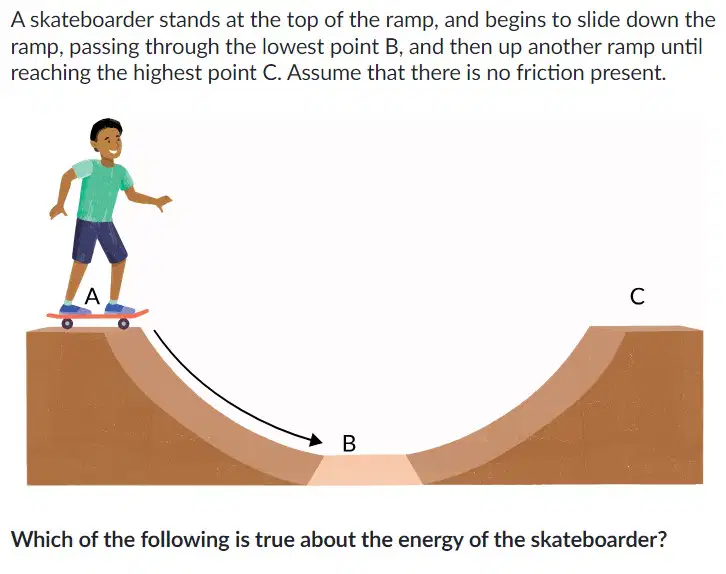
A skateboarder stands at the top of the ramp, and begins to slide down the ramp, passing through the lowest point B, and then up another ramp until reaching the highest point C. Assume that there is no friction present.
Which of the following is true about the energy of the skateboarder?
His gravitational potential energy was used up going down the first ramp, and he had no mechanical energy at point B.
His mechanical energy is the same at point C as it was at point A.
He had no mechanical energy at point B and gained gravitational potential energy riding up to point C.
His kinetic energy has been used going up the ramp, and he has no mechanical energy at point C.
A glass of cold water is left on a kitchen countertop on a hot day. Over time, the temperature of the water in the glass approaches room temperature.
What is happening to the average speed of the water molecules during this process?
It decreases.
It increases.
It stays the same.
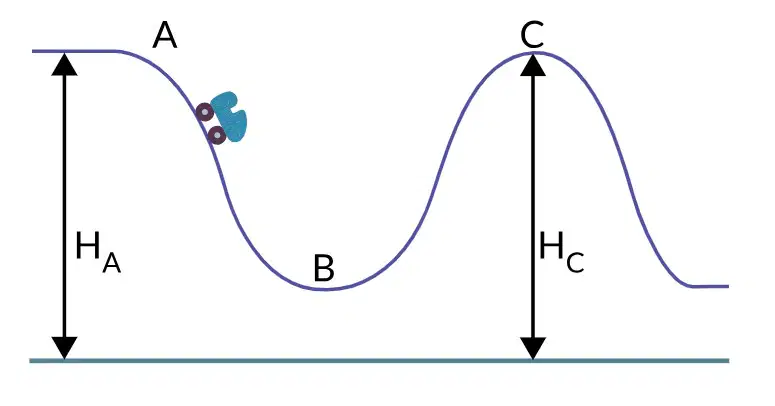
A roller coaster car goes down from point A to point B. The car continues to roll along the track and rolls up another hill to reach point C, which is the same height as point A. Assume friction is negligible.
How does the mechanical energy of the car at point B compare to that at point C?
It is the same because energy is conserved during the motion.
It is lower because energy is lost as the roller coaster car moves.
It is greater because energy is gained as the roller coaster car goes up.

