
 Worksheets
Mitosis, Meiosis & Crossing over Test Review
Total questions: 46
Worksheet time: 1hrs 17mins
A patient who has been diagnosed with cancer has been given a blood test in order for their
doctor to investigate their genetic code. What information from the test would help confirm the
patient's cancer diagnosis?
data indicating somatic cell production is being inhibited by the patient's cancer cells
data indicating there is a genetic mutation in a protein controlling the patient's cell’s cycle
data indicating gametes are becoming diploid cells due to the introduction of cancerous
cells
data indicating that cells are increasing their chromosome number due to the occurrence of cancer cells
Oncogenes are mutated forms of genes. Oncogenes can transform a cell into a cancerous
tumor cell. How does the presence of an oncogene lead to the formation of a cancerous
tumor?
Gamete cells become diploid cells.
Diploid cells become haploid cells.
Cell division becomes unregulated.
Somatic cell growth becomes controlled.

Figure 1 shows various types of enzymes and the reaction they catalyze.
If a mutation were to occur in a gene that codes for one of the enzymes, which one would lead to cancer?
Lipase
Trypsin
Phosphofructokinase
Cyclin-Dependant Kinase
Helicase is an enzyme responsible for unwinding the double helix of the DNA during DNA
replication. In which phase of the cell cycle is helicase performing this function?
S
M
G1
G2

The chart below shows the count of cells for each phase of the cell cycle in a leaf.
Based on the data table, which of the following would be a valid conclusion about the amount of time that a cell spends in a phase
during the cell cycle?
The cell spends the most amount of time in the mitotic phase because the cell needs to take its time when dividing the
nucleus.
The cell spends the least amount of time in interphase because the cell completes the long process of replicating its DNA
prior to interphase.
The cell spends the most amount of time in interphase because the cell only goes through mitosis during periods of growth
or repair for the organism.
The cell spends the least amount of time in the mitotic phase because the cell divides the nucleus during interphase leaving
only growth to occur in mitosis.

Below is an image of a cell performing cellular division.
Which phase has not occurred?
Metaphase
Anaphase
Telophase
Cytokinesis
Which of the following images correctly identifies the results of meiosis, including crossing over
and independent assortment?


The diagram shows the results of meiosis. The parent cell has one pair of chromosomes. The
locations of three genes - A, B, D, are shown on each chromosome.
Why are the chromosomes in two of the sex cells different from the chromosomes in the parent
cell?
A mutation occurred during replication.
Crossing over occurred in the chromosome.
Some of the genes were damaged during replication.
Chromosomes from another species were introduced.
A Zea mays seed has 20 chromosomes in their genome. Which statement would describe a
gametic cell from Zea mays produced at the end of meiosis?
The new daughter cells will each have 10 chromosomes, each cell will be genetically
different.
At the end of meiosis, there will be four unique daughter cells, each containing 5
chromosomes.
The resulting cells will have 40 chromosome pairs in each new daughter cell in order to
maintain the correct chromosome number.
Because DNA replication does not change chromosome number, meiosis will result in
identical daughter cells that each have 20 chromosomes.

Figure 1 above, shows reproduction of a human cell.
Which of the following accurately labels each step in this process?


Four students were asked to describe how three types of cells are formed: a pollen cell, a leaf cell, and a human egg cell. Their
responses are indicated in each row above.
Student A
Student B
Student C
Student D
Many plants reproduce asexually through vegetative propagation. In vegetative propagation,
plant tissues and organs are regenerated from another part of the plant and a new organism
can be produced. Which of the following statements describes a consequence of this type of
reproduction?
It will decrease the genetic diversity of this population.
It will result in more genetic variation within the population.
It will utilize a process, like meiosis, to produce identical offspring.
It will result in haploid daughter cells for the plant that can be used to create other plants.
Cell division occurs differently in prokaryotes and eukaryotes. Eukaryotes undergo mitosis to create new cells and prokaryotes
undergo a process called binary fission to create new cells. Why would cell division have to be different in prokaryotes and
eukaryotes?
Eukaryotes do not have a cell wall that needs to be divided.
Prokaryotes do not have a nucleus that needs to be divided.
Eukaryotes have circular DNA that has to be unwound before cell division.
Prokaryotes have extra organelles that need to be replicated before cell division.

There are many different types of cells. The image shows two different cell types.
Which of the following correctly describes these cells?
Both of the cells have a cell wall.
Both of these cells are eukaryotic cells.
Cell A is a plant cell while cell B is an animal cell.
Cell A is a prokaryotic cell while cell B is a eukaryotic cell.

The image shows cell in the final stage of cell division.Which of the following describes the type of cell being observed in the image?
This is an animal cell because it has DNA.
This is a plant cell because it has a plasma membrane.
This is a plant cell because it does not have chloroplasts.
This is an animal cell because it does not have a cell wall.

What do the blue and yellow arrows represent
The blue arrow is prophase and the yellow is interphase
The blue arrow is mitosis and the yellow arrow is meiosis
The blue arrow is interphase and the yellow is mitosis
The blue arrow is meiosis and the yellow is prophase

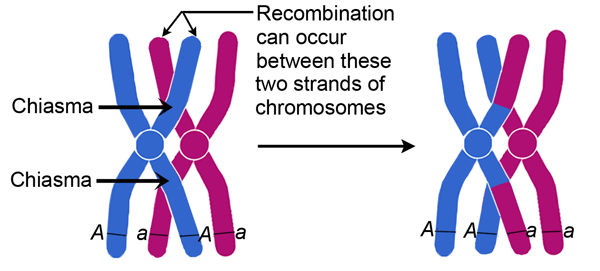
Crossing over occurs during prophase I of meiosis. Which statement about crossing over is true?
RNA translation occurs in the smooth endoplasmic reticulum
Crossing over takes place in backterial cells
Crossing over produces genetically identical daughter cells
Crossing over provides genetic diversity in eukaryotic cells
If a person has leukemia, they are given a medicine that inhibits (stops) DNA synthesis. Which phase of the cell cycle will be most affected by this medicine?
G1
S
G2
M phase

What does the image demonstrate
Punnet squares
Crossing over
Metaphase
Dna replication
In mitosis, one parent cell -
Forms two identical daughter cells
Forms four identical daughter cells
Forms two genetically diverse daughter cells
Forms four genetically diverse daughter cells
What is the primary cause of genetic variation during meiosis?
chromosomes lining up
"crossing over" of chromosomes
separation of chromosomes
chromosomes pulling apart
Involves crossing over
Mitosis
Meiosis
Both
Chromosomes condense
Mitosis
Meiosis
Both
Produces four cells
Mitosis
Meiosis
Both
produces identical daughter cells
Mitosis
Meiosis
Both
forms gametes
Mitosis
Meiosis
Both
for growth and repair
Mitosis
Meiosis
Both
produces haploid cells
Mitosis
Meiosis
Both
produces two cells
Mitosis
Meiosis
Both
produces non-identical cells
Mitosis
Meiosis
Both
begins with diploid parent cell
Mitosis
Meiosis
Both

In one phase of mitosis the chromosomes are attached to spindle fibers and line up in the center of the cell – what phase is this?
Anaphase
Telophase
Prophase
Metaphase
What happens to the chromosomes during anaphase?
they line up
they are pulled apart
they are at either end of the cell
they duplicate


When the cells completely split it is call what?
Telophase
Cytokinesis
Anaphase

