
NEW
Font size
 Worksheets
Radiography - Chapter 6 Labeling - Lower Limb 11
Total questions: 16
Worksheet time: 8mins
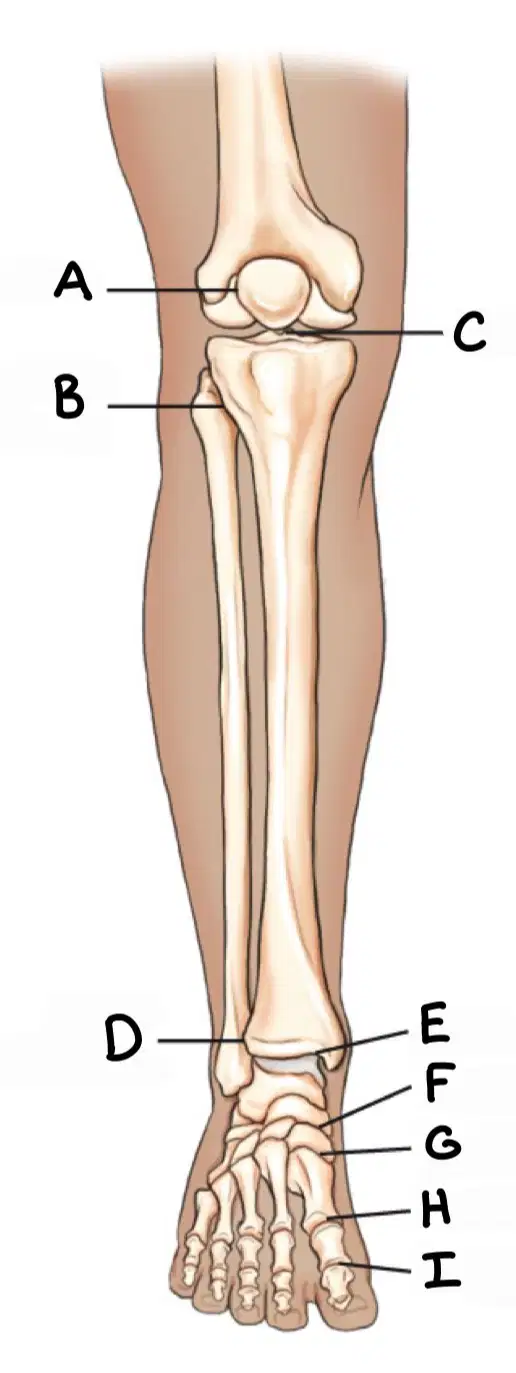
What is labeled A?
Patellofemoral
Proximal tibiofibular
knee
Distal tibiofibular
Ankle
What is labeled B?
Patellofemoral
Proximal tibiofibular
knee
Distal tibiofibular
Ankle
What is labeled C?
Patellofemoral
Proximal tibiofibular
knee
Distal tibiofibular
Ankle
What is labeled D?
Patellofemoral
Proximal tibiofibular
knee
Distal tibiofibular
Ankle
What is labeled E?
Patellofemoral
Proximal tibiofibular
knee
Distal tibiofibular
Ankle
What is labeled F?
Intertarsal
Tarsometatarsal
Metatarsophalangeal
Interphalangeal
Ankle
What is labeled G?
Intertarsal
Tarsometatarsal
Metatarsophalangeal
Interphalangeal
Ankle
What is labeled H?
Intertarsal
Tarsometatarsal
Metatarsophalangeal
Interphalangeal
Ankle
What is labeled I?
Intertarsal
Tarsometatarsal
Metatarsophalangeal
Interphalangeal
Ankle
How many bones are found in the foot?
24
26
27
28
Which of the following bones of the foot is fractured most often?
Base of the fifth metatarsal
Navicular
Distal fifth phalanx
Third cuneiform
What is the strongest and largest of the tarsal bones?
Navicular
Cuboid
Calcaneus
Talus
The sustentaculum tali is found on the:
Calcaneus - medial aspect
Talus
Base of the metatarsal
Cuboid
The articular facets making up the tibial plateau slopes posteriorly at:
5 - 8 degrees
10 - 20 degrees
25 - 30 degrees
35 - 45 degrees
Another term for the patellar surface of the distal femur is:
Capitellum
Intercondylar fossa
Meniscus
Intercondylar sulcus
The knee joint is classified as:
Sellar
Ginglymus
Bicondylar
Plane

