
 Worksheets
Unit 3 Energy Flow Honors Test #1
Total questions: 20
Worksheet time: 12mins
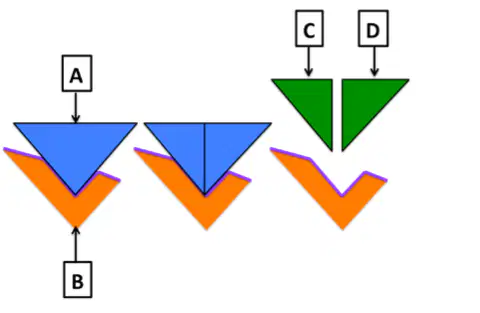
In the enzyme substrate complex, what is happening during step 2?
The catalyzed reaction is releasing a product.
The enzyme is breaking bonds in the substrate.
The enzyme leaves the bonds between the substrates.
The substrates are beginning to bind to the enzyme.
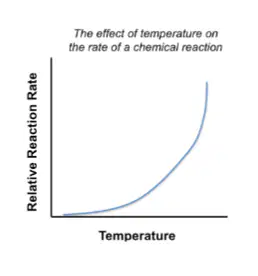
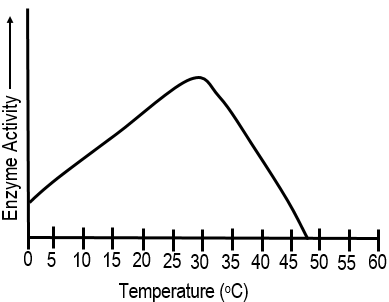
In the graph to the right, an increase in temperature results in
a decrease in the required activation energy.
an increase in reaction rate.
a decrease in the rate of reaction.
an increase in both the reaction rate and activation energy.
If a reaction in one direction releases more energy than it absorbs, that same reaction in the opposite direction would
absorb more energy than it releases.
also release more energy.
destroy energy.
create energy.
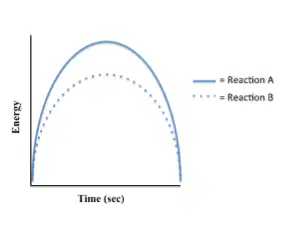
Which statement best describes the graph shown at right?
More energy is released by reaction A.
More energy is needed to start reaction B.
Reaction B is the catalyzed version of Reaction A.
Reaction B occurs at a slower rate.
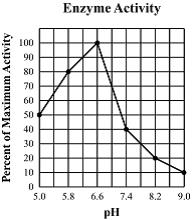
Pepsin, a common enzyme found in the stomach, is most active at pH values between 0.5 and 2.5. It works slowly between pH values of 2.6 and 3.4. Beyond a pH of about 3.5, it becomes completely inactive. Why does this happen?
The enzyme inactivates because it melts into a liquid when it is not at the right pH.
The shape of the enzyme is denatured, changing its active site needed for binding to specific substrates.
The enzyme slows down, because changing the pH changes the temperature as well, and affects the reaction.
The enzyme is able to bind more substrate with a higher pH.

According to the graphs to the right, which graph shows a reaction during which more energy is released than absorbed?
Graph A
Graph B
Both graphs
Neither graph
On the diagram on your answer sheet, which of the following best shows the effect of adding a catalyst to the reaction, and what does it do?
It lowers the activation energy, making the reaction proceed faster.
It increases the activation energy, slowing down the reaction.
It changes the products of the reaction.
It stops the reaction from occurring.
An energy diagram for an exothermic reaction should show which of the following features?
Reactant energy higher than product energy, activation energy labeled
Product energy higher than reactant energy, no activation energy
Reactant energy equal to product energy, activation energy not shown
Activation energy lower than both reactant and product energies
Which of the following lists three factors that affect the rate of chemical reactions and describes how each one specifically affects the rate?
Temperature, concentration, and surface area; increasing any of these generally increases the reaction rate.
Color, odor, and taste; these properties do not affect the reaction rate.
Volume, mass, and density; these are unrelated to reaction rate changes.
Shape, texture, and weight; these do not influence the rate of chemical reactions.
Which of the following reactions directly provides chemical energy for most cell functions?
ADP → ATP + P
ADP + P → ATP
ATP + P → ADP
ATP → ADP + P
Energy is released from an ATP molecule when it
loses a phosphate group.
converts a phosphate group to ADP.
stores an extra phosphate group.
produces a sugar molecule.
What macromolecule will your body use first as a means of obtaining energy?
Carbohydrates
Proteins
Lipids
Nucleic acids
Which phrase best describes the function of ATP molecule?
absorbs energy
increases energy
stores energy
creates energy
Where does your body get the energy for reattaching a third phosphate to ADP, creating ATP?
from your cells
from carbs like glucose
from nucleic acids
from breaking ATP
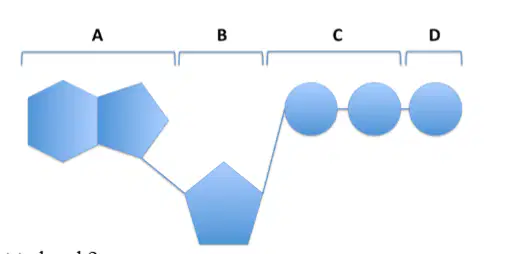
All of the following parts make up an ADP molecule EXCEPT
structure A
structure B
structure C
structure D
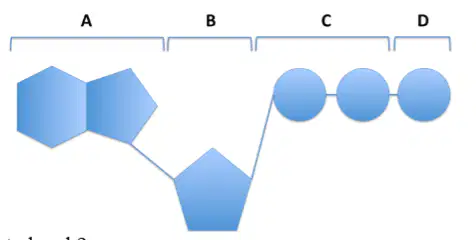
Which structures pictured would make up an ATP molecule?
A and B only
A, B and C
C and D only
A, B, C, and D
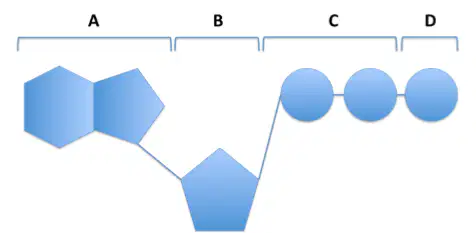
Between which two letters is the bond the most unstable and easiest to break?
A and B
B and C
C and D
C and D
Complete the statements below by choosing the correct biomolecule.
Biomolecules are substances that are produced by cells that have a variety of functions in our bodies.
(a) , such as glucose, provide us with quick energy source. (b) , which include fats, store energy that can be broken down to yield larger amounts of energy. (c) , which are composed of amino acids, help with muscle growth and repair. (d) , which include DNA and RNA, play a major role in the storage and expression of genetic information.

