
 Worksheets
Maha test -1
Total questions: 47
Worksheet time: 1hrs 25mins
Ambident nucleophile is
CN
H2O
Cl
NH2
Among dihaloarenes, the melting point is highest for
o-Isomer
p-Isomer
m-Isomer
Same for all
The reactivity of halides in SN2 reaction is
3o>2o>1o
2o>1o>3o
1o>3o>2o
1o>2o>3o
SN2 reaction involves the formation of __________ intermediate
Carbocation
Carboanion
Transition state
None of these

Which of the carbon atoms present in the molecule given below are asymmetric?
a, b, c, d
b, c
a, d
a, b, c
Alkaline hydrolysis of (CH3)3CBr involves two steps as follows.
(CH3)3CBr → (CH3)3C+ + Br- slow
(CH3)3C+ + OH- → (CH3)3COH fast
Which of the following shows the rate equation for the reaction scheme?
Rate = k[OH-]
Rate = k[(CH3)3CBr]
Rate = k[(CH3)3CBr]2
Rate = k[(CH3)3CBr][OH-]
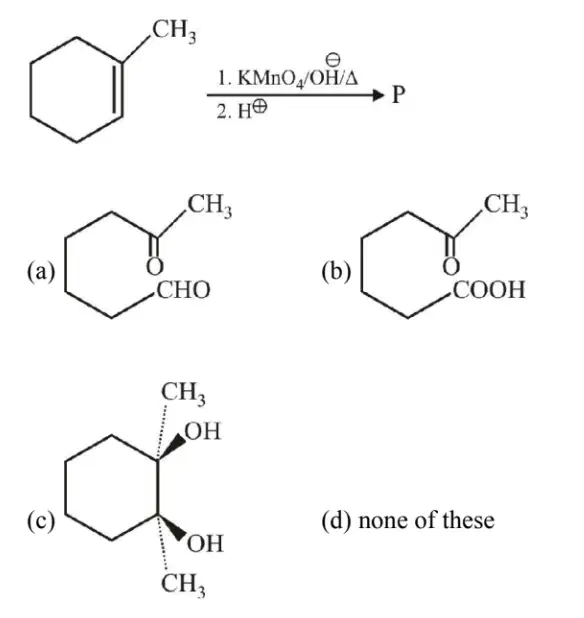
A
B
C
D
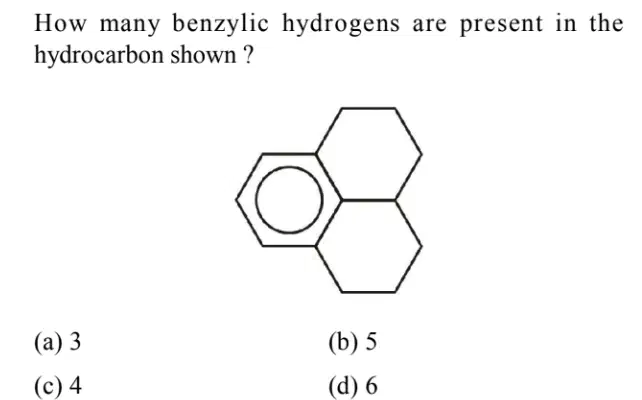
A
B
C
D
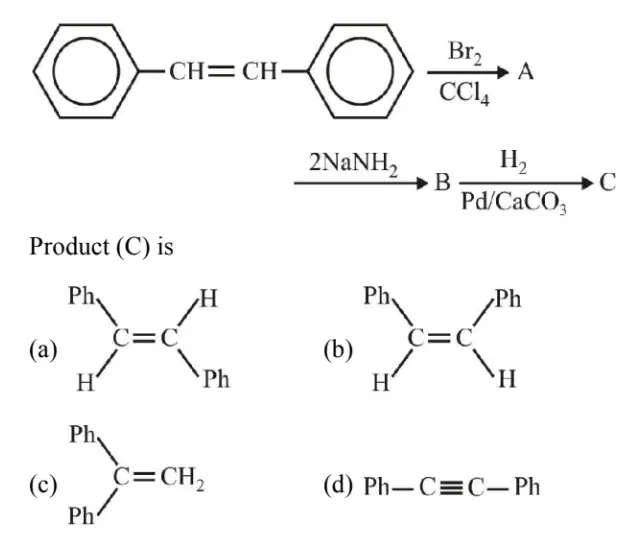
A
B
C
D
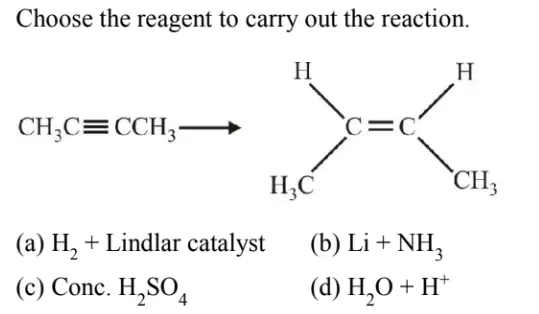
A
B
C
D
A
B
C
D
A
B
C
D
A
B
C
D
How does the presence of catalyst increase reaction rate?
It lowers down activation energy
It increases collision of particles
It increases the energy of the reactant
It increases activation energy
change in time, Δ tchange in concentration, Δ[conc] = ?
Rate of reaction
constant, k
rate law
reaction order
The rate constant of a reaction is 5.8 × 10 M-1s-1. The order of the reaction is...
0th order
1st order
2nd order
3rd order

The plot shows the decomposition of H2O2.
What is the order of the reaction?
0th order
1st order
2nd order
3rd order

The iodide ion reacts with hypochlorite ion in the following way:
OCl- + I- ⟶ OI- + Cl-.
This rapid reaction gives the rate data shown. What is the rate law?
rate = [OCl-]2[I-]
rate = [OCl-][I-]2
rate = [OCl-][I-]
rate = [OCl-]
The quantity of charge required to obtain one mole of Aluminium from one mole of Al2O3 is
1F
6F
3F
2F
The cell constant of a conductivity cell
changes with change of electrolyte.
changes with change of concentration of electrolyte.
changes with temperature of electrolyte.
remains constant for a cell.
The positive value of the standard electrode potential of Cu2+/Cu indicates that
this redox couple is a stronger reducing agent than the H+/H2 couple.
this redox couple is a stronger oxidizing agent than the H+/H2 couple
Cu can displace H+from dilute acid.
H+can displace Cu 2+from dilute acid.
The emf of the cell:
Ni / Ni2+ (1.0 M) // Au3+ (1.0 M) / Au (E° = -0.25 V for Ni2+/Ni; E° = 1.5 V for Au3+/Au) is
1.25 V
-1.25 V
1.75 V
2.0 V
1.An example of ambidentate ligand
CN
en
ONO
BOTH A AND C
2.[Co(NH3)(H2O)5]Cl3 is an example of ............. isomerism.
linkage
coordination
ionisation
hydrate
3.coodination number of [Cr(en)3]Cl3 is
3
4
6
a
3 and 6
4.IUPAC name of [Pt(H2O)Cl(NH3)2]Cl
(a)

Which type of isomerism does it have?
Geometrical isomerism
Functional Group isomerism
Optical isomerism
Structural isomerism
Which of the following complexes can exhibit optical isomerism? (en = H2N–CH2–CH2–NH2 and is bidentate)
cis–Co(NH3)4Cl2
trans–Co(en)2Br2
cis–Co(en)2Cl2
Co(NH3)3Cl3

A
B
C
D
Which one among the following is a strongest base
methyl amine
Ammonia
Phenyl amine
Which is the correct arrangement of compounds based on decreasing order of Kb value
methyl amine > ammonia > phenyl amine
Phenyl amine > ammonia > methyl amine
Ammonia > phenyl amine > methyl amine
Reduction with iron scrap and HCl is preferred because
Iron scrap is cheap
FeCl2 formed gets hydrolysed to release hydrochloric acid
FeCl3 is formed during the process
NOne of the above
Which reagent can be used to convert Nitrobenzene to Aniline
KMNO4
Ammonia
Hydrogen on Palladium
None of the above
The breaking of the C–X bond by ammonia molecule is known as
Halogenation
Ammonolysis
Reduction
Ammonification
What is the equilibrium-constant expression for
CO2(g) + H2(g) ⇌ CO(g) + H2O(l)
Removing O2(g) will
heat + N2 + O2 ↔ 2NO
If the heat is added to the chemical system, the equilibrium will shift _______.
Which of the following are Lewis acids?
PH3 and BCl3
AlCl3 and SiCl4
PH3 and SiCl4
BCl3 and AlCl3
What is the conjugate base of OH–?
O2
H2O
O–
O2-
Species acting as both Bronsted acid and base is
(HSO4) –
Na2CO3
NH3
OH-
The molar solubility of Cd(OH)2 is 1.84 × 10⁻⁵ M in water. The expected solubility of Cd(OH)2 in a buffer solution of pH = 12 is
1.84 × 10⁻⁹ M
2.49 × 10⁻¹⁰ M
(2.49/ 1.84)× 10–9 M
6.23 × 10⁻¹¹ M
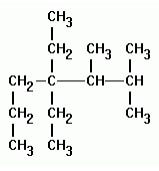

Arrange the following in increasing order of stability based on resonance:
i<ii<iii<iv
i<iii<ii<iv
i<iv<ii<iii
i<iii<iv<ii
Among the following, the least stable resonance structure
is


Arrange in order of increasing acidic strength
X>Z>Y
Z<X>Y
X>Y>Z
Z>X>Y

