
 Worksheets
Free Body Diagrams & Resultant Forces
Total questions: 20
Worksheet time: 13mins
What is the net force when two forces of 5N and 3N act in the same direction?
8N
10N
2N
0N
If a force of 10N acts to the right and a force of 7N acts to the left, what is the net force?
3N
17N
2N
4N
How do you calculate the direction of the resultant force when forces act in opposite directions?
Add the smaller force to the larger force and use the direction of the smaller force as the direction of the resultant force.
Divide the larger force by the smaller force and use the direction of the larger force as the direction of the resultant force.
Ignore the direction of the forces and only consider the magnitude of the forces to determine the direction of the resultant force.
Subtract the smaller force from the larger force and use the direction of the larger force as the direction of the resultant force.
If a force of 8N acts to the right and a force of 4N acts to the left, what is the direction of the resultant force?
Down
Up
Right
Left
When two forces act in the same direction, how do you find the resultant force?
Add the magnitudes of the two forces together
Divide the magnitudes of the two forces
Subtract the magnitudes of the two forces
Multiply the magnitudes of the two forces together
If a force of 12N acts to the right and a force of 9N acts to the left, what is the net force?
3N
21N
6N
15N
What is the net force when a force of 15N acts to the right and a force of 10N acts to the left?
5N
25N
20N
2N
How do you determine the direction of the resultant force when forces act in the same direction?
The resultant force is in a circular direction.
The resultant force is in a random direction.
The resultant force is in the opposite direction of the individual forces.
The resultant force is in the same direction as the individual forces.
If a force of 6N acts to the right and a force of 2N acts to the left, what is the direction of the resultant force?
Right
Left
Up
Down
When two forces act in opposite directions, how do you find the resultant force?
Add the two forces together
Ignore the forces and find the average
Subtract the smaller force from the larger force.
Divide the larger force by the smaller force
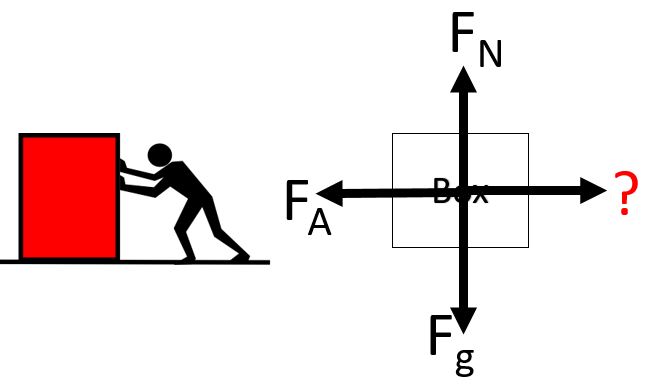
Name the missing force...
Frictional force
Weight force
Thrust
Buoyant force
Whenever an object is in motion, there is always a force opposing the motion:
inertia
momentum
friction
applied force
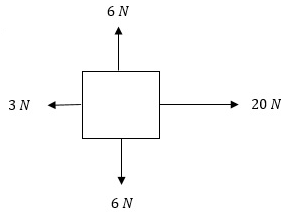
What is the net force of this diagram?
17 N, right
17 N, left
23 N, right
12 N, up

How do you calculate the net force when forces are going in the opposite direction?
Add the forces
Divide the forces
Find a fraction of the forces
Subtract the forces
What do the arrows represent in a free body diagram? (Select two)
Object
Direction
Size
Mass
A rightward force is applied to a dresser to accelerate it to the right across the bedroom floor.


Which of the following free-body diagrams would represent the net force of this free body diagram?


Which of the following represent the net force?


Which of the diagrams shows a force being pulled to the left with a force of 10 N and being pull right with 20 N?


What is the overall Net Force of the previous question? 30 N being pushed to the right and 10 N being pulled to the right.
20 N
0 N
40 N
300 N

