Wayground logo

Free Printable Worksheets

Font size

S
M
L
XL
Worksheets

HM2 Module 1 Review

Total questions: 72

Worksheet time: 4hrs 36mins

Name
Class
Date
1.
A transformation that “turns” a figure about a fixed point at a given angle and a given direction.
a)
rotation
b)
translation
c)
reflection
d)
dilation
2.
A type of transformation where a figure is “flipped” over a line of symmetry. A reflection produces a mirror image of a figure.
a)
rotation
b)
translation
c)
dilation
d)
reflection
3.
Determine how to translate triangle ABC to triangle A'B'C'. 
a)
right 2, down 5
b)
right 2, down 9
c)
left 2, up 9
d)
left 2, down 9
4.
How is trapezoid ABCD translated to trapezoid A'B'C'D'?
a)
5 units down and 5 units to the right
b)
5 units down and 1 to the right
c)
8 units down and 5 units to the right
d)
5 units down and 4 units to the right
5.
How many degrees was the figure rotated?
a)
90 degrees counterclockwise 
b)
180 degrees
c)
270 counterclockwise 
6.
Identify the transformation from ABCD to A'B'C'D'.
a)
Translation
b)
Reflection across the x-axis
c)
Reflection across the y-axis
d)
90o counter clockwise rotation
7.
Identify the transformation from ABC to A'B'C'.
a)
90o clockwise rotation
b)
90o counter clockwise rotation
c)
Reflection across the y-axis
d)
Reflection across the x-axis
8.
If the quadrilateral is translated 4 units to the left and 5 units down what is the coordinates for Point A'?
a)
(4,0)
b)
(0,4)
c)
(-1,5)
d)
(5,-1)
9.
Point P is graphed at (4,5) shown on the grid below.  Point P is 90⁰ counterclockwise to Point P'.  What are the coordinates of P'?
a)
(-5, 4)
b)
(-4, 5)
c)
(5, -4)
d)
(-4, -5)
10.
Determine where X' would be if you translated X 3 units to the left and 9 units down.
a)
(-4, 4)
b)
(-10, 2)
c)
(-4, -5)
d)
(-1, 5)
11.
Determine how to translate triangle A'B'C' to triangle ABC.
a)
right two, down five
b)
right two, down 9
c)
left two, down 9
d)
left two, down 5
12.
If the dotted figure is the image, the original figure was reflected over the ...
a)
x-axis
b)
y-axis
13.
A slide is also called a _________.
a)
Translation
b)
Reflection
c)
Rotation
d)
Transformation
14.
True or false: A reflection makes a congruent figure. 
a)
true
b)
false
15.
Congruent means...
a)
The same angles.
b)
The same size and same shape.
c)
Equal to.
d)
The same transformation.
16.
What symbol is used to show that two things are congruent?
a)
≠
b)
≅
c)
≡
d)
=
17.
The original figure prior to a transformation.
a)
Pre-image
b)
Image
18.
Identify the smallest angle of rotation that maps the image to itself.
a)
72°
b)
180°
c)
144°
d)
45°
19.
How many lines of symmetry does this shape have?
a)
2
b)
4
c)
6
d)
8
20.
How many lines of symmetry does this shape have?
a)
1
b)
2
c)
3
d)
4
21.
Identify the angles of rotation that maps the image to itself.
a)
multiples of 120°
b)
multiples of 180°
c)
multiples of 90°
d)
multiples of 60°
22.
What are the angles of rotation for a square?
a)
multiples of 30
b)
multiples of 45
c)
multiples of 90
d)
multiples of 180
23.
What are the angles of rotation for an octagon?
a)
multiples of 45
b)
multiples of 51.4
c)
multiples of 60
d)
multiples of 72
24.
What are the angles of rotation for a rectangle?
a)
multiples of 45
b)
multiples of 90
c)
multiples of 180
d)
360
25.
What is/are the angle of rotation for a parallelogram?
a)
multiples of 90
b)
multiples of 180
c)
multiples of 60
d)
360
26.
What is one of the angles of rotation needed to rotate this octagon onto itself?
a)
60
b)
135
c)
120
d)
240
27.
What are the angles of rotation for a trapezoid?
a)
multiples of 90
b)
multiples of 180
c)
multiples of 270
d)
360
28.

Which number of degrees below describes an angle that can rotate this regular polygon back onto itself?

a)

216

b)

288

c)

72

d)

40

29.

Which number of degrees below describes an angle that can rotate this regular polygon back onto itself?

a)

45

b)

90

c)

80

d)

216

30.
Does this image have a line of symmetry?
a)
Yes
b)
No
31.
How many lines of symmetry does the butterfly have?
a)
1
b)
2
c)
3
d)
4
32.
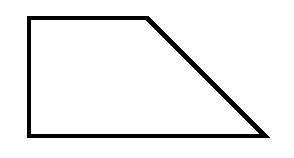
How many lines of symmetry does this trapezoid have?
a)
0
b)
1
c)
2
d)
3
33.
Write a rule for the translation.
a)
 (x -1, y  + 2)
b)
 (x -2, y  + 1)
c)
 (x +2, y  - 1)
d)
(x +1, y  -  2)
34.
Describe the transformation shown in the graph.
a)
Reflect over x-axis
b)
Reflect over y-axis
c)
Rotate 270 degrees CCW
d)
Rotate 90 degress CCW
35.
If you were to rotate ABCD 180°  about the origin, what would the coordinate of A' be?
a)
(-5, 5)
b)
(-3, -5)
c)
(-5, 3)
d)
(-3, 3)
36.

What are the coordinates of C(-6, 2) and B(-1, -1) if rotated 90 degrees counterclockwise?

a)

C' (-6, 2), B' (-1, -1)

b)

C' (6, 2), B' (1, -1)

c)

C' (2, -6), B' (-1, -1)

d)

C' (-2, -6), B' (1, -1)

37.

Figures that are same size, same shape and same angles are...

a)

Congruent

b)

Image

c)

Angles

d)

Vertices

38.

If the figure is rotated 270° clockwise about the origin, what are the coordinates of Q'?

a)

(-4, 1)

b)

(4, -1)

c)

(-1, -4)

d)

(-1, 4)

39.

Which number of degrees below describes an angle that can rotate this regular polygon back onto itself?

a)

280

b)

300

c)

315

d)

120

40.

Which number of degrees below describes an angle that can rotate this regular polygon back onto itself?

a)

280

b)

90

c)

45

d)

120

41.

Which number of degrees below describes an angle that can rotate this regular polygon back onto itself?

a)

40

b)

120

c)

72

d)

240

42.

Which number of degrees below describes an angle that can rotate this regular polygon back onto itself?

a)

60

b)

280

c)

288

d)

320

43.

Which number of degrees below describes an angle that can rotate this regular polygon back onto itself?

a)

60

b)

160

c)

144

d)

45

44.

Which number of degrees below describes an angle that can rotate this regular polygon back onto itself?

a)

216

b)

288

c)

72

d)

40

45.

Which number of degrees below describes an angle that can rotate this regular polygon back onto itself?

a)

315

b)

45

c)

320

d)

225

46.
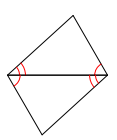
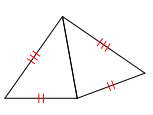
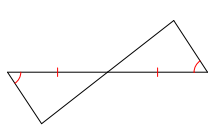
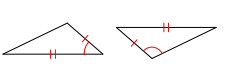
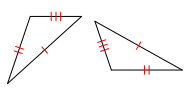
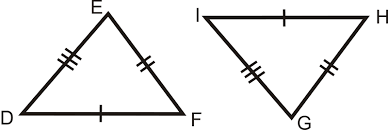
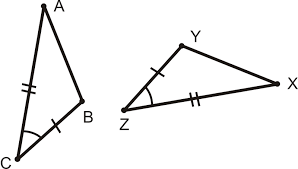
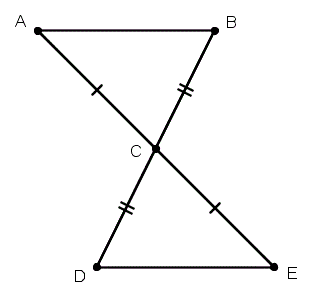
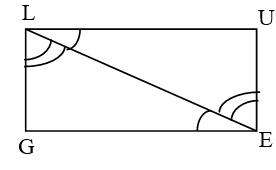
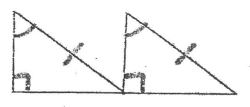
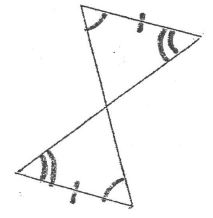
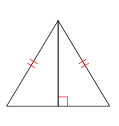
How are the triangles congruent?
a)
AAS
b)
SAS
c)
ASA
d)
SSS
47.
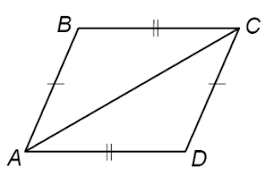
How are the triangles congruent?
a)
SAS
b)
SSS
c)
AAS
d)
HL
48.
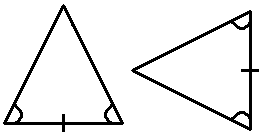
How are the triangles congruent?
a)
HL
b)
SAS
c)
ASA
d)
AAS
49.
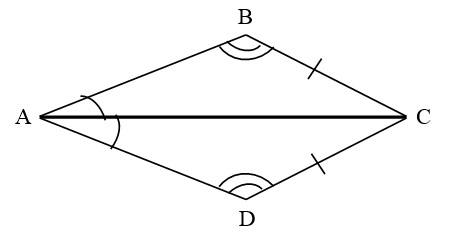
How are the triangles congruent?
a)
Not congruent
b)
AAS
c)
SAS
d)
ASA
50.
How are the triangles congruent?
a)
AAS
b)
SAS
c)
ASA
d)
Not congruent
51.
How are the triangles congruent?
a)
Not congruent
b)
SSS
c)
ASA
d)
SAS
52.
How are the triangles congruent?
a)
SAS
b)
SSS
c)
ASA
d)
HL
53.
How are the triangles congruent?
a)
ASA
b)
AAS
c)
SAS
d)
SSS
54.
How are the triangles congruent?
a)
ASA
b)
SAS
c)
AAS
d)
SSS
55.
How are the triangles congruent?
a)
SAS
b)
SSS
c)
HL
d)
ASA
56.
Which triangle congruence theorem can be used to prove the triangles are congruent?
a)
SAS
b)
SSS
c)
ASA
d)
HL
57.
Which triangle congruence theorem can be used to prove the triangles are congruent?
a)
SSS
b)
ASA
c)
AAS
d)
SAS
58.
Which triangle congruence theorem can be used to prove the triangles are congruent?
a)
AAS
b)
SSS
c)
Not enough information given
d)
ASA
59.
Which triangle congruence theorem can be used to prove the triangles are congruent?
a)
AAS
b)
SSS
c)
SAS
d)
SSA
60.
Which triangle congruence theorem can be used to prove the triangles are congruent?
a)
SAS
b)
Not enough information
c)
SSS
d)
AAS
61.

Which triangle congruence theorem can be used to prove the triangles are congruent?

a)

SSS

b)

SAS

c)

ASA

d)

NONE

62.

Which triangle congruence theorem can be used to prove the triangles are congruent?

a)

SSS

b)

SAS

c)

ASA

d)

NONE

63.
a)
Congruent by HL
b)
Congruent by SAS
c)
Congruent by SSS
d)
Not Necessarily Congruent
64.
a)
Congruent by ASA
b)
Congruent by SAS
c)
Congruent by SSS
d)
Not Necessarily Congruent
65.
Name the postulate, if possible, that makes the triangles congruent.
a)
SAS
b)
ASA
c)
AAS
d)
Not Possible
66.
Name the postulate, if possible, that makes the triangles congruent.
a)
SSS
b)
SAS
c)
ASA
d)
AAS
67.

Identify the correct triangle congruence theorem.

a)

ASA

b)

AAS

68.

Identify the correct triangle congruence theorem.

a)

ASA

b)

AAS

69.
How are the triangles congruent?
a)
HL
b)
SSS
c)
SAS
d)
AAS
70.
How are the triangles congruent?
a)
SAS
b)
SSS
c)
ASA
d)
HL
71.
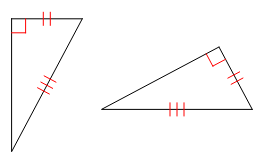
What are the five ways to prove triangles congruent?
a)
SSS, ASA, AAS, SAS, HL
b)
SSS, SSA, HL, AAS, SAS
c)
SAS, SSA, HL, AAS, SSS
d)
HL, SAS, SSA, SSS, ASA
72.
State if the two triangles are congruent.  If they are, state which theorem you would use.
a)
Yes, SAS
b)
Yes, SSS
c)
Yes, HL
d)
No