
 Worksheets
Geometry Vocabulary
Total questions: 72
Worksheet time: 43mins
What is the resulting figure after a transformation of a pre-image called?
Inductive reasoning
Image
Initial point
Inscribed angle
What is the region of an angle between its rays, often found in polygons?
Intersection
Interior angle
Inverse
Line of symmetry
What is the term for where two or more geometric figures meet?
Line
Leg
Intersection
Linear pair
What is the form of a conditional statement formed by negating the hypothesis and conclusion?
Inverse
Image
Inductive reasoning
Initial point
What is a triangle with two congruent sides and two congruent base angles called?
Kite
Isosceles
Lateral face
Line segment
What are the sides of a right triangle adjacent to the right angle called?
Line
Leg
Linear pair
Lateral face
What is a straight path that extends forever in two directions?
Line segment
Line
Linear pair
Lateral face
What is a portion of a line with two endpoints called?
Line segment
Line
Leg
Linear pair
What is a line of reflection that maps a figure onto itself?
Line segment
Line of symmetry
Linear pair
Lateral face
What are two angles that are both adjacent and supplementary called?
Line segment
Line of symmetry
Linear pair
Lateral face
What is the definition of a median in a triangle?
A segment from the vertex of a triangle to the midpoint of the opposite side
A point that divides a segment into two congruent segments
A segment connecting the midpoints of two sides of a triangle
A portion of a circle with a measure greater than 180°
What is a midpoint?
A point that divides a segment into two congruent segments
A segment from the vertex of a triangle to the midpoint of the opposite side
A portion of a circle with a measure less than 180°
A segment connecting the midpoints of two sides of a triangle
What is a midsegment in a triangle?
A segment connecting the midpoints of two sides of a triangle
A segment from the vertex of a triangle to the midpoint of the opposite side
A portion of a circle with a measure greater than 180°
A point that divides a segment into two congruent segments
What is a nonagon?
A nine-sided polygon
A seven-sided polygon
A six-sided polygon
A five-sided polygon
What is a hypothesis in a conditional statement?
The part of a conditional statement that follows 'if'
The longest side of a right triangle
A seven-sided polygon
Half a sphere
What does dilation refer to in geometry?
A transformation resulting in an enlargement or reduction of a figure based on a scale factor
A rotation of a figure around a point
A reflection of a figure over a line
A translation of a figure along a vector
What is the definition of distance in geometry?
The length of a segment connecting two points
The area between two points
The angle formed by two intersecting lines
The volume of space between two points
What is an equilateral triangle?
A triangle with three congruent sides
A triangle with two equal sides
A triangle with no equal sides
A triangle with one right angle
What is an exterior angle?
All the points in a region outside the angle
The angle inside a polygon
The angle formed by two intersecting lines
The angle between two parallel lines
What is an obtuse angle?
An angle whose measure is between 90° and 180°
An angle whose measure is exactly 90°
An angle whose measure is less than 90°
An angle whose measure is exactly 180°
What is an octagon?
An eight-sided polygon
A six-sided polygon
A five-sided polygon
A four-sided polygon
What are opposite rays?
Rays going in opposite directions that share a common endpoint
Rays that are parallel to each other
Rays that intersect at a right angle
Rays that form a straight line
What are parallel lines?
Two lines in the same plane that never intersect
Two lines that intersect at one point
Two lines that form a right angle
Two lines that are perpendicular
What is a pentagon?
A five-sided polygon
A six-sided polygon
A four-sided polygon
A three-sided polygon
What is the perimeter?
The one-dimensional distance around the outside of a figure
The area inside a figure
The volume of a three-dimensional figure
The diagonal of a figure
What is a perpendicular bisector?
A line that intersects a segment at its midpoint and forms a right angle.
Two lines that never intersect.
A line that divides an angle into two equal parts.
A line that runs parallel to another line.
What is a plane in geometry?
A flat surface that extends forever in all directions.
A three-dimensional object with volume.
A line that has no endpoints.
A point with no dimensions.
What is a decagon?
A 10-sided polygon.
A 5-sided polygon.
A 12-sided polygon.
A 6-sided polygon.
What is the part of a conditional statement that follows "then"?
Hypothesis
Conclusion
Converse
Contrapositive
What is a statement in the form "if, then" with a hypothesis and a conclusion?
Conjecture
Proof
Conditional statement
Construction
What term describes figures that have the same size, shape, and/or measure?
Congruent
Coordinate
Converse
Construction
What is an unproven statement based on previous data called?
Proof
Conjecture
Conclusion
Construction
What is the form of a conditional statement formed by negating and switching the hypothesis and conclusion?
Converse
Contrapositive
Conclusion
Conditional statement
What is a transformation that flips a figure across a line called?
Rotation
Translation
Reflection
Dilation
What is an angle whose measure is 90° called?
Acute angle
Obtuse angle
Right angle
Straight angle
What is a transformation in which a figure is turned about a fixed point called?
Translation
Reflection
Rotation
Dilation
What are points on the same line called?
Collinear
Coplanar
Concurrent
Congruent
What are two angles whose measures have a sum of 90° called?
Supplementary
Complementary
Adjacent
Vertical
What is the combination of two or more transformations to form a single transformation called?
Translation
Composition of transformations
Reflection
Rotation
What are two angles formed by two lines and a transversal on the inside of the two lines and on the same side of the transversal called?
Alternate interior angles
Corresponding angles
Same side interior angles
Vertical angles
What is a biconditional statement?
A conditional statement that includes the phrase 'if and only if.'
A statement that is always true.
A statement that includes the phrase 'as long as.'
A statement that is never true.
What is a scalene triangle?
A triangle with no congruent sides.
A triangle with two congruent sides.
A triangle with all sides congruent.
A triangle with one right angle.
What is the measure of a straight angle?
90°
45°
180°
360°
What are supplementary angles?
Two angles whose measures have a sum of 90°
Two angles whose measures have a sum of 180°
Two angles that are equal
Two angles that are adjacent
What is an acute angle?
An angle whose measure is exactly 90°
An angle whose measure is between 0° and 90°
An angle whose measure is more than 180°
An angle whose measure is exactly 180°
What are alternate exterior angles?
Two angles on the same side of a transversal
Two angles inside two lines and on opposite sides of the transversal
Two angles outside two lines and on opposite sides of the transversal
Two angles that are adjacent
What is the definition of an angle bisector?
A line that divides a segment into two equal parts
A ray that divides an angle into two congruent angles
A line that is perpendicular to a segment
A ray that extends infinitely in one direction
What is a proven statement about a mathematical concept known as?
Hypothesis
Postulate
Theorem
Conjecture
What is a change in a figure that produces a new figure called?
Rotation
Reflection
Transformation
Dilation
What is a transformation that moves every point the same distance in the same direction?
Rotation
Translation
Reflection
Dilation
What is a line that intersects two or more coplanar lines at different points called?
Parallel line
Perpendicular line
Transversal
Diagonal
What is a vertex?
A quantity with both direction and magnitude
The common endpoint of two rays
Two angles opposite each other
The three-dimensional measure of space inside a solid
What are vertical angles?
Two angles opposite each other formed by two intersecting lines
A quantity with both direction and magnitude
The common endpoint of two rays
The three-dimensional measure of space inside a solid
The figure before a transformation has occurred is called what?
Which transformation does not preserve the original size and shape of the object?
Translation
Rotation
Reflection
Dilation
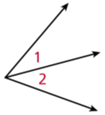
What type of angles are these?
Adjacent Angles
Linear Pair
Complementary Angles
Supplementary Angles
Vertical Angles


What is the measure of BC?
12
6
not enough information
10

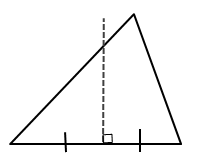
The figure is an example of a(n) ...
angle bisector
perpendicular bisector
median
altitude

a corner where two sides meet
vertex
variable
area
base
Bonnie described the light from the sun as a line that starts at the sun and continues on forever. Which geometric term best describes Bonnie's description of the sun’s light?
Line segment
Ray
Point
What is the term for a figure the continues endlessly in two directions?
Line
Line Segment
Ray
Point
Which of these figures BEST models a ray?


Extents infinitely in 4 directions
Point
Line
Plane
Space
A figure with 2 endpoints.
Plane
Line Segment
Line
Ray



