
Font size
 Worksheets
Polar Graphs Mastery Quiz
Total questions: 40
Worksheet time: 2hrs 29mins
What is the name of the polar graph represented by the equation r=1+sin(θ) ?
Limaçon
Circle
Lemniscate
Rose
Which of the following equations represents a circle in polar coordinates?
r=2cos(θ)
r=1−sin(θ)
r=2
r=2sin(2θ)
How would the polar coordinates (3,2π) be converted to rectangular coordinates?
(0,3)
(3,0)
(−3,0)
(0,−3)
What is the graph of the polar equation r=2sin(2θ) known as?
Circle
Limaçon
Lemniscate
Rose
If a polar equation is given by r=4cos(θ) , what type of graph does it produce?
Circle
Ellipse
Limaçon
Rose
Convert the rectangular coordinates (3,1) to polar coordinates.
(2,6π)
(2,3π)
(2,65π)
$(2, \frac{\pi}{4})"
What is the name of the polar graph represented by the equation r=cos(2θ) ?
Circle
Limaçon
Lemniscate
Rose
How would the polar coordinates (4,π) be converted to rectangular coordinates?
(4,0)
(−4,0)
(0,4)
(0,−4)
What is the graph of the polar equation r=3cos(θ) known as?
Circle
Limaçon
Lemniscate
Rose
Convert the rectangular coordinates (2,2) to polar coordinates.
(22,4π)
(22,2π)
(22,43π)
(22,π)
How would the polar coordinates (5,32π) be converted to rectangular coordinates?
(−2.5,4.33)
(2.5,−4.33)
(−2.5,−4.33)
(2.5,4.33)
Convert the rectangular coordinates (1,2) to polar coordinates.
(5,arctan(2))
(2,arctan(0.5))
(5,arctan(0.5))
(2,arctan(2))
How would the polar coordinates (2,4π) be converted to rectangular coordinates?
(2,2)
(−2,2)
(2,−2)
(−2,−2)
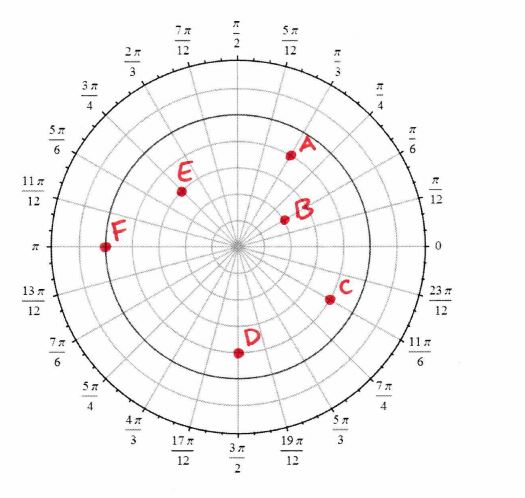

How do you write an ordered pair in polar coordinates?
(X, Y)
(θ, r)
(r,θ)
(Y_Y)
Find the rectangular coordinates of each polar point. (4, 3π/2)
(4,4)
(4,0)
(0,-4)
(0,1)


Which point describes the location of the following graph.
(5,300°)
(−5,330°)
(−5,300°)
Check ALL of the coordinate sets that give the same resulting point as (7,3π) .
(−7,34π)
(−7,−32π)
(−7,−3π)
(7,−35π)
Change the following coordinates from rectangular to polar. (1, −3)
(2,32π)
(−2,3−π)
(2,35π)
(2, 611π)
r=2sinΘ+2cosΘ
r=sinΘ
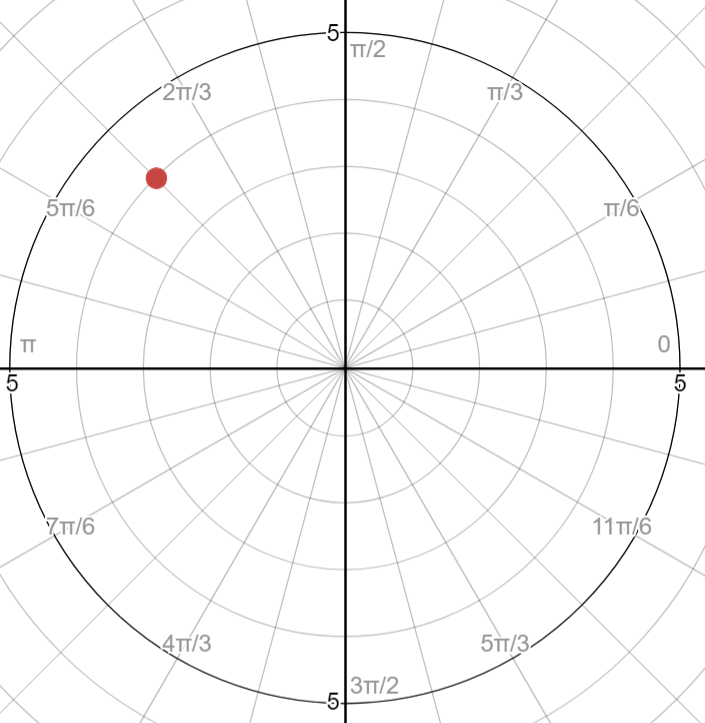
Which of the following are the coordinates of the point.
(4, −45π)
(−4, 43π)
(−4, 4π)
(4, 4π)
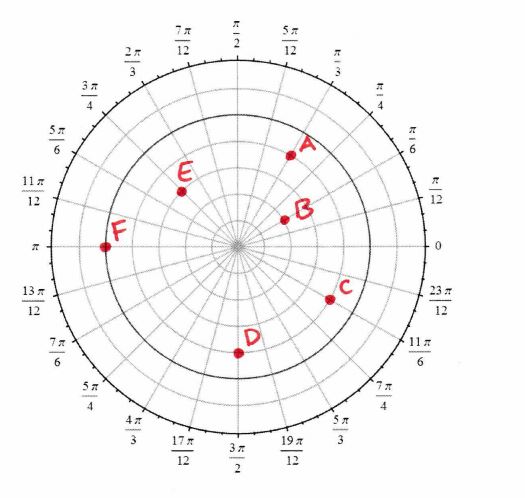
Convert from polar to rectangular:
(5, 135o)
(-5√2/2, 5√2/2)
(5√2/2, 5√2/2)
(5√2/2, -5√2/2)
(-5√2/2, -5√2/2)
What is the radius to the following rectangular point:
(5, 2)
5
2
√29
√27
What are the polar coordinates for the point (6, 6)?
(√24, 90°)
(√72, 45°)
(10, 60°)
(8, 30°)
Find the polar coordinates for the point (4, -3).
(3, 45°)
(4, -53.13°)
(6, 120°)
(5, -36.87°)
If the rectangular coordinates are (9, -12), what are the polar coordinates?
(15, 126.87°)
(9, -12)
(15, 53.13°)
(21, 45°)
If the polar equation is r =5 , what is the rectangular equaiton?
x +y=5
r=5cosθ
x2+y2=25
tanθ=5
Do the rectangular points (3, -2) and (3, 2) have the same polar coordinates? Choose the best answer.
yes, because you square the x and y values.
no, the r values will be the same but angle theta will be different because the points are in different quadrants.
no, both r and angle theta are different.
How do we find values for cosθ and sinθ ?
We look at our trusty unit circle!
We take a wild guess.
Covert the rectangular equation to polar form y=x2
r = cot θ csc θ
r = tan θ csc θ
r = tan θ sec θ
r = 0
Covert the rectangular equation to polar form x2+y2=9
r² = 81
r = 3
r = 4.5
r sin θ = 9
Convert the polar coordinates to rectangular form (2, −4π)
(1, 1)
(1, -1)
(-1, 0)
(-1, -1)


