
 Worksheets
Environmental Interactions remediation
Total questions: 55
Worksheet time: 59mins
Natural disturbances, such as fires or hurricanes, can result in
A.parasitism.
B.competition.
C.commensalism.
D.succession.
The end result of ecological succession is usually a(n)
A.land biome.
B.aquatic biome.
C.unstable community.
D.climax community.
. Which of the following is an example of primary succession?
A.lichens growing on rocks following a volcanic eruption
B.grasses growing after a forest fire
C.oak trees replacing pine trees in a forest
D. non-native species introduced into a climax community
Which of these organisms would you most expect to find on a small island that formed as a result of a volcanic two years prior?
A.climbing vines
B.hardwood tree
C.monkey
D.lichen
How is primary succession different from secondary succession?
Primary succession starts with soil.
Secondary succession start with bare rock.
Primary succession starts with bare rock, with lichens and moss.
Fire is an example of primary succession.
Which of the following best
describes biodiversity
A. a diverse Biology class
B. variety of all life on earth
C. a variety of plants
D. a variety of animals
Abandoned railroad tracks are overgrown with weeds. Ten years later there are small aspen trees growing in the middle of the tracks. This change is an example of:
Primary succession
Biological evolution
Secondary succession
Heterotrophic nutrition

F
G
H
J

A
B
C
D

A
B
C
D

A
B
C
D

A
B
C
D
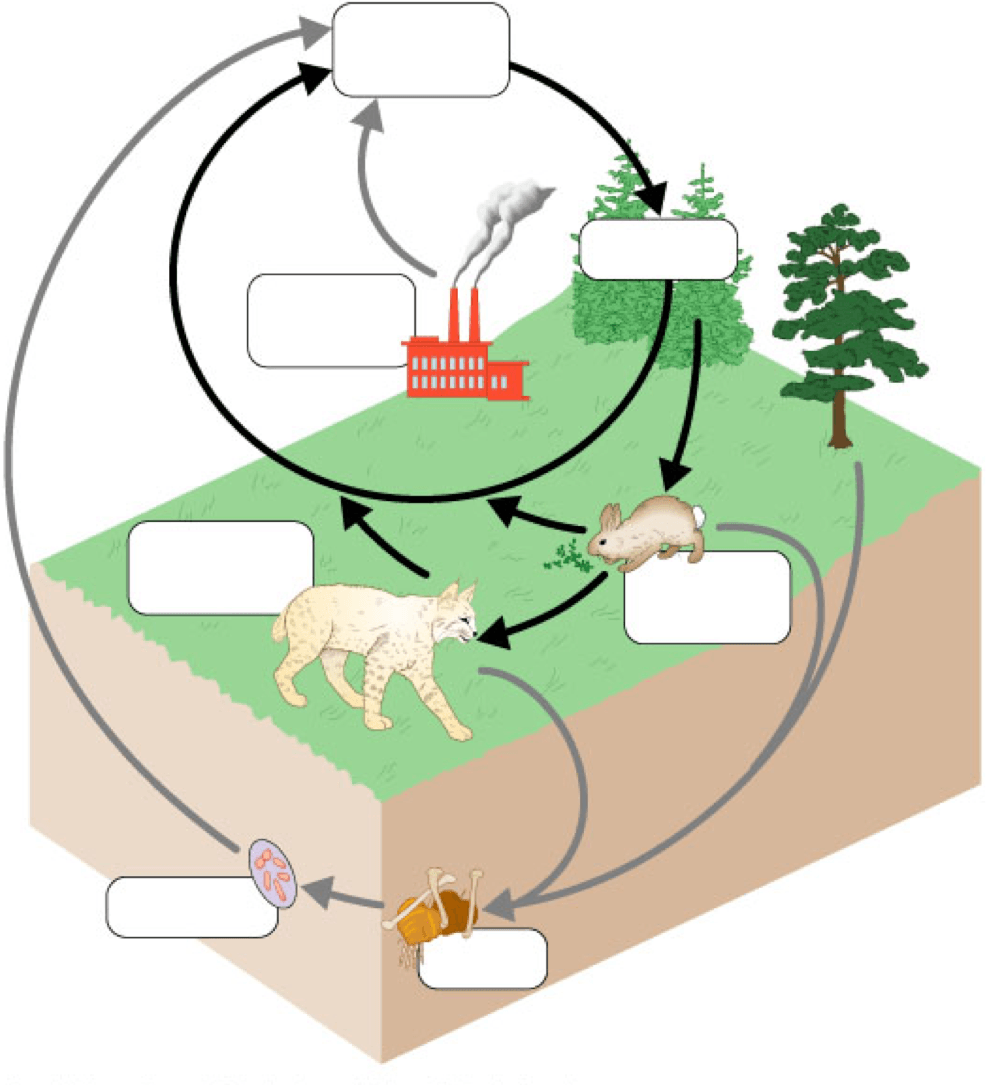
Which gas do plants release, that humans depend on for survival?
Water
Carbon Dioxide
Oxygen
Sugar
Which gas do animals release, that plants depend on for survival?
Carbon dioxide
Oxygen
Sunlight
Water
What would most likely happen to the carbon dioxide-oxygen cycle if Earth's large forests were all cut down?
There would be more carbon dioxide in the atmosphere because fewer plants would be using it to produce their own food.
The remaining plants would stop producing carbon dioxide, and animals would use less oxygen.
The remaining plants would produce more oxygen, and animals would produce less carbon dioxide.
There would be more oxygen in the atmosphere because fewer plants would be using it to produce their own food.
Which statement best describes the relationship between humans and plants in the carbon dioxide-oxygen cycle?
Humans depend on oxygen released into the air by plants, and plants depend on carbon dioxide that humans release into the air.
Plants produce carbon dioxide as a product of photosynthesis and release it into the air to provide energy for humans.
Plants depend primarily on energy supplied by oxygen for photosynthesis, a process which releases carbon dioxide needed by humans.
Humans and plants use gases in the air and the energy of sunlight to produce their own food.
What is the process where animals and people use oxygen to make carbon dioxide?
Photosynthesis
Respiration
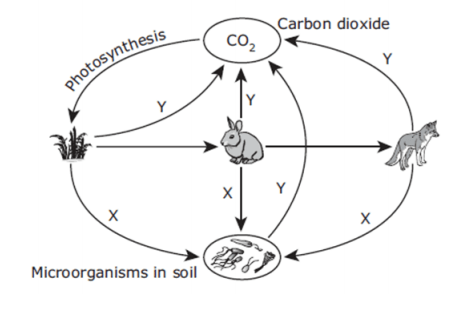
Y : Predation
Y : Decomposition
Y : Nitrogen Fixation
Y : Respiration
C6H12O6 is also known as glucose (sugar). Where is it found?
Plants
Animals
Both plants and animals
Neither plants or animals

What are two (2) ways to reduce the carbon emissions from passenger cars?
Use less expensive gas
Carpooling
Public Transportation
Driving only passenger cars
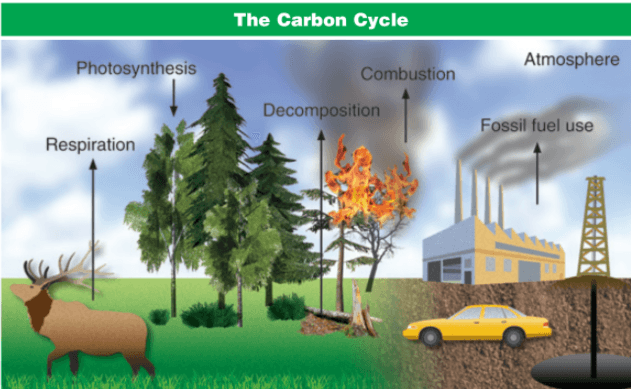

What INCREASES carbon dioxide in the atmosphere?
Photosynthesis
Combustion
Decomposing
Combustion and Respiration

In what way is most of the nitrogen fixed by lightning made available for plants?
Moved by the wind to dry areas
Inside of bugs
Breathed in by birds
Carried by rain into the soil

What is the difference between a community and an ecosystem?
communities are only living, ecosystems are living and nonliving
ecosystems are only living, communities are living and nonliving
communities are only 1 species, ecosystems are different species

What is the FIRST species to arrive into an ecosystem called?
Pioneer species
Organic matter
Succession
A small town in the piney woods of East Texas has a soccer field composed of native grasses. The soccer field is mowed once a week.
What effect does continual mowing have on the ecology of the field?
Mowing increases the likelihood of nonnative species displacing native species.
Mowing increases the number of species found in the field.
Mowing causes different types of communities to form across the field.
Mowing maintains a low species diversity by inhibiting further succession.
What converts nitrogen gas into a usable form for plants and animals?
bacteria
rain
fungi
car exhaust
Organisms that need nitrogen to survive.
only plants
only animals
only bacteria
all living things
How is nitrogen "fixed" into a usable form for plants?
Through action of bacteria only
Through lightning only
Through action of bacteria and lightning
Through photosynthesis
Gas that makes up 78% of our atmosphere.
Oxygen
Nitrogen
Hydrogen
Carbon Dioxide
What is the process of combining nitrogen gas with other elements to make nitrogen into usable compounds?
nitrogen composition
nitrogen fixation
ammonia
denitrification
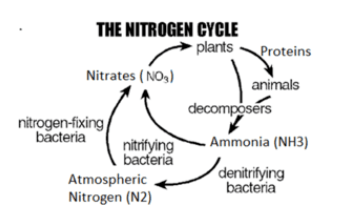
According to this diagram, plants use nitrogen to make _________________________
bacteria
animals
proteins
decomposers
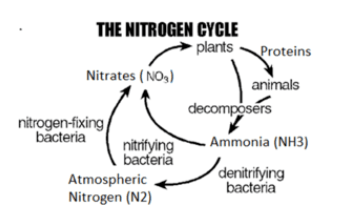
According to this diagram, plants absorb
nitrates
nitrogen fixing bacteria
animals
decomposers
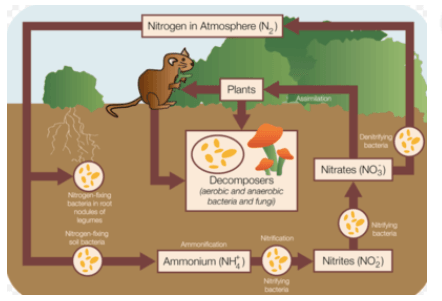
A correct path that nitrogen could take would be
air -> animals -> plants -> bacteria
animals -> air -> bacteria -> plants
bacteria -> air -> plants -> animals
air -> bacteria -> plants -> animals
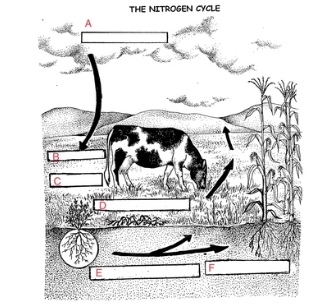
In the nitrogen cycle, what does label A in the diagram represent?
Gas
Clouds
Carbon dioxide in the atmosphere
Nitrogen in the atmosphere


When fertilizer runs off of fields into streams it causes algae blooms that eventually lead to dead zones or areas that lack oxygen. The nutrients that are found in fertilizer that cause this situation called eutrophication are
carbon and nitrogen
nitrogen and phosphorus
phosphorus and sulfur
carbon and phosphorus
3. Choose the proper sequence of the level of biological organization.
cell - organ - organism - tissue - organ system
cell - organ - organ system - tissue - organism
cell - tissue - organ - organ system - organism
organism - tissue - cell - organ system - organ
4. It is the basic unit of structure and function of all living organism
organ system
organ
tissue
cell
5. Made of the same type of cells grouped together to do a specific job.
tissues
organs
organ system
organism
7. Made up of different tissues that work together to do a specific function.
organ
cell
organ system
organism
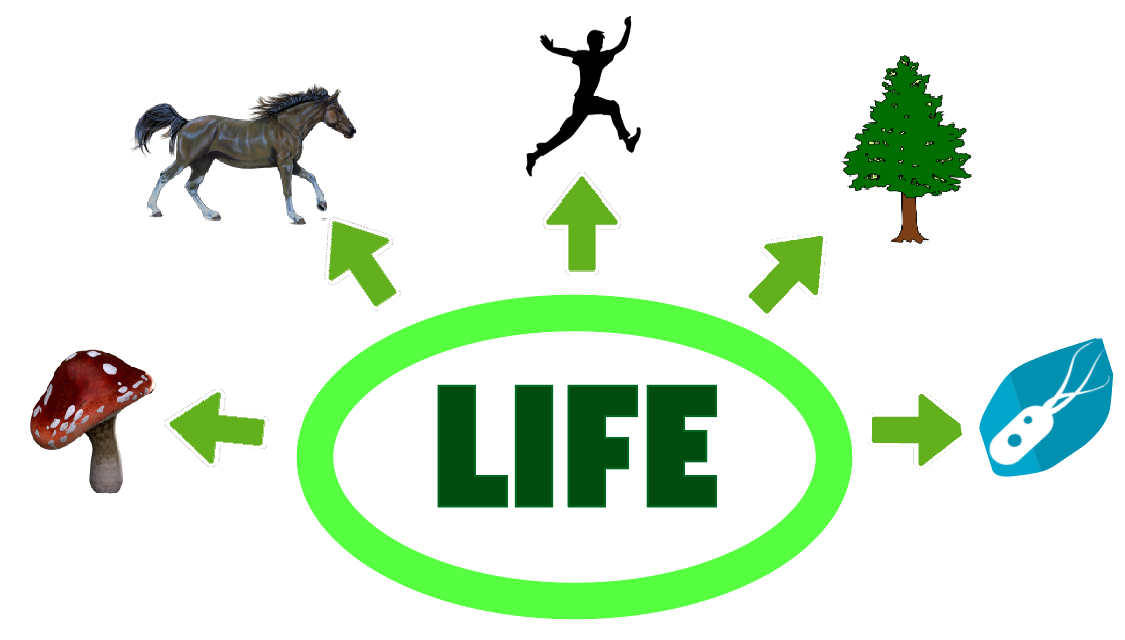
Any single living individual, and can refer to a single human, animal, plant,
Protista, bacteria, or fungi.
Community
Cell
Population
Organism
All ecosystems combined...
biosphere
community
habitat
population
Consists of all the biotic and abiotic factors of the environment...
population
community
ecosystem
all of the above

Organisms who are members of the same species in an ecosystem.
Organism
Population
Organ
Community

Group of populations in an area.
Organism
Ecosystem
Community
Biosphere

