
 Worksheets
Homeostasis & Nervous System
Total questions: 68
Worksheet time: 1hrs 13mins
Homeostasis refers to
the maintenance of a constant heart beat.
the dynamic processes occurring in the kidney.
the static unchanging environment factors.
the constancy of the internal environment of an organism.


Which is NOT a characteristic/example of positive feedback?
Enhances the stimuli
Body temperature, Blood pressure
Labor contractions
What hormone is produced in the pancreas that lowers blood sugar?
Insulin
Glucagon
Ketones
Glucose

Sweating cools the body through a process called
conduction
evaporation
ionisation
dehydration

Blood sugars are controlled by
brain generated chemicals
blood
hormones from the pancreas
chemicals from the liver

The hormone that makes the liver store sugars is
glucose
glycogen
glucagon
insulin

The liver normally stores blood sugar as
glucose
glycogen
glucagon
fats

The action of insulin causes
The liver to secrete enzymes
The liver to make glycogen
The liver to make glucose
none of these

After a period of strenuous exercise you may need to
drink tea
drink water with electrolytes
drink a high energy drink
drink water
What is a receptor?
Receptors are located in the skin
Receptors carry messages to the hypothalamus
A receptor receives messages and causes a response
Receptors or sensors detect changes in the body

Why our hair will stands erect during cold days?
To increase body metabolism
To trap air which acts as heat insulator
To let more blood flows near skin surface
To cool down skin when sweats is evaporated

Salt water crocodiles bask in the sun for several hours every morning. which one of the following statements best describes the method of thermoregulation in salt water crocodiles?
Endothermy, increase body temperature to increase rate of metabolism reactions in cells
Ectothermy, decrease body temperature to increase rate of metabolic reactions in cells.
Endothermy, decrease body temperature to increase rate of metabolic reactions in cells
Ectothermy, increase body temperature to increase rate of metabolic reactions in cells
A student walks into a cold room.
Which of the following happens to his body?
Sweating and vasodilation of blood vessels.
Shivering and vasoconstriction of blood vessels
Sweating and vasoconstriction of blood vessels.
Shivering and vasodilation of blood vessels.

Diagram shows the cross section of human skin.
Which of the following will occur when the surrounding temperature drops below 10 ° C?
R constrict
Q relax
P erect
S become active
Which body system controls the body to maintain homeostasis?
excretory
nervous
circulatory
skeletal

Homeostasis is a ________ of an internal environment in organisms body to be in ________ and balance condition.
repair , stable
maintenance , stable
repair , higher
maintenance , higher
Which organ acts as a control centre of a homeostasis process?


These are corrective mechanisms when ...
Water level Increases
Water level Decreases
Body temperature increases
Body temperature decreases

Choose Corrective mechanisms when body temperature increases
Hair lies flat
Hair stands erect
Blood vessel dilates
Blood vessel constricts
More sweats is produced
Why our hair will stands erect during cold days?
To increase body metabolism
To trap air which acts as heat insulator
To let more blood flows near skin surface
To cool down skin when sweats is evaporated

the reason for all these corrective mechanisms during homeostasis is to ..
Keep body warm
Cool down body

What is an effector in the model above?
Hypothalamus
sweat glands
thermoreceptors
sweating
What is the sensor in the model above?
Hypothalamus
muscles
thermoreceptors
Blood vessels
What is the stimulus in the model above?
body temperature
increase in body temperature
decrease in body temperature
blood vessels dilating

What type of feedback system does the model represent?
positive
negative
neutral
glyogen

What type of feedback system is described above?
positive
negative
neutral
leofied
The feedback system that returns the body back to the normal set point.
positive
negative
neutral
returnable
A noticeable change in an organism's environment.
control center
response
stimulus
set point
receives and analyzes information received from the sensors
control center
effector
sensor
response
The reaction of the effector is called..
response
sensor
stimulus
set point
It transmits signals to the control center when it detects a change.
control center
effector
response
sensor
This is the term used to describe the normal range of a variable in an organism
control center
effector
stimulus
set point
Which of the following are in the correct order?
organ system, cell, organ, tissue, organism
cell, organ, tissue, organ system, organism
cell, tissue, organelle, organ system, organism
cell, tissue, organ, organ system, organism


What is this? It coordinates muscle movements.
Cerebrum
Cerebellum
Brain Stem
Diencephalon
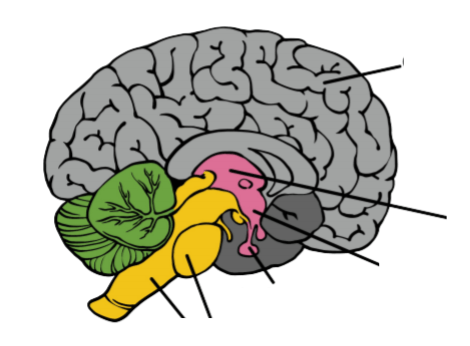
What structure is grey in this picture. It controls conscious thought and memory?
Cerebrum
Cerebellum
Brain Stem

Which part of the brain controls your blood pressure and heart rate?
brain stem
cerebrum
cerebellum
adrenal gland
Which statement best describes a reflex arc?
Slow response that you have to think about
Rapid response to protect body from harm

Where would the nerve impulse start in this reflex arc?
A
C
D
E

_____ neurons carry messages away from the central nervous system and out to muscles or glands. The RED neuron in diagram.
sensory
motor
inter
central

How is a message delivered from the "sending" neuron to the "receiving" axon?
sympathetic nerves
hormones
medulla oblongata
neurotransmitters

