wayground logo

Free Printable Worksheets

Font size

S
M
L
XL
Worksheets

Basic Geometric Terms

Total questions: 40

Worksheet time: 41mins

Name
Class
Date
1.
Identify the geometric term.
a)
point 
b)
line
c)
ray
d)
line segment
2.
Identify the geometric term.
a)
point
b)
line
c)
ray
d)
line segment
3.
Identify the geometric term.
a)
ray
b)
line segment
c)
line
d)
point
4.
Identify the geometric term.
a)
line segment
b)
ray
c)
point
d)
line
5.
Identify the geometric term.
a)
point
b)
line
c)
line segment
d)
ray
6.
True or False.
A line is continuous in both directions.
a)
True
b)
False
7.
True or False.
A line segment has one endpoint and one side that is continuous.
a)
True 
b)
False
8.
a part of a line with two endpoints
a)
line
b)
line segment
c)
ray
d)
point
9.
an exact location in space
a)
line 
b)
line segment
c)
ray
d)
point
10.

A figure that is formed by two rays or line segments that intersect at a common endpoint.

a)

line

b)

angle

c)

triangle

d)

perpendicular lines

11.
An angle with measure between 90° and 180
a)
Acute angle
b)
Obtuse angle
c)
Right angle
d)
Straight angle
12.
Has no dimension and is represented by a dot 
a)
Point
b)
Plane
c)
Line
d)
Line segment
13.
An angle with measure equal to 90°
a)
Acute angle
b)
Complementary angle
c)
Straight angle
d)
Right angle
14.
An angle with measure equal to 180°
a)
Straight angle
b)
Supplementary angle
c)
Linear pair
d)
Obtuse angle
15.

Which symbol is used to denote an angle?

a)

\angle  

b)

Δ\Delta  

c)

π\pi  

d)

\nabla  

16.

How do we classify angles?

a)

according to their measure

b)

according to their vertex

c)

according to their size

d)

according to their number of points

17.

Which statement describes an acute angle?

a)

An acute angle measure 90 degrees 

b)

An acute angle is an angle whose measures is between 180 degrees  and 270 degrees 

c)

An acute angle is an angle whose measure is greater than 0 degree  but less than 90 degrees 

d)

An acute angle is an angle whose measure is greater than 90 degrees but less than 180 degrees 

18.

What kind of angle is \angle  AOB?

a)

acute

b)

obtuse

c)

reflex

d)

right

19.

What is the measure of \angle  COB?

a)

30 °\degree  

b)

60 °\degree  

c)

90 °\degree  

d)

150 °\degree  

20.

A scalene triangle has...

a)

All congruent sides

b)

Two congruent sides

c)

No congruent sides

21.

An obtuse triangle has...

a)

One angle greater than 90°

b)

A right (90°) angle

c)

All angles less than 90°

d)

All congruent angles

22.

An acute triangle has...

a)

One angle greater than 90°

b)

All angles that are less than 90°

c)

All angles that are greater than 90°

d)

A right (90°) angle

23.

An isosceles triangle has...

a)

No congruent sides

b)

All congruent sides

c)

Two congruent sides

24.

An equiangular triangle has...

a)

No congruent angles

b)

All congruent angles

c)

Two congruent angles

25.

An equilateral triangle has...

a)

All congruent sides

b)

Two congruent sides

c)

No congruent sides

26.

A right triangle has...

a)

One right (90°) angle

b)

All angles less than 90°

c)

All angles greater than 90°

d)

Angles that tell you that you're right

27.

What type of triangle is shown?

a)

Scalene

b)

Right

c)

Isosceles

d)

Equilateral

28.

What type of triangle is shown?

a)

Equilateral

b)

Isosceles

c)

Obtuse

d)

Right

29.

What type of triangle is shown?

a)

Equiangular

b)

Obtuse

c)

Right

d)

Isosceles

30.

What is the name of this triangle?

a)

ΔDEF\Delta DEF  

b)

ΔABC\Delta ABC  

c)

ΔXYZ\Delta XYZ  

31.
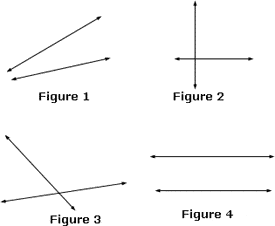
Which figure shows a set of parallel lines?
a)
Figure 1
b)
Figure 2
c)
Figure 3
d)
Figure 4
32.
The memorial for the Twin Towers in NYC is an example of what type of lines?
a)
parallel lines
b)
perpendicular lines
c)
intersecting lines
d)
interurban lines
33.
What types of lines does this rectangle have?
a)
parallel lines
b)
perpendicular lines
c)
both parallel and perpendicular lines
d)
neither parallel nor perpendicular lines
34.
What types of lines does this triangle have?
a)
parallel lines
b)
perpendicular lines
c)
both parallel and perpendicular lines
d)
neither parallel nor perpendicular lines
35.
Parallel lines ...
a)
will never intersect
b)
intersect to form right angles
c)
are curved lines
36.

What is the definition of perpendicular lines?

a)

Lines that never intersect.

b)

Lines that intersect to form right angles.

c)

Lines that intersect at any angle.

d)

Lines that are straight.

37.

Match the following

a)

1.

ABC\angle ABC

b)

2.

CAB\angle CAB

c)

3.

BCA\angle BCA

d)

4.

ΔABC\Delta ABC

38.

Match the following

a)

1.

AB\overline{AB}

b)

2.

AB\overrightarrow{AB}

c)

3.

BA\overrightarrow{BA}

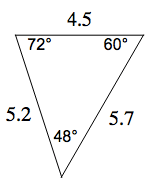
39.
Which would be the best classification for the triangle shown?
a)
acute isosceles
b)
right scalene
c)
acute scalene
d)
obtuse scalene
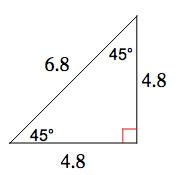
40.
Which would be the best classification for the triangle shown?
a)
right isosceles
b)
obtuse scalene
c)
obtuse isosceles
d)
right scalene