
NEW
Font size
 Worksheets
Alsager - PCS Block 7
Total questions: 59
Worksheet time: 30mins
What is an embedded computer typically responsible for?
A) A variety of complex tasks
B) A dedicated task
C) External communications
D) Running multiple operating systems
Which of the following is an example of an embedded system?
A) Smartphone
B) Traffic lights
C) Desktop computer
D) Web server
What is one of the functions of the controller in traffic lights as an embedded system?
A) To display advertisements
B) To switch the lights
C) To play music for pedestrians
D) To provide Wi-Fi connectivity
How does the traffic light controller receive input for its operations?
A) From satellite signals
B) From manual operation by a person
C) From the pedestrian button
D) From a central traffic management system
Which of the following is NOT a characteristic of an embedded system?
High power consumption
Task specific (single purpose)
Small physical size
Low maintenance
Embedded systems are often designed to be:
High maintenance
Large in size
Real-time or responsive to their environment
Multi-purpose
What is a common characteristic of the cost associated with embedded systems?
High cost
Variable cost
Low cost
Premium cost
What is the Internet of Things (IoT)?
A global network of interconnected computers
The name given to the everyday devices which are increasingly being given network connectivity
A specific type of wireless network
A software platform for managing connected devices
Where can devices connected to the Internet of Things (IoT) be found?
Only in industrial settings
Only in your own home
Both in public spaces and in your own home
Exclusively in scientific laboratories
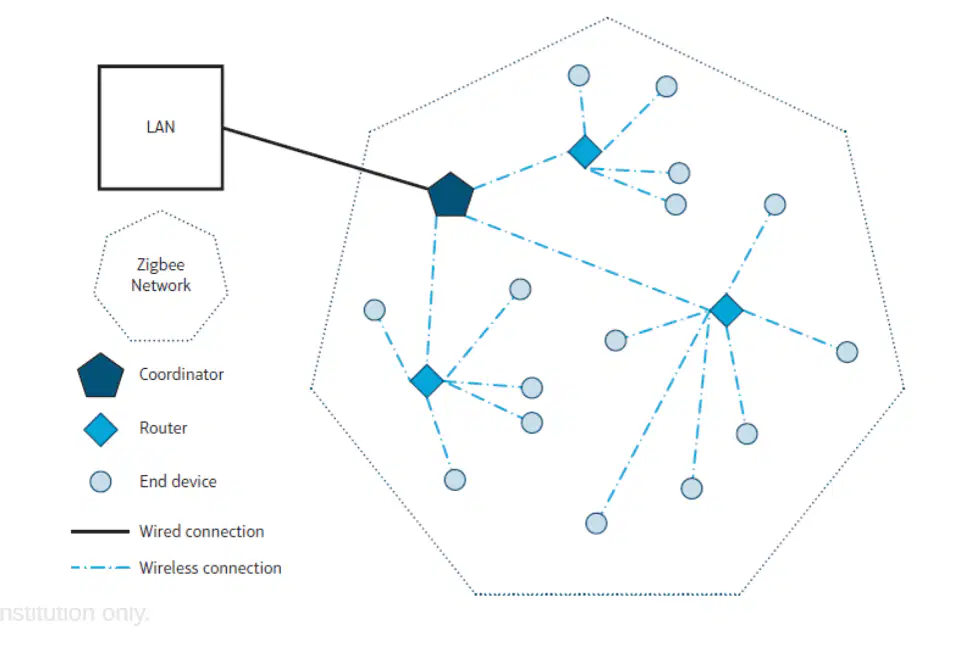
In the provided diagram, what does the solid line represent?
A wireless connection
An electrical circuit
A wired connection
A disconnected link
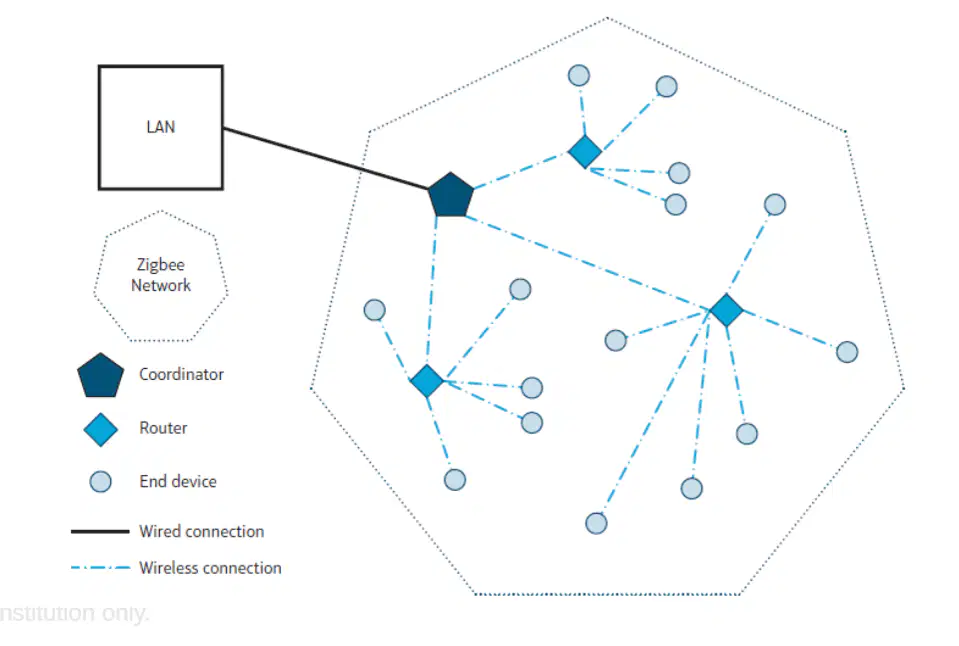
According to the diagram, which component is responsible for forming the central part of the network?
End device
Router
Coordinator
Zigbee Network
What are characteristics of most IoT devices?
High-powered with extensive memory
Low-powered with reduced-memory
Do not generate any data
Require manual analysis of data
For IoT generated data to be useful, what must be done with it?
It should be deleted immediately
It must be passed on to a platform that can store and analyse it
It should be kept on the device only
It must be printed and distributed
What does packet sniffing involve?
Decrypting secure wireless traffic to access data
Accessing unsecured wireless traffic to potentially obtain sensitive data
Blocking wireless signals to prevent data access
Sending fake packets to disrupt network communication
Which security concern could make it easier for cars to be stolen?
Home invasion
Hijacking and ransomware
Counterfeit devices containing security back doors
Vehicle theft – keyless entry and other such technologies
What could compromised IoT home security systems lead to?
Increased online privacy
Enhanced network security
Home invasion
Safer internet browsing
What is one of the concerns people have about IoT devices?
Device durability
Personal privacy
Battery life
Internet speed
What do IoT devices increasingly do that raises privacy concerns?
Play music on demand
Listen to conversations and monitor the environment
Only function during specific hours
Require frequent manual updates
Why is power consumption an important design consideration when developing IoT devices?
To increase the complexity of the device
To make the devices more expensive
To maximize battery life and performance
To make the devices heavier
What is a particular challenge when it comes to IoT devices like environmental sensors in industrial settings?
They are too easy to access for battery changes
They require constant power supply from the grid
They are often difficult to reach for changing batteries
They use a negligible amount of power
What should firmware developers for IoT devices consider to reduce power consumption?
Making programs more complex
Using less efficient programs
Increasing the number of functions
Creating more efficient programs
What are the two main components of a packet?
Header and Body
Header and Footer
Header and Data
Data and Footer
Which of the following is NOT information typically contained in the header of a packet?
Sequence number
Type of packet
Time to live
Encryption key
What is the purpose of the header in a packet?
To provide the actual content being transmitted
To encrypt the data being sent
To contain information about the packet
To increase the size of the packet
What are IP addresses used for in a network?
To identify the physical location of devices
To determine the software version of devices
To identify devices in a network, including the internet
To store data for devices on a network
When you access a webpage, how are packets sent to your computer?
Using the website's name as the destination address
Using the IP address of the website as the destination address
Through a direct cable connection to the server
By broadcasting to all devices on the network
What happens after an image is broken up into smaller parts for downloading?
The parts are sent directly to your computer in the correct order.
Each part is put into a packet with the correct information added, including your IP address.
The server requests the parts from your computer.
Your computer immediately reassembles the image.
How do packets containing parts of an image travel across the internet?
They travel in a single path and arrive in the correct order.
They are sent via email to your computer.
They take different paths and may arrive in the wrong order.
They are all sent together in one large packet.
What does your computer do if any packets are missing during the download process?
It waits for the server to resend them automatically.
It reassembles the packets into the image without them.
It requests that the missing packets are resent.
It discards the entire download and starts over.
What is the primary purpose of a router in a network?
To prevent unauthorized access to the network
To send packets on to the next part of the network
To store data for the network
To increase the speed of the network
What is the process called when routers send each packet along a connection to another router by choosing the path with the least traffic?
Packet filtering
Packet encoding
Packet switching
Packet routing
What is the role of routers in the hierarchy of the Internet?
To provide wireless connectivity to local devices
To direct network packets by one step in their journey from the source to the destination
To store data for quick access across the network
To encrypt data for secure transmission
What does the backbone in the Internet hierarchy refer to?
The main server that controls all internet traffic
The primary user interface for accessing the internet
The long distance, high bandwidth cables that travel around the region, country, or the world
The central database that stores all internet data
What are Network Access Points (NAPs)?
Devices that provide local network access to the Internet
Specialised high-performance routers that handle high-speed network traffic between countries
Software protocols that manage network traffic
Satellite systems that distribute internet signals globally
What are protocols in the context of computing devices?
A type of computer hardware
A programming language
Sets of rules for communication
A type of software application
What is a layered protocol stack?
A single protocol that provides all necessary rules for communication
A set of hardware components stacked together
A set of protocols that interact with one another, without being concerned with how each other work
A visual representation of data transfer rates
What is the primary function of the TCP/IP stack?
It provides encryption for secure communication.
It enables communication on the internet.
It stores data for long-term retrieval.
It manages user interfaces on devices.
Can layers in the TCP/IP stack be skipped during the communication process?
Yes, layers can be skipped if they are not needed.
Yes, but only in special circumstances.
No, layers cannot be skipped.
It depends on the type of data being transmitted.
In the TCP/IP stack, how is the result produced by each layer used?
It is discarded after the layer's task is completed.
It is stored for future communication sessions.
It is used by the next layer, being passed lower or higher.
It is sent directly to the receiving device.
Do both the sending and receiving devices use all layers of the TCP/IP stack during communication?
Only the sending device uses all layers.
Only the receiving device uses all layers.
Both devices use only the necessary layers.
Both the sending device and receiving device use all layers of the stack.
Which layer of the TCP/IP stack is responsible for providing the functions necessary to transmit data between two devices on the same network?
Application layer
Transport layer
Internet layer
Link layer
What is the correct sequence of layers in the TCP/IP model from the top layer to the bottom layer?
Application layer, Transport layer, Internet layer, Link layer
Transport layer, Application layer, Internet layer, Link layer
Internet layer, Transport layer, Application layer, Link layer
Link layer, Internet layer, Transport layer, Application layer
In the TCP/IP stack, which layer is responsible for establishing end-to-end communication and error checking?
Application layer
Transport layer
Internet layer
Link layer
Which layer of the TCP/IP stack is responsible for routing data packets across multiple networks?
Application layer
Transport layer
Internet layer
Link layer
Which layer is responsible for how user applications like email and web browsers package their data to be sent online?
Transport layer
Internet layer
Application layer
Physical layer
What is the primary function of protocols in the Transport layer?
Addressing and routing data
Packaging user data for applications
Establishing a channel between devices and splitting data into packets
Encrypting data for secure transmission
In which layer is addressing carried out, adding the addresses of the sending and receiving devices to the packet header?
Application layer
Transport layer
Internet layer
Data Link layer
What is the responsibility of the Link layer in data transmission?
It is responsible for routing data packets to their destination.
It is responsible for transporting raw data over the transmission medium.
It is responsible for encrypting and decrypting data.
It is responsible for error checking and correction.
What type of signal does the Link layer generate for a fiber connection?
Radio signal
Light signal
Acoustic signal
Electrical signal
During the reception of data, what is the sequence of steps taken by the receiving computer?
The signal is translated into data, the addresses are taken off, and the packets are reconstructed.
The addresses are taken off, the data is rendered for the application, and the signal is translated into data.
The packets are reconstructed, the signal is translated into data, and the addresses are taken off.
The signal is translated into data, the data is rendered for the application, and the packets are reconstructed.
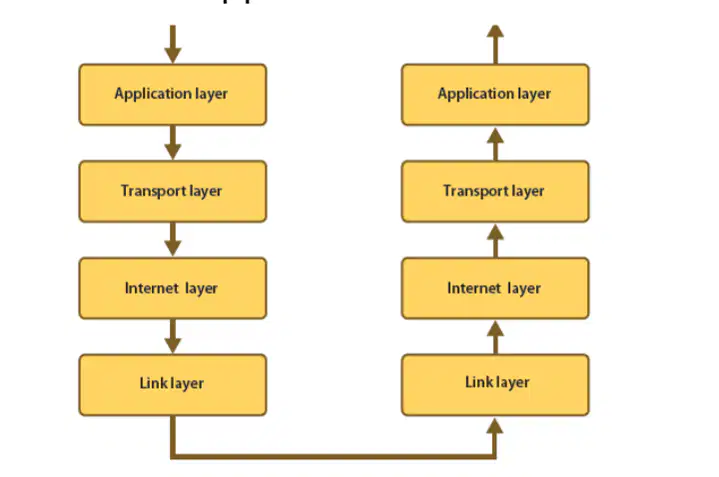
Which layer is directly above the Link layer in the diagram provided?
Application layer
Transport layer
Internet layer
Physical layer
What is the primary function of the protocols in the application layer?
They are responsible for the physical connection between devices.
They are responsible for the rendering of web pages and packaging of emails.
They control the flow of data between servers.
They encrypt and decrypt data for secure transmission.
Which of the following is NOT a protocol in the Application Layer?
HTTP(S)
FTP
TCP
IMAP
What does the application layer interact with?
The network layer
The transport layer
The users
The data link layer
What is the primary function of the transport layer in network protocols?
Defining how data is transmitted across connections
Establishing a virtual channel between two devices
Adding source and destination addresses to the data packet
Routing data packets across the network
Which protocol is used at the transport layer to ensure data packets are ready for sending?
IP
Ethernet
Wi-Fi
TCP
What is the Internet layer also known as?
Transport layer
Network layer
Link layer
Interface layer
What identifier is added to the data packet at the Internet layer for routing purposes?
TCP
Ethernet
IP
Wi-Fi
Which two main protocols are used at the link layer?
TCP and IP
IP and Ethernet
Ethernet and Wi-Fi
Wi-Fi and TCP

