
 Worksheets
Cardiovascular Anatomy (Heart Focused)
Total questions: 57
Worksheet time: 37mins
Arteries have a thicker tunica media than veins.
True
False
Arteries are high pressure vessels.
True
False
The pulmonary veins bring deoxygenated blood back to the heart.
True
False
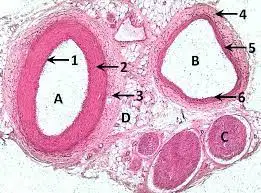
Is the blood vessel indicated by the letter “A” an artery or a vein?
Artery
Vein
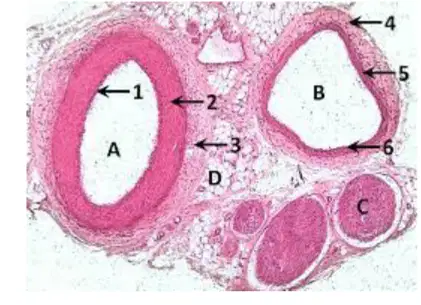
Which large arterial structure's histology is characterized by smooth muscle and abundant elastic fibers?
Superior vena cava
Inferior vena cava
Pulmonary veins
Aorta
Which of the following is not a venous structure that drains blood directly into the right atrium?
dural sinuses
coronary sinus
superior vena cava
inferior vena cava
The tricuspid valve is between the atria and ventricle on the ________ side of the heart; while the mitral (bicuspid) valve is on the ________ side of the heart.
left; right
The tunica media of blood vessels is made up of __________ muscle. [1 pt]
cardiac
smooth
endothelial
skeletal
Coronary circulation refers to the blood supply to the ________.
heart
pancreas
liver
lungs
kidneys
The innermost layer of the heart wall is called the _________________. [1pt]
epicardium
myocardium
endocardium
visceral pericardium
The left side of the heart pumps blood to the body through the ________________. [1pt]
pulmonary trunk
pulmonary veins
aorta
superior vena cava

The structure labeled "14" in the diagram is the
aorta
superior vena cava
pulmonary artery
pulmonary vein
The only vessel of its type to carry deoxygenated blood is the
aorta
pulmonary vein
pulmonary artery
superior vena cava
In which type of blood vessels is blood pressure the highest?
Capillaries
Veins
Apex
Arteries

The structure labeled 12 in the image is the
left atrium
right atrium
left ventricle
right ventricle

Through which structure does all of the deoxygenated blood from the body come back to the heart?
15
2
9
8

What is the name of the structure labeled 8 in the diagram?
aorta
pulmonary vein
pulmonary artery
superior vena cava
What is the name of the structure labeled 8 in the diagram?
aorta
pulmonary vein
pulmonary artery
superior vena cava
T/F: Blood Pressure is measured in BPM (beats per minute).
True
False
What type of blood flows through the aorta?
Oxygen-poor
Oxygen-rich
Both oxygen-rich and oxygen-poor
Blue
What does the pulmonary loop flow between?
The heart and the rest of the body
Capillaries and veins
The heart and the lungs
The lungs and the rest of the body
What keeps the left and right sides of the heart separate?
Valves
Septum
Aorta
Veins
Where does oxygen-rich blood enter the heart?
left atrium
left ventricle
right atrium
right ventricle
What part of the cardiovascular system prevents backflow of blood?
heart
pulmonary artery
valves
veins
Which valve controls the opening between the right atrium and the right ventricle?
Tricuspid valve
Pulmonary semilunar valve
Mitral valve
Aortic semilunar valve
What is the primary function of capillaries?
Transport blood away from the heart to all body parts
Permit the exchange of nutrients and waste products between the blood and the cells
Return blood from all body parts to the heart
Bring oxygen and nutrients to the cells
What is the primary function of veins?
Pump blood into the arteries
Transport blood away from the heart to all body parts
Permit the exchange of nutrients and waste products between the blood and the cells
Return blood from all body parts to the heart

Letter D is pointing to
Aorta
Right Pulmonary Artery
Superior Vena Cava
Pulmonary Trunk

Letter G is pointing to
Right atrium
Left Atrium
Right ventricle
Left ventricle

Which letter is pointing to the Apex?
H
I
E
B

Of the four chambers, which one carries deoxygenated blood?
F and J
F and A
A and G
J and G

Which letter is pointing to the tricuspid valve?
M
N
L
O
The mitral valve is another name for the
Aortic valve
Pulmonary valve
Tricuspid valve
Bicuspid valve
Which of the following carries blood TO the lungs?
pulmonary veins
pulmonary arteries
aorta
superior vena cava
The "semilunars" include
mitral and tricuspid
aortic and pulmonary
bicuspid and aortic
tricuspid and pulmonary
Which are larger, atria or ventricles?
atria
ventricles

Which of the following brings blood back to the heart from the lungs?
C
D and K
E
B

H is pointing to the
interatrial septum
interventricular septum
interpulmonary septum
atrioventricular septum

Structure B carries
oxygenated blood
deoxygenated blood

The aortic semilunar valve is letter
O
L
M
N

After dropping off oxygen to the body, blood will re-enter the heart through the
pulmonary veins
aorta
superior and inferior vena cava
pulmonary arteries
The aorta branches off into 3 vessels. Which of the following is NOT one of them?
left subclavian
coronary artery
brachiocephalic
left common carotid
Back flow into the left atrium would be caused by a faulty (not working properly) valve; which one?
aortic semilunar
pulmonary semilunar
tricuspid
bicuspid

The left side of the heart carries oxygenated blood to the:
body
lungs
The left side of the heart is red because it carries _______ blood.
oxygenated
deoxygenated
The right side of the heart is blue because it carries _______ blood.
oxygenated
deoxygenated

Identify the chamber labeled #1
right atrium
left atrium
left ventricle
right ventricle

The valve labeled #7 is
bicuspid
tricuspid
aortic semilunar
pulmonary semilunar

The structure labeled #4 is
septum
apex
left ventricle
papillary muscle

The structure labeled #6 is
left auricle
right auricle
left ventricle
adipose tissue
If you were to insert your finger into the superior vena cava, you would be feeling inside which chamber?
right atrium
left atrium
left ventricle
right ventricle
If you inserted a probe into the aorta, which chamber of the heart would it lead to?
left ventricle
right ventricle
left atrium
right atrium
If you insert your finger into the pulmonary vein, you will be feeling inside which chamber?
right atrium
left atrium
left ventricle
right ventricle
The pulmonary artery connects to which heart chamber?
right ventricle
left ventricle
right atrium
left atrium
The chordae tendineae are attached to the _______ muscles.
pectinate
trabecula carneae
semilunar
The first branch of the aorta is the
brachiocephalic artery
left common carotid
left subclavian
pulmonary vein
If you are looking at the dorsal side of the heart you are looking at the ______ side of the heart.
front
side

