
 Worksheets
AI | Product Centric Value Delivery - Knowledge Quiz
Total questions: 40
Worksheet time: 13mins

What is the primary goal of implementing AI in product development?
Reducing costs
Enhancing efficiency
Creating new revenue streams
Improving employee morale

AI is capable of processing _____________ amount of data at a higher speed.
Tiny
Medium
Very Large
All of the listed options

How are neural networks trained?
By randomly assigning weights to connections between neurons
Through reinforcement learning and trial-and-error
By using only the input data without any adjustments
Through back propagation and adjusting the weights of connections between neurons

What is the key benefit of adopting a product-centric approach?
Faster time-to-market
Increased customer satisfaction
Enhanced cross-functional collaboration
Lower product quality

Face Lock in Smartphones is an example of ________________
Natural Language Processing (NLP)
Computer Vision
Machine Language (ML) - Data science

What are the different layers in a neural network?
top layer, middle layers, bottom layer
input layer, hidden layers, and output layer
primary layer, secondary layers, tertiary layer
visible layer, invisible layers, output layer

Alexa is an example of _____________________ domain
Natural Language Processing
Machine Learning
Computer Vision

Which of the following is NOT a goal or feature of AI?
Reasoning/decision making
Forward planning
Natural Language
Displaying emotion

Which of the following is a characteristic of a product-centric organization?
Focus on building features requested by customers
Long development cycles
Departmental isolation
Limited customer engagement

What role does continuous feedback play in product-centric development?
It is unnecessary
It ensures alignment with customer needs
It slows down the development process
It increases silos between teams
It fosters innovation and improvement throughout the product lifecycle

What is a potential risk of over-reliance on AI in decision-making?
Increased efficiency
Loss of human oversight
Reduced errors
Improved transparency
It is a subset of Artificial Intelligence which enables machines to improve at tasks with experience (data).
Deep Learning
Machine Learning
AI

What is the role of user personas in product-centric development?
To ignore user needs and preference
To create fictional representations of target users
To represent the actual needs and behaviors of target users
To limit the scope of user feedback and input

In this model, the machine is trained with huge amounts of data which helps it in training itself around the data. Such machines are intelligent enough to develop algorithms for themselves.
AI
Deep Learning
Machine Language

The basis of decision making depends upon the availability of information and how we experience and understand it. ‘Information’ includes:
Past experience
Intuition
Knowledge
All of the above
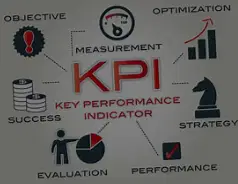
What is the purpose of using metrics and KPIs in product-centric development?
To increase project complexity
To measure team productivity
To evaluate the success of product initiatives
To track individual performance

In a product-centric organization, what role does the product manager play?
Managing day-to-day operations
Setting strategic product direction
Writing code for product features
Conducting market research and analysis

An air conditioner can be turned on and off remotely with the help of internet is an example of:
Augmented Reality
Automation
Internet of Things

The AI domain which can be used to predict AIR quality index is
NLP
Computer Vision
Data Science

Amazon’s Alexa and Apple’s Siri are examples of_______
AI Chatbots
AI virtual assistants
Smart phones
None of the above

How does data science differ from traditional statistics?
Data science focuses on analyzing historical data, while traditional statistics focuses on predicting future trends.
Data science uses machine learning and big data technologies, while traditional statistics uses manual methods.
There is no difference between data science and traditional statistics.

What role does computing power play in deep learning, a subset of AI?
Deep learning models require significant computing power to train on large datasets.
Deep learning models can be trained without any computing power.
Deep learning models perform better with less computing power.
Computing power is not relevant to deep learning.
What are the three Vs of big data?
Volume, Velocity, Validation.
Variety, Velocity, Value.
Velocity, Variety, Volume.
Validation, Value, Volume.

What is the Turing test?
A test to determine if a machine can exhibit intelligent behavior equivalent to, or indistinguishable from, that of a human.
A test to determine if a machine can pass a series of logical reasoning tasks.
A test to determine if a machine can understand and respond to natural language.
A test to determine if a machine can learn from data and improve over time.
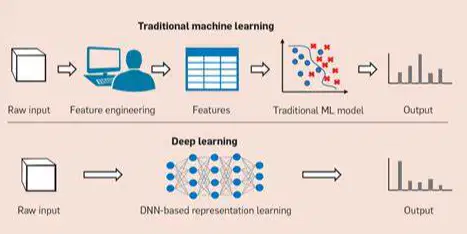
How does deep learning differ from traditional machine learning?
Deep learning uses neural networks with multiple layers to learn from data, while traditional machine learning uses simpler algorithms.
Deep learning requires more computational power than traditional machine learning.
There is no difference between the two.

What industries or sectors are most vulnerable to the risks of deepfake technology?
Entertainment and media
Politics and elections
Business and finance
All of the above

How can deepfake technology be used in a positive way?
Enhancing entertainment and film production
Improving security and surveillance
Facilitating online learning and training
None of the above

What are some limitations of large language models?
They can be biased or produce biased outputs
They may generate incorrect or nonsensical text
They require large amounts of computational resources
All of the above

What are the phases in product-centric value delivery?
Initiation, Planning, Execution, Monitoring and Control, Closure.
Discovery, Validation, Delivery, Growth, Optimization.
Ideation, Development, Testing, Deployment.
Research, Design, Development, Testing, Deployment.

How do large language models like GPT-3 generate text?
By randomly selecting words from a dictionary
By predicting the next word based on context and probability
By copying and pasting text from existing documents
By translating text from another language

What are the key steps in the data science process?
Data collection, data cleaning, data analysis, and data visualization.
Data encryption, data storage, data retrieval, and data deletion.
Data processing, data transmission, data compression, and data archiving.
All of the above.

How are large language models typically trained?
Using labeled data only
Using unsupervised learning on unstructured text data
Using reinforcement learning on structured text data
Using a combination of supervised and unsupervised learning on diverse text data

What is a large language model (LLM)?
A model used for analyzing images
A model used for translating languages
A model trained on vast amounts of text data to understand and generate human-like text
A model used for playing video games

What is the role of continuous integration and continuous deployment (CI/CD) in Agile product development?
To delay the release of new features until they are fully tested
To automate the process of testing and deploying new features
To limit the frequency of software releases
To avoid incorporating user feedback into the development process

How does demand management differ in product-centric value delivery compared to traditional approaches?
Product-centric approaches focus more on meeting customer needs, while traditional approaches prioritize cost reduction
Product-centric approaches require less forecasting, while traditional approaches rely heavily on forecasts
There is no difference between the two approaches

How does demand management impact the design and development of new products?
It influences the features and specifications of new products based on customer feedback
It determines the pricing strategy for new products
It delays the launch of new products to match demand
It has no impact on new product development

How does Robotic Process Automation (RPA) differ from traditional automation?
RPA requires human intervention, while traditional automation does not.
RPA can automate tasks across multiple systems and applications without integration, while traditional automation requires integration.
There is no difference between RPA and traditional automation.

What is a chatbot?
A robot that chats with humans in natural language
A software program that simulates conversation with users, typically over the internet
A type of chat room for discussing bots
A tool for detecting and blocking spam messages

How do bots differ from traditional software applications?
Bots can only perform simple tasks, while traditional applications are more complex.
Bots are typically used for repetitive tasks, while traditional applications are used for diverse purposes.
There is no difference between bots and traditional applications.
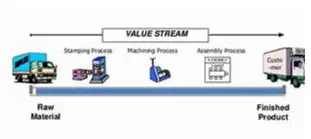
What is the primary focus of product-centric value delivery on a value stream?
Maximizing the efficiency of each individual process in the value stream.
Ensuring that each process delivers value to the end customer
Minimizing the time spent on each process in the value stream.
Achieving cost reduction in each process of the value stream.

