
NEW
Font size
 Worksheets
Flight Test Study Guide
Total questions: 36
Worksheet time: 36mins
A systematic, problem-solving strategy that designers follow to come up with a solution to a problem
Design Process
Glider
Prototype
an aircraft similar to an airplane that has no engine
prototype
glider
a working model used to test a design concept by making observations and necessary adjustments
prototype
glider
working together on a common purpose
collaboration
team norms
guidelines that are developed by a team regarding how they are to interact, communication, and conduct themselves as part of the team
collaboration
team norms
a push or pull on an object
fluid
unbalanced forces
force
forces that are directed opposite each other and are not equal in magnitude
force
unbalanced forces
gravity
What is gravity?
the force that makes it difficult for one object to slide along the surface of another or to move through liquid or gas
the force that attracts a body toward the center of the earth or toward any other physical body having mass
What is friction?
The force that makes it difficult for one object to slide along the surface of another or to move through liquid or gas
The force that attracts a body toward the center of the earth or toward any other physical body having mass
What is acceleration?
the rate at which an object speeds up, slows down, or changes direction
the amount of matter in an object
What is mass?
the rate at which an object speeds up, slows down, or changes direction
the amount of matter in an object
In 1686, Sir Isaac Newton discovered the Three Laws of Motion
True
False
Law of inertia- objects in motion tend to stay in motion AND objects at rest tend to stay at rest UNLESS something pushed or pulls on the object
3rd Law of Motion
2nd Law of Motion
1st Law of Motion
(Force = Mass x Acceleration) - Acceleration is produced when a force acts on an object. The greater the mass of the object, the greater the amount of force needed to accelerate the object.
3rd Law
2nd Law
1st Law
For every action there is an equal and opposite reaction
3rd Law of Motion
2nd Law of Motion
1st Law of Motion
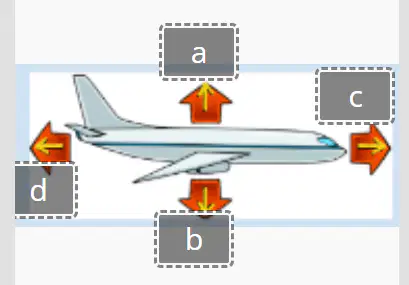
Which of the four Forces of Flight does letter a represent?
lift
drag
weight
thrust
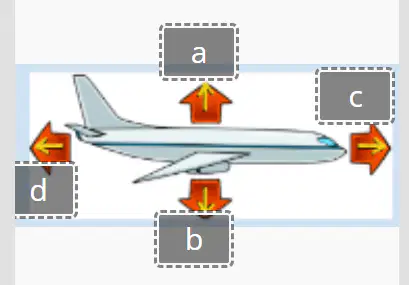
Which of the four Forces of Flight does letter b represent?
lift
weight
thrust
drag
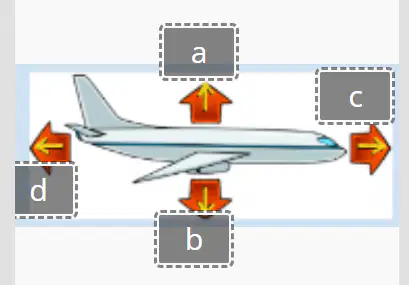
Which of the four Forces of Flight does letter c represent?
lift
weight
thrust
drag
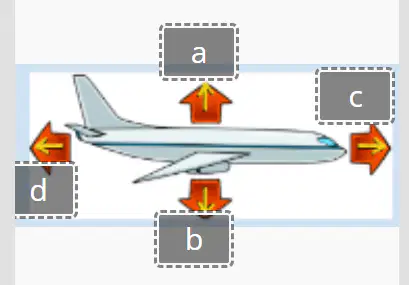
Which of the four Forces of Flight does letter d represent?
lift
weight
thrust
drag
What is magnitude?
the force of gravity that pulls objects downward
the size or quantity of something
the force that directly opposed the weight of an aircraft and holds the aircraft in the air
What is lift?
the force of gravity that pulls an object downward
the size or quantity of something
the force that directly opposed the weight of an aircraft and holds the aircraft in the air
What is weight?
the force of gravity that pulls objects downward
the size or quantity of something
the force that directly opposed the weight of an aircraft and holds the aircraft in the air
payload
the force applied to a body to propel it in a desired direction
the weight of occupants, cargo, and baggage on board an aircraft
the density of the air, which varies at different altitudes
thrust
the weight of occupants, cargo, and baggage on board an aircraft
a force applies to a body to propel it in a desired direction
to drive, or cause to move forward
propel
resistance of air against the forward movement of an aircraft
the means by which aircraft and spacecraft are pushed forward
a person who operates the flying controls of an aircraft
to drive, or cause to move forward
drag
resistance of air against the forward movement of an aircraft
the means by which aircraft and spacecraft are pushed forward
a person who operated the flying controls of an aircraft
the drive, or cause to move forward
propulsion
resistance of air against the forward movement of an aircraft
the means by which aircraft and spacecraft are pushed forward
a person who operates the flying controls of an aircraft
to drive, or cause to move forward
pilot
resistance of air against the forward movement of an aircraft
the means by which aircraft and spacecraft are pushed forward
a person who operated the flying controls of an aircraft
to drive, or cause to move forward
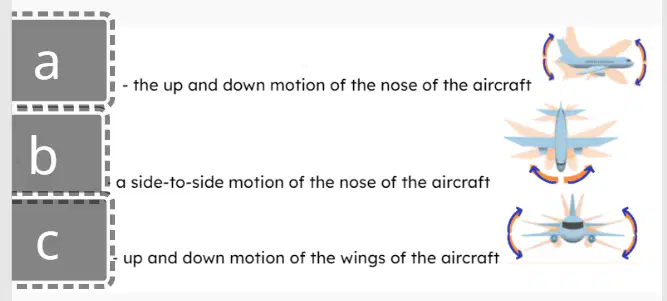
Which movement does letter a represent?
pitch
yaw
roll
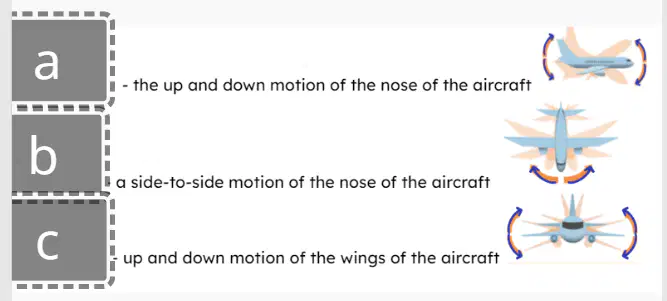
Which movement does letter b represent?
pitch
yaw
roll
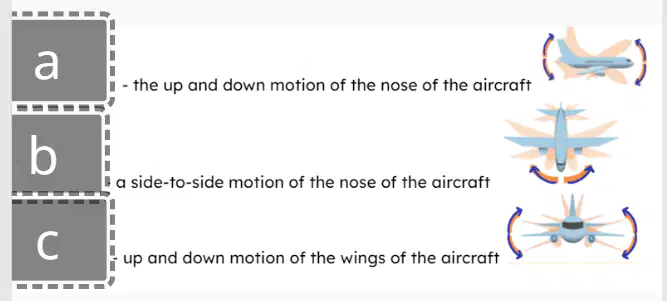
Which movement does letter c represent?
pitch
yaw
roll
What is an airfoil?
the hinged part of the stabilizer on an aircraft that is used to deflect the rail of the plane up and down
a streamlined surface designed in such a way that air flowing around it produces useful motion. The cross-section of an airplane wing.
What is an elevator?
the hinged part of the stabilizer on an aircraft that is used to deflect the tail of the plane up and down
a streamlined surface designed in such a way that the air flowing around it produces useful motion. The cross-section of an airplane wing.
What is an aileron?
small moving section at the rear of the stabilizer that helps to control the yawing motion of the aircraft
the curvature of the airfoil
the part of an airplane that raises and lowers the wings, causing the airfoil to roll
What is a rudder?
small moving section at the rear of the stabilizer that helps control the yawing motion of the aircraft
the curvature of the airfoil
that part on an airplane that raised and lowers the wings, causing the aircraft to roll
What is camber?
small moving section at the rear of the stabilizer that helps to control the yawing motion of the aircraft
the curvature of the airfoil
the part on an airplane that raises and lowers the wings, causing the aircraft to roll

