
 Worksheets
Evolution CUA Retake
Total questions: 20
Worksheet time: 3hrs 20mins
During early stages of development, dolphin embryos begin to develop hind limbs. By the time the dolphin fetuses are fully developed, the hind limbs have disappeared. Which statement best explains the early development and then disappearance of hind limbs in dolphins?
Dolphin fetuses change their development to adapt to an aquatic environment.
The genes that control the development of hind limbs are destroyed as the fetus develops.
The early ancestors of dolphins had hind limbs.
Dolphins are evolving to become terrestrial animals.
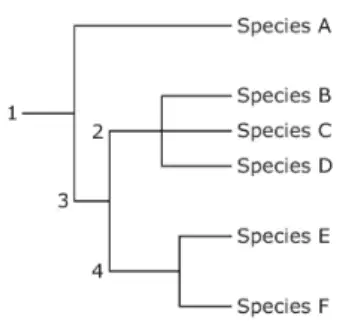
A phylogenetic tree based on genetic similarities is shown. Which numbered location on the phylogenetic tree identifies characteristics shared by Species B, C, and D?
Location 1
Location 2
Location 3
Location 4
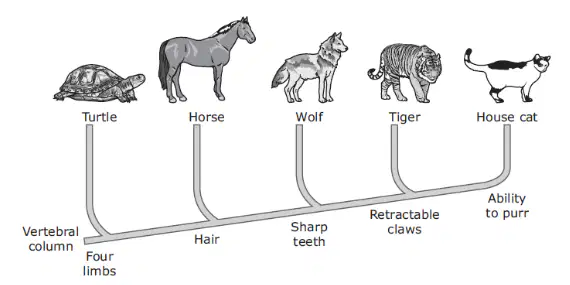
A cladogram of five species is shown. Based on the cladogram, the ancestral species most likely had —
a vertebral column
vertebral column and hair
sharp teeth and retractable claws
the ability to purr
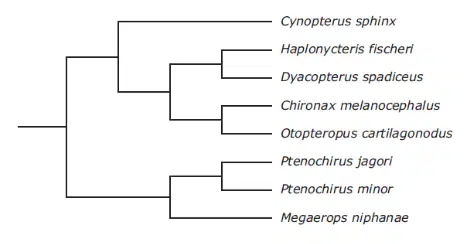
Researchers analyzed a mitochondrial gene of different bat species to determine relatedness. A cladogram of their results is shown. Based on the cladogram, which set of bat species is the least related?
Ptenochirus minor and Megaerops niphanae
Dyacopterus spadiceus and Otomops cartilagonodus
Halopteris fisheri and Ptenochirus jagori
Cynopterus sphinx and Chironax melanocephalus
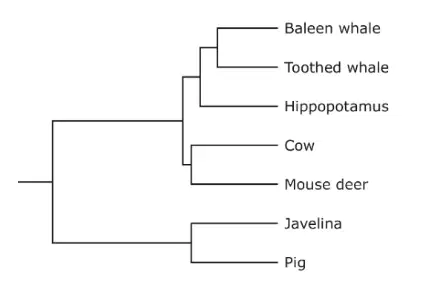
This cladogram shows the evolutionary relationships among some mammals based on homologous structures. Which statement is supported by this cladogram?
Hippopotamuses are more closely related to cows than to javelinas.
Toothed whales are more closely related to mouse deer than to hippopotamuses.
Javelinas and pigs are more closely related than baleen whales and toothed whales.
Cows and mouse deer are more closely related than javelinas and pigs.
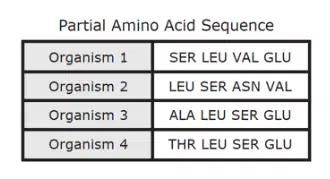
Scientists can determine relatedness among organisms by comparing partial amino acid sequences. The table shows four partial amino acid sequences from four organisms. Which organism is the LEAST related to the other three organisms?
Organism 1
Organism 2
Organism 3
Organism 4
Certain species of the coral-like sea organisms called bryozoans first appeared about 140 million years ago. They remained unchanged for the first 40 million years and then suddenly experienced rapid genetic change. Which process would BEST account for the pattern of evolution in bryozoans?
Convergent evolution
Differentiation
Punctuated equilibrium
Gradualism
Two scientists studied patterns of evolution in the fossil record. Many species they analyzed showed periods of slow changes interrupted by a period of rapid change. This pattern of periods of slow change interrupted by periods of rapid change with few, if any transitional fossils, best describes the theory of —
natural selection
genetic drift
punctuated equilibrium
gene flow
When multiple transitional fossils are found in many rock layers, they provide evidence of —
seasonal variation in the diet of a species
gradual change of a species over time
DNA functioning as the genetic material of organisms
an unchanging environment
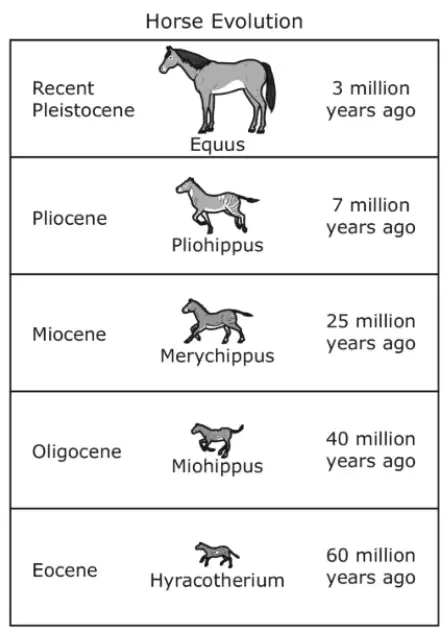
The diagram shows data on the evolution of horses. The data in the diagram is evidence that —
a new species of horse suddenly appeared
horses slowly developed over time
horses have similar stages of rapid embryological development
horses have a common ancestry with other hooved animals
Farmers spray pesticides on their plants to protect the plants from being eaten by insects. Some individual insects have a genetic mutation that makes them resistant to the toxins in the pesticides. Which statement best describes how only a few resistant individuals resulted in the pesticide becoming ineffective?
The resistant insects change the toxin on the plants, making it safe for others.
The resistant insects grow larger and eat less of the plants.
The resistant insects eat the contaminated surface and leave the rest for others.
The resistant insects are able to survive to reproduce and create a population that is also resistant.
Male guppies found in areas without predators are more colorful than the ones found in locations with large predator populations. A population of adult guppies originating from an area with a large number of predators is transferred to a nearby area with few predators. Which of these is most likely to happen over a few generations?
The mortality rate of the guppies will increase.
Offspring will stop competing for resources.
There will be an increase in mutations in the offspring.
There will be an increase in the number of colorful guppies.
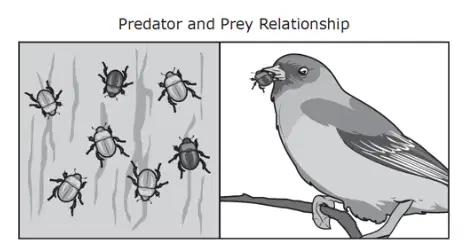
The diagram shows light- and dark-colored beetles that live on a tree. Which result is most likely to occur to the beetle population due to predation over time?
The number of light-colored beetles in the population will increase.
There will be more dark-colored beetles than light-colored beetles.
The number of light-colored beetles will decrease.
The dark-colored beetles will move to a different type of tree.
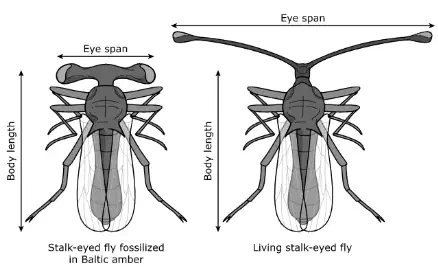
The figure shows fossilized and living stalk-eyed flies from the family Diopsidae. In fossils, the eye spans of the flies are much smaller than those of living flies. Which question would BEST help determine whether the change in eye span in stalk-eyed flies was influenced by natural selection?
Is the eye span of male stalk-eyed flies similar to that of female flies?
What is the relationship between the body length and eye span of stalk-eyed flies?
How does the eye span of stalk-eyed flies compare from one generation to the next?
Do fossilized stalk-eyed flies have a shorter body length than living flies?
Blue flying fish live in the upper layers of the ocean. Blue flying fish have enlarged pectoral fins that enable them to glide for 400 meters above the ocean surface and appear to fly. Which statement best describes how natural selection led to enlarged pectoral fins in blue flying fish?
Fish were able to glide out of the ocean and into other bodies of water to mate with other species.
Fish were able to live both on land and in the water as a result of their larger pectoral fins.
Fish with enlarged pectoral fins were able to glide out of the ocean to escape predators, increasing their fitness.
Fish changed their DNA to express enlarged pectoral fins, changing the allele frequency of the population.
The giant octopus lays 20,000 to 100,000 fertilized eggs. After hatching, most octopuses become prey to larger marine organisms, and less than 5% will reach adulthood to reproduce. One benefit of the giant octopus laying many eggs is to —
increase the average body size for surviving individuals to avoid predation
decrease competition between different octopus species to maintain resources in the population
increase the chance that more individuals will survive to maintain the population
decrease the likelihood of offspring being consumed by predators
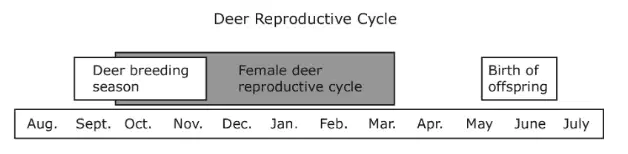
What is the most likely explanation for white-tailed deer having a seasonal breeding cycle instead of a monthly breeding cycle like many domesticated animals?
Male and female deer come into contact with each other only in the fall.
Large predators are not found in deer habitats during the spring and summer months.
Giving birth only in the spring and summer ensures that offspring are born when food is most available.
Deer give birth in the spring and summer in order to avoid being pregnant during the hot summer months.
Analyze and evaluate the relationship of natural selection to adaptation and to the development of diversity in and among species. The salamanders of the genus Ambystoma in northeastern North America are an entirely female population that reproduces asexually through the process of cloning. However, they have developed a way of inserting DNA from other species of salamanders into their own DNA. How has DNA from other salamander species helped these Ambystoma salamanders survive environmental changes over the past 6 million years?
By decreasing the mutations that occur in the DNA
By increasing genetic diversity in the population
By making the DNA more similar across the population
By creating many genetically identical individuals
A
B
C
D
A
B
C
D

