
Font size
 Worksheets
Mid Year Review
Total questions: 31
Worksheet time: 17mins
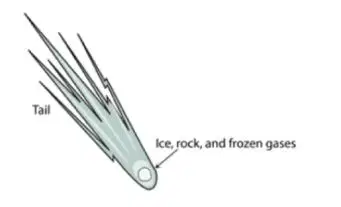
What celestial body is this a picture of?
Comet
Asteroid
Moon
Meteor
How are the gas planets different from the terrestrial planets?
The gas planets are closer to the sun than the terrestrial planets.
The gas planets are larger than the terrestrial planets.
The terrestrial planets are larger than the gas planets.
The terrestrial planets are closer to the sun than the gas planets.
Which statements are true about the planets in our solar system?
Earth, Venus, Mars, and Mercury are located inside the asteroid belt, closer to the sun.
Gas planets are located inside the asteroid belt, closer to the sun.
Saturn, Mars, Jupiter, and Pluto are located on the outer part of the solar system.
Gas planets are located outside the asteroid belt, farther from the sun.
Rocky planets are located closer to the sun.
If you can fit 12 Earths across the diameter of Jupiter, which image shows an appropriate scale model of the Solar System?


What would happen if the sun stopped exerting a force on Earth?
Nothing, Earth would continue its orbit around the sun.
The tilt of the Earth's axis would change.
Earth's North and South poles would be reversed.
Earth would leave its orbit and travel in a straight line.
Spring tides (the highest high tide) happen during which moon phases?
New and 1st Quarter
Full and New
Full and 3rd Quarter
1st and 3rd Quarter
The most extreme high and low tides occur
when the sun, earth, and moon are at right angles to one another.
each time the earth rotates.
when the sun, earth, and moon are lined up in a straight line.
in the morning and evening.
Mars is an inner planet and Jupiter is an outer planet. Which best describes the relationship between the two planets?
They are made of the same materials.
They orbit the Sun in opposite directions.
They have the same orbital periods around the Sun.
They are located on opposite sides of the asteroid belt.
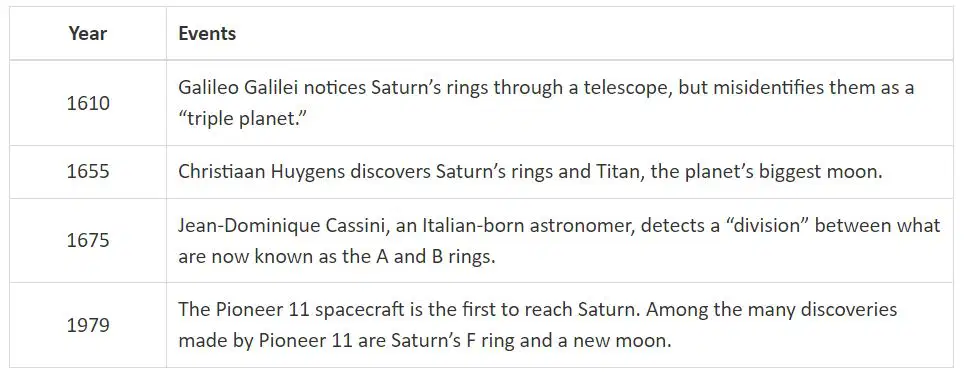
The table describes some observations of Saturn.
Which of these discoveries followed the identification of Saturn’s biggest moon?
Discovery of the A, B, and F rings and a new moon to Saturn.
Discovery of Saturn’s ring and the telescope.
Identification of Saturn as a triple planet along with A and B rings.
Discovery of the telescope and the F ring of Saturn.
Which fact best explains why there is life on Earth but not on the Moon?
The Moon has no gravity.
The Moon does not go around the Sun.
The Moon is much smaller than Earth.
The Moon has little water and oxygen.
Of all the planets in our solar system, which characteristic can ONLY be found on Earth?
Water is found in all 3 states of matter.
Earth's crust is made of solid rock.
There are gases in the atmosphere.
Earth's surface has craters made from meteorites hitting it.
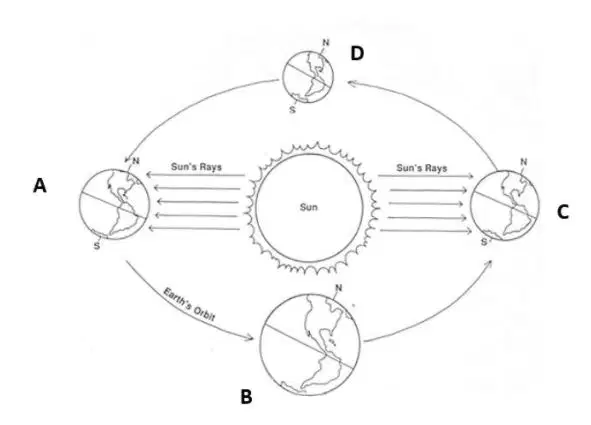
The season at position A in the Northern Hemisphere is
Spring
Summer
Winter
Fall
Which of these are both supplied to Earth by the Sun?
friction and electricity
coal and oil
heat and light
gravity and magnetism
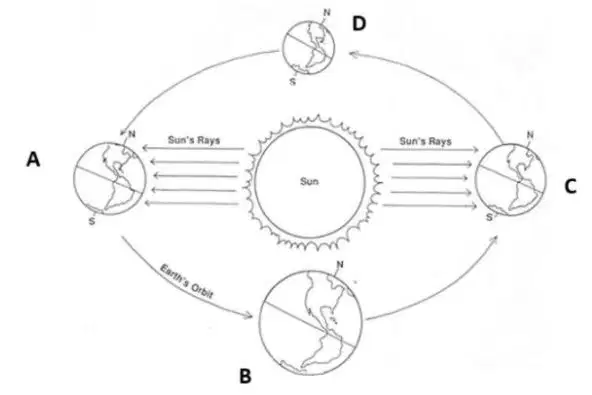
The season in the Northern Hemisphere at position C is
Spring
Summer
Winter
Fall+
Which diagram shows the Moon when it is least visible from Earth?


A student developed the hypothesis below. Choose whether the underlined section is the independent or dependent variable.
If I raise the temperature of a cup of water, then the amount of sugar that can be dissolved in it will be increased.
Independent variable
Dependent variable
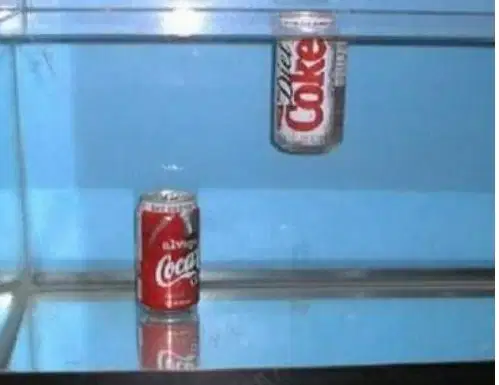
What inference can be made by looking at the picture below?
Regular Coke is less dense than Diet Coke.
Diet Coke is more dense than water.
Diet Coke is less dense than regular Coke.
Regular Coke is less dense than water

How many different elements are represented in this chemical equation?
2
3
4
5

How many different compounds are in the equation?
1
2
3
4

Which of the following are true about this chemical equation? Select all that apply.
There are the same number of atoms of each element on both sides of the equation.
There are different numbers of atoms of each element on one side of the equation than there are on the other.
There are different elements on one side of the equation than on the other side.
There are the same elements on both sides of the equation.
Where do the protons live in an atom?
In the electron shell
In the nucleus
Which subatomic particles live in the nucleus of an atom?
Neutrons
Electrons
Protons
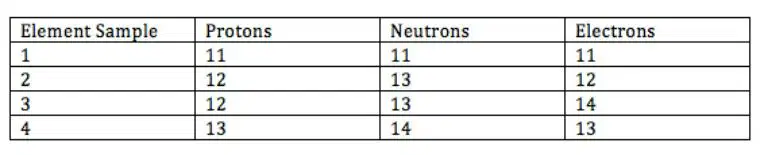
A student is working in the lab with four element samples. Which two samples are samples of the same element?
Sample 1
Sample 2
Sample 3
Sample 4
What are the 2 most abundant gases in the Earth's atmosphere?
Oxygen
Hydrogen
Carbon dioxide
Nitrogen
When thermal (heat) energy is added to water, what happens at the molecular level?
Molecules move slower; liquids change into vapors.
Molecules move faster; liquids change into vapors.
Molecules move slower; liquids change into solids.
Molecules move faster; liquids change into solids.
When is the force of gravity between two objects greatest?
When masses are small and objects are far apart
When masses are small and the objects are close together
When masses are large and objects are far apart
When masses are large and objects are close together
The chemical symbol for niobium is Nb. Based on its symbol, what can be concluded about niobium?
Niobium is a compound.
Niobium is an element.
Niobium is a metal.
Niobium is a mixture.
When table salt (NaCl) is produced, which of the following best describes the actions of the sodium (Na) and chlorine (Cl) atoms?
Sodium and chlorine atoms bond chemically.
Sodium atoms replace chlorine atoms.
Sodium and chlorine atoms mix together.
Sodium atoms dissolve in chlorine atoms.
Ammonia (NH3) is an ingredient in many household cleaning products. Ammonia is made in a chemical process from nitrogen (N2) and hydrogen (H2). Which chemical equation models this reaction?


Which picture best shows what change occurs when heat is added to ice?


Condensation in the water cycle can best be described as the result of water vapor
rising into the atmosphere, warming and changing into a gaseous form.
changing from a liquid form into a solid and forming snow.
rising into the atmosphere, cooling and changing into a liquid form.
changing from a gas form into a solid and forming hail.
changing from a gas form into a solid and forming hail.

