wayground logo

Free Printable Worksheets

Font size

S
M
L
XL
Worksheets

11.1 -11.2 Quizizz

Total questions: 77

Worksheet time: 3hrs 5mins

Name
Class
Date
1.

Which graph represents g(x)=x3+2g(x)=-\sqrt[]{x-3}+2 ?

a)

b)

c)

d)

2.

Which graph represents g(x)=x+3+2g(x)=-\sqrt[]{x+3}+2 ?

a)

b)

c)

d)

3.

Which graph represents g(x)=x+3+2g(x)=\sqrt[]{x+3}+2 ?

a)

b)

c)

d)

4.

Which graph represents g(x)=x3+2g(x)=\sqrt[]{x-3}+2 ?

a)

b)

c)

d)

5.

Graph the function y=x3 +2y=-\sqrt{x-3}\ +2  

a)
b)
c)
d)
6.
What is the domain of the function in this graph?
a)

(-∞,3]

b)

[3,∞)

c)

(-∞,0]

d)

[0,∞)

7.

What is the range of the function in this graph?

a)

(-∞,3]

b)

[3,∞)

c)

(-∞,0]

d)

[0,∞)

8.
What is the domain of this graph?
a)

[ -1,∞)

b)

(-∞,-1]

c)

[0,∞)

d)

(-∞,0]

9.

What is the range of this graph?

a)

[ -1,∞)

b)

(-∞,-1]

c)

[0,∞)

d)

(-∞,0]

10.

What is the domain of this function?

y=x13y=\sqrt{x-1}-3  

a)

[1,∞)

b)

(-∞,1]

c)

[-3,∞)

d)

[-1,∞)

11.

What is the domain of the function?

a)

[0,∞)

b)

[-2,∞)

c)

(-∞,-2]

d)

[2,∞)

12.

What is the range of the function?

a)

(-∞,3]

b)

[2,∞)

c)

[3,∞)

d)

(-∞,2]

13.

What is the range of this function?

y=x2+4y=\sqrt{x-2}+4  

a)

[-2,∞)

b)

[2,∞)

c)

[4,∞)

d)

[-4,∞)

14.
Describe the transformation.
a)
Down 1
b)
Reflect over y-axis
c)
Up 1
d)
Reflect over x-axis
15.
What are the transformations of this functions compared to the parent function?
a)
Shifted down 2
b)
Shifted up 2
c)
Shifted left 2
d)
Shifted right 2
16.
What are the transformations of this functions compared to the parent function?
a)
Shifted right 5, shifted down 2, and reflected over the x-axis
b)
Reflected over the x-axis, vertical stretch, and shifted right 5
c)
Reflected over the x-axis, vertical stretch, and shifted left 5
d)
Shifted right 5, shifted down 2
17.
What are the transformations to the graph compared to the parent function?
a)
Shifted right 2, shifted up 3, and reflected over the y-axis
b)
Shifted left 2, shifted up 3, and reflected over the y-axis
c)
Shifted left 2, shifted up 3, and reflected over the x-axis
d)
Shifted right 2, shifted up 3, and reflected over the x-axis
18.

Describe the transformation.

a)

Left 1unit, Reflect over x-axis, up 2 units

b)

Left 1unit, Reflect over y-axis, down 2 units

c)

Right 1 unit, Reflect over x-axis, up 2 units

d)

Right 1unit, Reflect over y-axis, up 2 units

19.

Which is an equation that shifts the graph of the function above to the left 5 units?

a)
b)
c)
d)
20.
What are the transformations for the graph of
the parent function f(x) = √x  to the function above 
a)
Vertical Stretch by a factor of 2; translated down 5 units 
b)
Shifted right 2 units and down 5 units 
c)
Vertical stretch by a factor of 2; translated left 5 units
d)
Vertical stretch by a factor of 2; translated right one unit 
21.
a)

y=x+1y=-\sqrt{x+1}

b)

y=x+1y=\sqrt{x+1}

c)

y=x1y=-\sqrt{x}-1

d)

y=x+1y=\sqrt{x}+1

22.

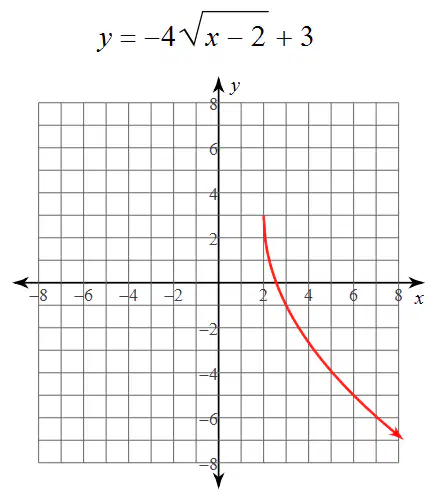
Determine the equation for the graph.

a)

y=2x4y=2\sqrt{x}-4

b)

y=x4y=-\sqrt{x-4}

c)

y=2xy=2\sqrt{x}

d)

y=2x+4y=2\sqrt{x}+4

23.

Match the correct equation with the given graph.

a)

y=x+2y=\sqrt{x}+2

b)

y=x2y=\sqrt{x}-2

c)

y=x+2y=\sqrt{x+2}

d)

y=x2y=\sqrt{x-2}

24.

What function best describes this graph?

a)

y=x+42y=-\sqrt{x+4}-2

b)

y=x42y=\sqrt{x-4}-2

c)

y=x42y=-\sqrt{x-4}-2

d)

y=x+4+2y=\sqrt{x+4}+2

25.

Which graph represents the function? g(x)=34x43+5g\left(x\right)=-\frac{3}{4}\sqrt[3]{x-4}+5

a)

b)

c)

d)

26.

Which graph represents the function? g(x)=34x+43+5g\left(x\right)=-\frac{3}{4}\sqrt[3]{x+4}+5

a)

b)

c)

d)

27.

Which graph represents the function? g(x)=34x534g\left(x\right)=\frac{3}{4}\sqrt[3]{x-5}-4

a)

b)

c)

d)

28.

Which graph represents the function?

a)
b)
c)
d)
29.

Which graph represents the function?

a)
b)
c)
d)
30.

Which is the domain?

a)

(-∞,∞)

b)

[-1,∞)

c)

[2,∞)

d)

[1,∞)

31.

Which is the range?

a)

(-∞,∞)

b)

[-1,∞)

c)

[2,∞)

d)

[1,∞)

32.
What is the Domain of ALL Cube Root Functions in interval notation?
a)
(−∞,∞)
b)
−∞<x<∞
c)
(−∞,0]
d)
All Cube Root Functions are different.
33.

What is the Range of ALL Cube Root Functions in interval notation?

a)
(−∞,∞)
b)
−∞<x<∞
c)
(−∞,0]
d)
All Cube Root Functions are different.
34.

What is the inflection (center) point of the function?

a)
(5,-1)
b)
(5,1)
c)
(-5,-1)
d)
(-5,1)
35.
If f(x) = ∛(x) is reflected over the x-axis, vertically compressed by a factor of 1/4, and shifted left 9, which equation is correct?
a)
1/4 ∛(x + 9)
b)
1/4 ∛(x - 9)
c)
- 1/4 ∛(x + 9)
d)
- 1/4 ∛(x - 9)
36.
Identify the Transformations. 
a)
Vertical stretch by 2 and down 4
b)
Horizontal compression by ½ and down 4
c)
Vertical stretch by 2 and up 4
d)
Horizontal compression by ½ and right 4
37.
What transformations have occurred to get the graph of g(x) from the graph of f(x)?
a)
reflection over the x-axis,vertical compress by a factor of 5
b)
reflection over the y-axis,vertical compress by a factor of 5
c)
reflection over the x-axis,vertical stretch by a factor of 5
d)
reflection over the y-axis,vertical stretch by a factor of 5
38.

Which function matches the graph?

a)

A

y = x+33+2y\ =\ \sqrt[3]{x+3}+2  

b)

B

y =  x+332y\ =\ \ \sqrt[3]{x+3}-2  

c)

C

y = x33+2y\ =\ \sqrt[3]{x-3}+2  

d)

D

y = x23+3y\ =\ \sqrt[3]{x-2}+3  

39.

Match the equation with the graph

a)

y=x33+5y=\sqrt[3]{x-3}+5

b)

y=x335y=\sqrt[3]{x-3}-5

c)

y=x+33+5y=\sqrt[3]{x+3}+5

d)

y=x+335y=\sqrt[3]{x+3}-5

40.

Match the equation with the graph

a)

y=x33y=\sqrt[3]{x-3}

b)

y=x+33y=\sqrt[3]{x+3}

c)

y=x3+3y=\sqrt[3]{x}+3

d)

y=x33y=\sqrt[3]{x}-3

41.

How do you find an inverse of a point?

a)

Switch x and y

b)

Flip the signs on all the x-values

c)

Flip the signs on all the y-values

d)

Do nothing

42.

Are the relations inverses?

a)

yes

b)

no

43.

Check all of the ordered pairs that are on the inverse of f(x).

a)

(-3, -1)

b)

(0, 1)

c)

(15, 2)

d)

(1, 1)

e)

(2, 17)

44.

Are the relations inverses?

a)

yes

b)

no

45.
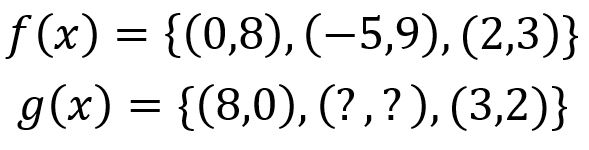
What are the missing values if g(x)=f-1(x)?
a)
(9,-5)
b)
(-9,-5)
c)
(5,9)
d)
(-9,5)
46.

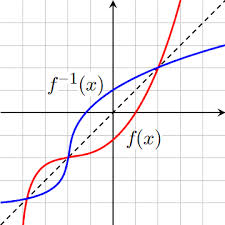
How can you tell if a graph shows and function and its inverse?

a)

The graphs will be reflected over y=x

b)

The graphs will be reflected over y=0

c)

The graphs will be reflected over x=0

d)

You can't

47.
The inverse has been reflected over which line?
a)
y = x
b)
x = 0
c)
y = 0
d)
x = -y
48.

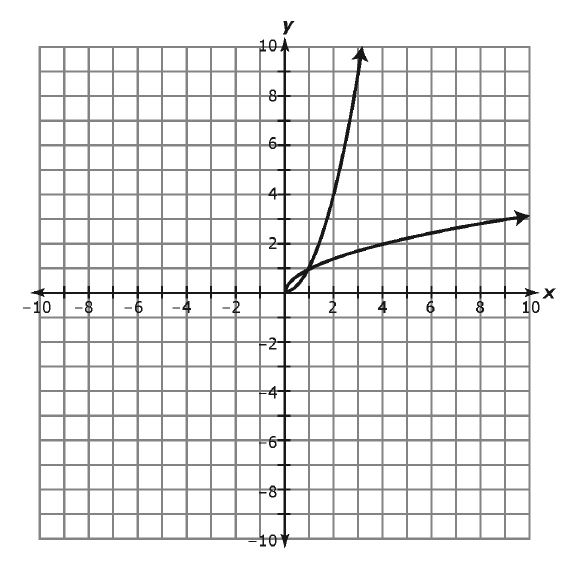
What's the best description?

a)

They are both functions, but not inverse functions.

b)

They are reflected over y=x, but they are not both functions.

c)

They are not reflected over y=x, and they are not both functions.

d)

They are inverse functions.

49.

Are the graphs inverses?

a)

yes

b)

no

50.

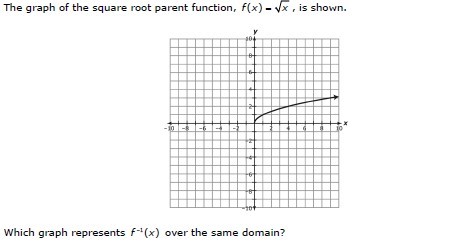
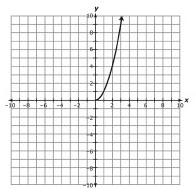
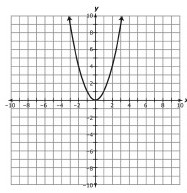
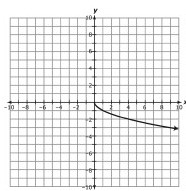
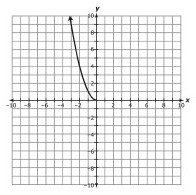
Which graph represents f-1(x) over the same domain?
a)
b)
c)
d)
51.

What's the best description?

a)

They are both functions, but not inverse functions.

b)

They are reflected over y=x, but they are not both functions.

c)

They are not reflected over y=x, and they are not both functions.

d)

They are inverse functions.

52.
When finding the inverse of a relation, 
1st you replace f(x) with y
2nd switch the x's and y's
What do you do next?
a)
solve for y
b)
replace y with f-1(x)
c)
solve for x
d)
find the greatest common factor
53.

Find the inverse of f(x)=x3+7f\left(x\right)=x^3+7

a)

f1(x)=x73f^{-1}\left(x\right)=\sqrt[3]{x-7}

b)

f1(x)=x37f^{-1}\left(x\right)=\sqrt[3]{x}-7

c)

f1(x)=(x7)3f^{-1}\left(x\right)=\left(x-7\right)^3

d)

f1(x)=x3f^{-1}\left(x\right)=x^3

54.

What is the inverse function of f(x)=x32f\left(x\right)=\frac{x^3}{2}  ?

a)

f1=2x3f^{-1}=2x^3  

b)

f1=2x3f^{-1}=\sqrt[3]{2x}  

c)

f1=x23f^{-1}=\sqrt[3]{\frac{x}{2}}  

d)

None of the above

55.

Find the inverse of f1(x)=(x4)3f^{-1}\left(x\right)=\left(x-4\right)^3

a)

f1(x)=x43f^{-1}\left(x\right)=\sqrt[3]{x-4}

b)

f(x)=x3+4f\left(x\right)=\sqrt[3]{x}+4

c)


f1(x)=x34f^{-1}\left(x\right)=\sqrt[3]{x}-4

d)

f1(x)=x+43f^{-1}\left(x\right)=\sqrt[3]{x+4}

56.

Given f(x)=(x5)3f\left(x\right)=\left(\frac{x}{5}\right)^3 , which is f-1(x)?

a)

f1(x)=5x3f^{-1}\left(x\right)=5\sqrt[3]{x}

b)

f1(x)=x35f^{-1}\left(x\right)=\frac{\sqrt[3]{x}}{5}

c)

f1(x)=5x3f^{-1}\left(x\right)=\sqrt[3]{5x}

d)

f1(x)=x53f^{-1}\left(x\right)=\sqrt[3]{\frac{x}{5}}

57.

Which of the following is the inverse function of f(x)=3(x2)3+5f\left(x\right)=3\left(x-2\right)^3+5  

a)

f1=x533+2f^{-1}=\sqrt[3]{\frac{x-5}{3}}+2  

b)

f1=3x23+5f^{-1}=3\sqrt[3]{x-2}+5  

c)

f1=13x53+2f^{-1}=\frac{1}{3}\sqrt[3]{x-5}+2  

d)

None of the above

58.

What is the inverse of the given function?

f(x)=9x3+3f\left(x\right)=\sqrt[3]{9-x}+3

a)

f1(x)=(x3)3+9f^{-1}\left(x\right)=-\left(x-3\right)^3+9

b)

f1(x)=(x3)39f^{-1}\left(x\right)=\left(x-3\right)^3-9

c)

f1(x)=(x9)3+3f^{-1}\left(x\right)=-\left(x-9\right)^3+3

d)

f1(x)=(x+9)33f^{-1}\left(x\right)=-\left(x+9\right)^3-3

59.

What is the inverse of the given function?

a)

f1(x)=2x+123f^{-1}\left(x\right)=\sqrt[3]{-2x+12}^{ }

b)

f1(x)=2x3+12f^{-1}\left(x\right)=\sqrt[3]{-2x}+12

c)

f1(x)=(2x+12)3f^{-1}\left(x\right)=\left(-2x+12\right)^3

d)

f1(x)=(2x12)3+12f^{-1}\left(x\right)=\left(2x-12\right)^3+12

60.

What is the inverse function of f(x)=(x+9)3f\left(x\right)=\left(x+9\right)^3  

a)

  f1(x)=x39f^{-1}\left(x\right)=\sqrt[3]{x}-9

b)

f1(x)=x93f^{-1}\left(x\right)=\sqrt[3]{x-9}  

c)

f1(x)=x3+9f^{-1}\left(x\right)=\sqrt[3]{x}+9  

d)

f1(x)=x+93f^{-1}\left(x\right)=\sqrt[3]{x+9}

61.

What is the inverse quadratic function?

a)

f1(x)=x2f^{-1}(x)=x^2

b)

f1(x)=± xf^{-1}\left(x\right)=\pm\ \sqrt[]{x}

c)

f1(x)=x2f^{-1}(x)=-x^2

d)

It doesn't have an inverse.

62.

Find the inverse of f(x) = (x-5)2 on the domain [5,∞)

a)

f1(x)=x+5f^{-1}(x)=\sqrt{x}+5

b)

f1(x)=x53f^{-1}(x)=\sqrt[3]{x-5}

c)

f1(x)=x+5f^{-1}(x)=\sqrt{x+5}

d)

f1(x)=x25f^{-1}(x)=x^2-5

63.

Find the inverse of f(x)=x25f(x)=x^2-5 on the domain (-∞,0]

a)

f1(x)=x+5f^{-1}(x)=\sqrt{x}+5

b)

f1(x)=x5f^{-1}(x)=\sqrt{x-5}

c)

f1(x)=x+5f^{-1}(x)=-\sqrt{x+5}

d)

f1(x)=x+5f^{-1}(x)=\sqrt{x+5}

64.

Find the inverse function of y=x2+9y=x^2+9  with a restricted domain of  (-∞,0]

a)

y=(x+9)2y=\left(x+9\right)^2  

b)

y=x9y=-\sqrt{x-9}  

c)

y=x9y=\sqrt{x-9}  

d)

y=x+9y=\sqrt{x+9}  

65.

Find the inverse function of y=x2+9y=x^2+9  with a restricted domain of  [0,∞)

a)

y=(x+9)2y=\left(x+9\right)^2  

b)

y=x9y=-\sqrt{x-9}  

c)

y=x9y=\sqrt{x-9}  

d)

y=x+9y=\sqrt{x+9}  

66.

Find the inverse of  f(x) =12x2f\left(x\right)\ =\frac{1}{2}x^2  on the domain [0,∞)

a)

f1(x) = 2xf^{-1}\left(x\right)\ =-\ \sqrt[]{2x}   

b)

f1(x) =2xf^{-1}\left(x\right)\ =\sqrt{2x}   

c)

f1(x) =f^{-1}\left(x\right)\ =   2x-2x  

d)

f1(x) =f^{-1}\left(x\right)\ =   12x\sqrt{\frac{1}{2}x}  

67.

Find the inverse of

f(x) = x + 1f\left(x\right)\ =\ \sqrt{x\ +\ 1}  

a)

f1(x) = (x+1)2f^{-1}\left(x\right)\ =\ \left(x+1\right)^2  on the domain (-∞,0]

b)

f1(x)=x21f^{-1}\left(x\right)=x^2-1  on the domain [0,∞)

c)

f1(x) = x21f^{-1}\left(x\right)\ =\ x^2-1  on the domain (-∞,0]

d)

f1(x) = x2f^{-1}\left(x\right)\ =\ -x^2   on the domain [0,∞)

68.

What is the inverse of the given quadratic function? f(x)=4(x+3)2f\left(x\right)=4\left(x+3\right)^2  when [-3,∞)

a)

f1(x)=x23f^{-1}\left(x\right)=-\frac{\sqrt{x}}{2}-3  

b)

f1(x)=4x+3f^{-1}\left(x\right)=\sqrt{4x+3}  

c)

f1(x)=x23f^{-1}\left(x\right)=\frac{\sqrt{x}}{2}-3  

d)

f1(x)=2x3f^{-1}\left(x\right)=2\sqrt{x}-3  

69.

Find the inverse of  f(x) =12x2f\left(x\right)\ =\frac{1}{2}x^2  on the domain (-∞,0]

a)

f1(x) = 2xf^{-1}\left(x\right)\ =-\ \sqrt[]{2x}   

b)

f1(x) =2xf^{-1}\left(x\right)\ =\sqrt{2x}   

c)

f1(x) =f^{-1}\left(x\right)\ =   2x-2x  

d)

f1(x) =f^{-1}\left(x\right)\ =   12x\sqrt{\frac{1}{2}x}  

70.

Find the inverse function of f(x)=x6f\left(x\right)=\sqrt{x}-6  

a)

f1(x)=(x+6)2f^{-1}\left(x\right)=\left(x+6\right)^2  on the domain [-6,∞)

b)

f1(x)=(x6)2f^{-1}\left(x\right)=\left(x-6\right)^2  on the domain (-∞,-6)

c)

f1(x)=(x+6)2f^{-1}\left(x\right)=\left(x+6\right)^2   on the domain (-∞,-6)

d)

f1(x)=x2+36f^{-1}\left(x\right)=x^2+36   on the domain [-6,∞)

71.

What is the RANGE of the INVERSE function?

a)

{-5, 1, 3, 4}

b)

{-4, -3, -1, 5}

c)

{-4, -2, 0, 7}

d)

{-7, 0, 2, 4}

72.

Here is the domain and range for a function:

D: (-∞, ∞)

R: [3, ∞)


What is the domain and range of the inverse?

a)

D: [3, ∞)

R: (-∞, ∞)

b)

D: (-∞, ∞)

R: [3, ∞)

73.

What is the DOMAIN of the INVERSE function?

a)

{-7, -2, -1, 1, 4}

b)

{-6, -3, -2, 0, 3}

c)

{-3, 0, 2, 3, 6}

d)

{-4, -1, 1, 2, 7}

74.

How must the domain of f(x) be restricted such that g(x)=f-1(x) ?

a)

(-∞,4]

b)

[4,∞)

c)

(-∞,0]

d)

[0,∞)

75.

How must the domain of f(x) be restricted such that g(x)=f-1(x) ?

a)

x ≤ 0

b)

x ≥ 0

c)

x ≤ 3

d)

x ≥ 3

76.

TRUE OR FALSE:

If the DOMAIN of a function is (-∞, 2], then the DOMAIN of the INVERSE function will also be (-∞, 2].

a)

false

b)

true

77.

TRUE OR FALSE:

If the RANGE of a function is (4, 2], then the DOMAIN of the INVERSE function will also be (4, 2].

a)

false

b)

true