NEW
Font size
 Worksheets
Bio MYA Review
Total questions: 23
Worksheet time: 19mins


The diagram below shows two setups used to study bacterial growth. Each setup initially contained an equal number of the bacterium E. coli in different carbohydrate solutions. After one hour, a 1-milliliter sample was drawn from each tube and analyzed. The number of bacteria found in the sample from test tube 1 was higher than the number in the sample from test tube 2.
What conclusion regarding this investigation is NOT valid?
The rate of growth of E. coli depends on the type of carbohydrate present.
All bacteria grow best in a solution of glucose than in a solution of sucrose.
E. coli grows better in a 10% solution of glucose than in a 10% solution of sucrose.
The type of sugar solution will make a difference in the rate of growth of E. coli.
If new experimental findings contradict a scientific theory, what might happen to the theory?
The theory could become a law, with an exception for the new evidence.
The new evidence could be rejected because it does not support the theory.
The theory could stand as written, ignoring the new evidence.
The new evidence could be accepted and the theory changed.
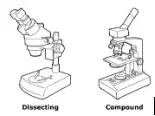
Two types of microscopes are shown in the diagram below.
Which statement describes the main difference between the dissecting microscope and the
compound microscope?
The dissecting microscope has one fewer lens than the compound microscope.
The dissecting microscope uses an electric bulb for light, and the compound microscope uses sunlight.
The dissecting microscope has a small viewing stage and the compound microscope has a large viewing stage.
The dissecting microscope is used to view larger objects, and the compound microscope is used to view very small objects.
Students use a compound light microscope to view unicellular organisms collected from pond water. Which statement describes why using a compound light microscope is better to view the structures of these organisms than a dissecting microscope?
Compound light microscopes use visible light.
Compound light microscopes use a single glass lens.
Compound light microscopes have higher magnification.
Compound light microscopes are used to view live specimens


Based off this punnett square, what fraction of the offspring will have wrinkled, green seeds?
9/16
3/16
1/16
16/16
The growth of which of the following usually occurs first in primary succession on a bare rock?
grasses
trees
lichens
shrubs
What is the role of the pioneer species in primary formation.
to provide oxygen for the environment
to provide a habitat for insects
to break down rock and start the formation of soil
to provide color for the environment
Selectively permeable

This type of inheritance pattern is a MIXTURE of two traits. This is known as ---
incomplete dominance.
codominance
When one allele is not dominant over the other, resulting in both traits expressed in a heterozygous individual.....
Incomplete Dominance
Codominance

What does this Punnett square and the probabilities of the ofspring represent?
incomplete dominance
codominance

Codominance occurs in calico cats, which allows for the Black and Tan colors to show. What percentage of the offspring will be calico (black and tan spotted)?
25
50
75
100

Incomplete dominance occurs in cats, which allows them to be Black, White, or gray as shown on this Punnett square. What percentage of the offspring will be black?
25
50
75
100


When do plant cells perform cellular respiration?
day
night
never
every Monday at 1:00 pm

What happens to the nitrogen in the atmosphere when it is fixed into usable forms by lightning?
nitrogen atoms are destroyed
nitrogen atoms are created
nitrogen atoms rearrange into a different form
nitrogen atoms disappear

Which activity does NOT release carbon into the atmosphere?
dead organisms decompose
fossil fuels burn during combustion
water cools and condenses to form clouds
humans exhale during respiration
Enzymes are an example of
Lipids
Carbohydrate
Protein
Nucleic Acid