
Font size
 Worksheets
Unit 3 Review
Total questions: 25
Worksheet time: 13mins
Territorial expansion in the early 1800s promoted nationalist feelings as the nation grew and developed a unique identity. What other consequence was a result of the expansion?
Disputes over slavery in the new territory led to increased sectionalism.
The lack of valuable natural resources led to an economic downturn.
The nation's population doubled when the Native Americans living in the territory were granted citizenship.
Lack of information about the new territory made people reluctant to move into it.
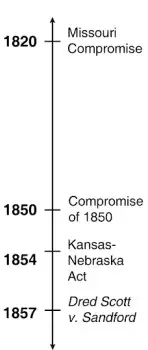
Use the provided timeline to answer the question. How do the events on the timeline demonstrate the legislative and judicial branches' response to sectionalism and westward expansion throughout the 1800s?
The federal government reduced the number of states where slavery could exist.
The federal government limited the rights of slaveholders in the western territories.
The federal government maintained an equal balance of slave states and free states.
The federal government continued to allow the expansion of slavery in western territories
Which of the components of the Compromise of 1850 were MOST supported by abolitionists? Select two answers.
A. California admitted to the Union as a free state
B. Tougher Fugitive Slave Law that made it more likely people would be returned to slavery
C. Allowing popular sovereignty in New Mexico and Utah Territories
D. Helping to pay off Texas' debts
E. An end to the slave trade in Washington, D.C.
Use the excerpt below to answer the question.
"I consider, then, the power to annul a law of the United States, assumed by one State, incompatible with the existence of the Union, contradicted expressly by the letter of the Constitution, unauthorized by its spirit, inconsistent with every principle on which It was founded, and destructive of the great object for which it was formed". —Andrew Jackson, Proclamation Regarding Nullification, 1832
How did President Jackson’s response to South Carolina’s attempt to nullify the Tariff of 1832 show differences in their views regarding the Union?
Jackson argued that state attempts to nullify the tariff were unconstitutional.
Jackson recognized that states had the right to nullify federal laws.
Jackson repealed the tariffs in the South because he agreed they hurt southern manufacturing.
Jackson refused to enforce the tariffs because he believed Congress exceeded its power.
Read the passage and answer the question that follows. [In July 1848, hundreds of reformers gathered in Seneca Falls, NY, in order to organize and act in support of women’s rights. Participants included Elizabeth Cady Stanton, Lucretia Mott, and Frederick Douglass. They signed a Declaration of Sentiments that stated in part, “We hold these truths to be self-evident, that all men and women are created equal . . . .”]
The Seneca Falls Convention’s Declaration of Sentiments illustrates the lasting impact of which of the following?
the values expressed in the Declaration of Independence
the principle of judicial review upheld in Marbury v. Madison
the system of checks and balances included in the Constitution
the resistance to federal power evidenced in the Nullification Crisis
Use the information to answer the question that follows.
[A new method of communication was first successfully tested in 1844 when a message was sent from Washington, D.C., to a railroad station in Baltimore, Maryland. After that, Americans had a powerful tool that made trains run more safely, enabled business to be conducted more easily across great distances, and helped westward expansion.]
What method of communication does this paragraph describe?
the radio
the telegraph
the telephone
the phonograph
How did transportation issues in the early 1800s contribute to sectionalism in the United States?
New transportation systems such as railroads and canals favored connecting the North and West, limiting the South’s access to major trade networks.
Railroads were funded with tax money, upsetting many northerners who objected to funding a project that only benefited the South.
Southerners felt that too much of their valuable farmland was being taken to build unnecessary canals in the South.
Westerners objected to new transportation systems being built to connect the South and North, excluding the West.
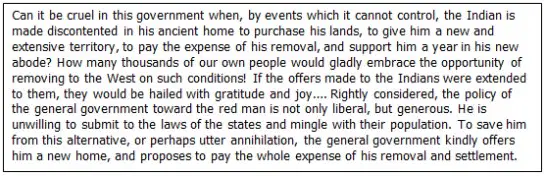
Based on this excerpt, President Jackson would most likely agree with which statement?
It is in the best interests of Native Americans to agree to removal and move westward.
It is unfair and unjust for Native Americans to be forcibly removed from their land.
Native Americans have a right to the land because they owned it first.
The government should forcibly take Native American land without compensation.
Use the information to answer the question that follows. [In its 1857 Dred Scott v. Sandford decision, the Supreme Court ruled that Congress could not ban slavery in U.S. territories. Also, in upholding the Fifth Amendment rights of slave owners, the Court recognized slaves as property. It further ruled that African Americans were not United States citizens.] How did this Supreme Court decision affect life in the United States?
It strengthened slavery as a part of United States society
It settled the debate over states’ rights and federal power.
It denied the government a role in making decisions about the economy.
It gave states the authority to determine who was a United States citizen.
Why was the Monroe Doctrine a significant foreign policy achievement during the 1820s?
It brought about a gradual end to the trans-Atlantic slave trade.
It ensured that revolution would not spread beyond South America.
It gave the United States control over Spain’s South American colonies.
It established the United States as a major power in the Western Hemisphere.
How did President Jackson’s response to South Carolina’s attempt to nullify the Tariff of 1832 show differences in their views regarding the Union?
A. Jackson argued that state attempts to nullify the tariff were unconstitutional.
B. Jackson recognized that states had the right to nullify federal laws.
C. Jackson repealed the tariffs in the South because he agreed they hurt southern manufacturing.
D. Jackson refused to enforce the tariffs because he believed Congress exceeded its power.
What role did the Election of 1860 play in the outbreak of the civil war?
It caused a split in Southern Democrats in their support for Lincoln.
It indicated that many non-slaveholders in the South supported Lincoln.
It confirmed that Southern states feared the election of Lincoln would bring about the end of slavery.
It showed that slave owners in the West viewed Lincoln as one who would protect slavery.
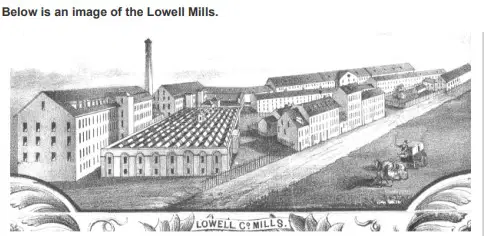
Considering the differences between the North and the South, Lowell Mills, like those pictured below, were part of what change in the American economy during the 1800s?
Anti-tariff feelings in both the North and South
A Market Revolution in which more and more Americans began to leave their homes and farms to work
A focus on growing the U.S. Military strength and forming foreign alliances
A push for more cotton to be planted in Northern states to support the Democratic-Republicans' agrarian goals
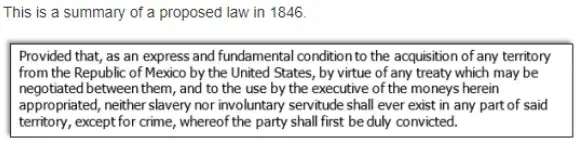
This law had the greatest impact on which group of people?
Democrats
Free Soilers
Secessionists
Southern Whigs
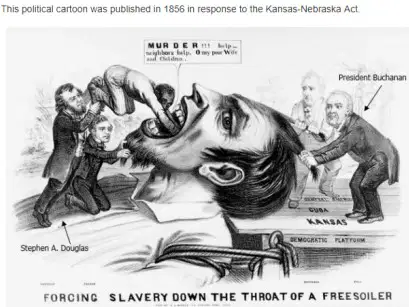
With which statement would the author of this cartoon most likely agree?
Popular sovereignty would lead to the end of slavery in the nation.
The government’s policies supported the expansion of slavery.
Slavery should expand into Latin American countries.
The government was obstructing the expansion of slavery.

Based on the above quotation, what was Jackson's main concern about the Bank of the United States?
It highlighted natural differences that exist in society.
It showcased the results of a superior work ethic by some people.
It promoted the role of the government to provide equal protection to all.
It allowed the government to help the rich more than the poor.
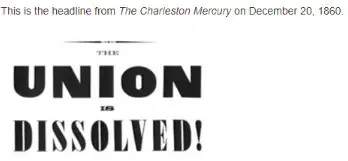
What ultimately led to this announcement?
After the election of President Lincoln, southerners were concerned that slavery would be outlawed.
Southerners feared northern abolitionists such as John Brown were attempting to start slave revolts.
After the Compromise of 1850, southern states enacted the principle of popular sovereignty to retain their status as slave states.
Southerners were angry over the ruling in the Supreme Court in Dred Scott v. Sandford which they believed was hurtful to their economy.
Why would some people support Jackson as opposed to his competitors?
Jackson opposed re-chartering the National Bank.
Jackson supported the forced removal of Native Americans.
Jackson was the first candidate from a western state.
Jackson was a champion of the common man.
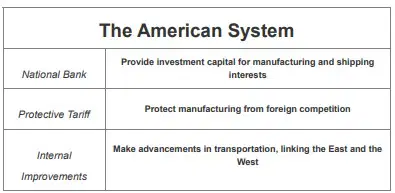
Use the chart to answer the question. Why did this economic policy contribute to sectional tensions between the North and the South?
It extended slavery only in the South.
It added regulations only in the South.
It aided progress, except in the South.
It increased taxes, except in the South.
Use the list of events to answer the question that follows.
1831 – William Lloyd Garrison began publishing The Liberator
1845 – Narrative of the Life of Frederick Douglass published
1852 – Uncle Tom’s Cabin published by Harriet Beecher Stowe
1859 – John Brown arrested after leading a raid at Harper’s Ferry, Virginia
This list identifies events that were important in the movement for what goal?
to annex Texas
to organize labor
to abolish slavery
to limit immigration
"I ordered an efficient military force to take a position between the Nueces and the Del Norte. This has become necessary to meet a threatened invasion of Texas. . . for which extensive military preparation had been made. The invasion was threatened solely because Texas had determined, in accordance with a solemn resolution of the Congress of the United States, to annex herself to our Union, and under these circumstances it was plainly our duty to extend our protection over her citizens and soul." -President James K. Polk, 1846
Read the provided excerpt from the speech. How did the message in this speech impact U.S. foreign policy and geographic expansion?
It led to a war that resulted in a continued adversarial relationship with Mexico.
It led to a breakdown in diplomatic relations with France as competition for trade increased.
It led to an alliance with Spain, which wanted to recover land it lost after Mexico declared independence.
It led to improved relations with Great Britain, which wanted to increase its influence in the Western Hemisphere.
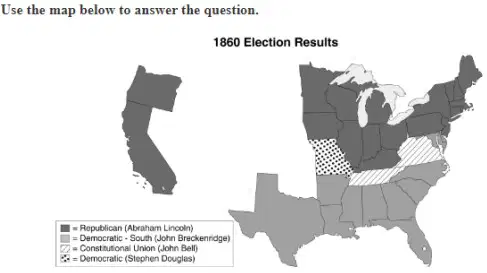
Based on the information on the map, what role did the Election of 1860 play in the outbreak of the civil war?
It caused a split in Southern Democrats in their support for Lincoln.
It indicated that many non-slaveholders in the South supported Lincoln
It confirmed that Southern states feared the election of Lincoln would bring about the end of slavery
It showed that slave owners in the West viewed Lincoln as one who would protect slavery
The Kansas-Nebraska Act (1854): Repealed the Missouri Compromise, Opened the territory of Kansas and Nebraska for settlement, Allowed the issue of slavery to be resolved through popular sovereignty
How did the passage of the Kansas-Nebraska Act impact the expansion of slavery in the United States?
It created more free states than slave states.
It encouraged cotton farmers to move westward
It protected slavery west of the Mississippi River.
It contributed to clashes between pro-slavery and anti-slavery forces.
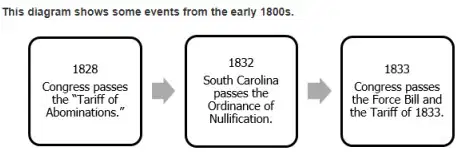
What issue is at the center of these pieces of legislation?
religious revivalism
education reform
women's suffrage
states' rights

Based on the above quotation, what was Jackson's main concern about the Bank of the United States?
It highlighted natural differences that exist in society
It showcased the results of a superior work ethic by some people
It promoted the role of the government to provide equal protection to all
It allowed the government to help the rich more than the poor

