
 Worksheets
Engineering Fundamental
Total questions: 30
Worksheet time: 28mins

What is the SI Base unit for Time?
Hour
Minute
Second
Day

Which prefix has a value of 106?
G
M
k
m
μ

Which option is an example of a Vector?
3km North
100 km/h
40 s
27 ms-1

Which arrow is pointing to the 'sense' of the vector?
A
B
C
D

Which option describes Newton's 1st Law of Motion?
F = ma
For every action there is an equal & opposite reaction
A body will remain stationary or at constant velocity unless an unbalanced force acts upon it
Which option describes Newton's 2nd Law of Motion?
F = ma
For every action there is an equal & opposite reaction
A body will remain stationary or at constant velocity unless an unbalanced force acts upon it

Mr O'Brien placed this coin on the balance in the classroom. How much does it weigh?
5.67 g
5.67 kg
0.0567 N
56.7 N
Mr O'Brien placed this coin on the balance whilst he was on the moon (Acceleration due to gravity on the moon is 1.620 m/s2). What is the mass of the coin on the moon?
5.67 g
5.67 kg
0.0091854 N
9.1854 N

Which property is being defined - "The ability of a material to be hammered or rolled into thin sheets"
Ductility
Malleability
Strength
Stiffness
What is the physical property that can be calculated by measuring the mass and dividing it by volume?
Weight
Porosity
Density
Mass

What subatomic particles would you find in the nucleus of an atom?
Protons only
Protons and Neutrons
Neutrons and Electrons
Protons and Electrons

Which subatomic particle has a neutral or no charge?
Proton
Electron
Neutron

When an atom loses an electron, it becomes a:
positive ion
negative ion
neutral ion
neutral atom

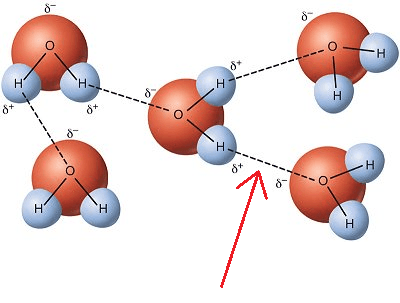
What type of bond is shown in this picture? It is the WEAKEST type & attracts one water compound to another!
Ionic bond
Polar Covalent (dipole)
Nonpolar Covalent
Van der Waals force (dipole)
Which of the following is the most workable of crystal structures?
FCC
BCC
HCP
Simple cubic

Identify the unit cell
simple cubic
BCC
FCC
HCP

Define the term 'allotrope'
Atoms with same proton number but different number of neutrons
Atoms with same proton number but different mass number
Atoms in different arrangement in structure
Atoms in different arrangement and different physical form
Ionic bonds are formed between
metals and metals.
metals and non-metals.
non-metals and non-metals.
none of the above.
Scalar quantities consist of
direction only.
magnitude only.
magnitude and direction.
none of the above.
Identify the property not a characteristic of metals.
malleability
metallic lustre
insulation (heat and electricity)
usually solid at room temperatures
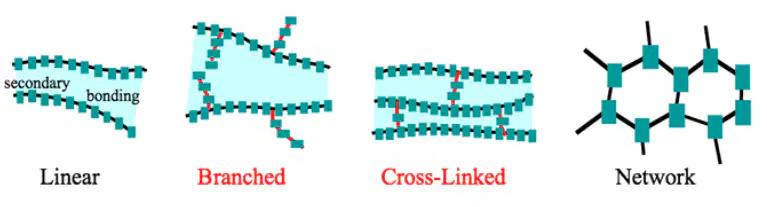
Identify which of the following shows polymer
structures in order of weakest to strongest.
linear, cross-linked, network, branched
branched, linear, cross-linked, network
linear, branched, network, cross-linked
linear, branched, cross-linked, network
Identify which of the following is not an example of
a laminar composite.
bimetallic strip
laminated glass
concrete
plywood
Thermoset polymers exhibit the following primary
type of bonding.
covalent
ionic
saturated
van der Waals
Orthographic drawings
may contain 3D sketches.
must always be dimensioned.
can only be created using drawing instruments.
consist of multiple two-dimensional drawings.

Welding as a joining process is
permanent.
semi-permanent.
temporary
all of the above
The velocity ratio of a pulley system is
equal to the mechanical advantage.
the efficiency of the system.
the same as the number of pulleys.
found by counting the number of ropes supporting
the lower block.

Identify the correct statement about second-class
levers.
The load arm moves further than the effort arm.
The effort arm moves further than the load arm.
The system operates at a mechanical disadvantage.
The fulcrum is positioned between the effort and
the load.

