

wayground logo

Free Printable Worksheets

Font size

S
M
L
XL
Worksheets

Ch. 3 - The Biosphere Test Review

Total questions: 28

Worksheet time: 14mins
Name
Class
Date
1.
The branch of biology that deals with interactions among organisms and between organisms and their environment is called
a)
Evolution
b)
Ecology
c)
Systematics
d)
Taxonomy
2.
Which of the following sequences accurately describes the levels of organization in ecology from smallest to largest?
a)
Community, population, biome, ecosystem, biosphere
b)
Biome, community, ecosystem, population, biosphere
c)
Population, community, ecosystem, biome, biosphere
d)
Biosphere, biome, ecosystem, community, population
3.
The original source of almost all the energy in ecosystems on earth is
a)
Carbohydrates
b)
Water
c)
Heat
d)
Sunlight
4.
Plants, algae, and some photosynthetic bacteria (prokaryotes) are
a)
Omnivores
b)
Autotrophs
c)
Heterotrophs
d)
Decomposers
5.
All of the interconnected feeding relationships that form a network of complex interactions among organisms in an ecosystem are called a(n)
a)
Interaction
b)
Food Chain
c)
Food Web
d)
Community
6.
What is the term for each step in the transfer of energy and matter within a food web?
a)
Energy path
b)
Food chain
c)
Trophic level
d)
Food pyramid
7.
A bird stalks, kills, and eats an insect. Based on its behavior, which ecological terms describe the bird?
a)
Herbivore, decomposer
b)
Heterotroph, carnivore
c)
Heterotroph, producer
d)
Autotroph, carnivore
8.
Only 10 percent of the energy stored in an organism can be passed on to the next trophic level. The other 90 percent is
a)
Used to hunt
b)
Lost as heat
c)
Stored as fat
d)
Reflected
9.
What is the process by which soil bacteria convert nitrogen gas in the air to ammonia or other nitrogen-containing compounds?
a)
Excretion
b)
Decomposition
c)
Nitrogen fixation
d)
Photosynthesis
10.
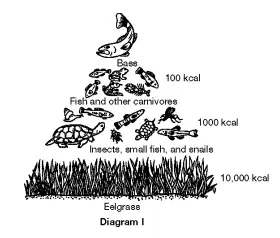
In this energy pyramid, how much energy is available to the bass?
a)
10 kcal
b)
100 kcal
c)
1,000 kcal
d)
10,000 kcal
11.
A term used to describe the members of a particular species that live in a given area is a(n)
a)
Population
b)
Community
c)
Ecosystem
d)
Biome
12.
A term used to describe all the of the living organisms and the non-living material in a given area is a(n)
a)
Population
b)
Community
c)
Ecosystem
d)
Biome
13.
Which of the following do NOT need sunlight to live?
a)
Chemosynthetic bacteria
b)
Algae
c)
Trees
d)
Grass
14.
Animals that eat both heterotrophs (consumers) and autotrophs (producers) are called
a)
Herbivores
b)
Chemotrophs
c)
Omnivores
d)
Autotrophs
15.
Which of the following processes puts carbon dioxide into the atmosphere?
a)
Cellular respiration
b)
Combustion
c)
Decomposition of detritus
d)
All of these are possible ways
16.
Why should farmers rotate their crops yearly between corn and some type of legume, such as soybeans?
a)
The corn puts nitrogen back into the soil
b)
Bacteria that live in nodules of legume roots put nitrogen into the soil
c)
Legumes, themselves, put nitrogen into the soil
d)
You should not rotate crops at all for maximum yield
17.
Which of the following is NOT a type of precipitation?
a)
Runoff
b)
Rain
c)
Sleet
d)
Fog
18.
Which of the following is NOT recycled through the biosphere?
a)
Water
b)
Energy
c)
Nitrogen
d)
Carbon
19.
The amount of matter at each trophic level in an ecosystem can be displayed in which model
a)
Energy pyramid
b)
Pyramid of numbers
c)
Food Chain
d)
Biomass pyramid
20.
Which of the following statements is true?
a)
There must always be more organisms (or at least more biomass) as you move down trophic levels on a pyramid.
b)
Energy is recycled through an ecosystem.
c)
Photosynthesis puts carbon dioxide into the atmosphere.
d)
Living things need nitrogen for their carbohydrates
21.

What is the primary role of decomposers in an ecosystem?

a)

To produce oxygen through photosynthesis

b)

To consume primary producers

c)

To break down dead material and waste into simpler substances

d)

To capture energy from the sun

22.

Which of the following best describes a keystone species?

a)

A species that is the most abundant in an ecosystem

b)

A species that has an unusually large effect on its ecosystem

c)

A species that can photosynthesize

d)

A species that does not interact with other species

23.

What process is primarily responsible for the oxygenation of Earth's atmosphere?

a)

Cellular respiration

b)

Combustion of fossil fuels

c)

Photosynthesis

d)

Decomposition

24.

Which of the following ecosystems has the highest biodiversity?

a)

Tropical rainforest

b)

Desert

c)

Tundra

d)

Temperate forest

25.

What is the primary function of the ozone layer?

a)

To absorb greenhouse gases

b)

To protect Earth from ultraviolet (UV) radiation

c)

To produce oxygen through photosynthesis

d)

To regulate Earth's temperature

26.

Which of the following best explains why energy transfer between trophic levels is not 100% efficient?

a)

Energy is lost as heat due to metabolic processes

b)

Energy is stored indefinitely within an ecosystem

c)

Energy is primarily transferred through water cycles

d)

Energy is converted to mass according to Einstein's theory

27.

Which of the following is a primary producer in a marine ecosystem?

a)

Zooplankton

b)

Sharks

c)

Phytoplankton

d)

Whales

28.

Which of the following best describes the process of nitrogen fixation in an ecosystem?

a)

Conversion of nitrogen gas into ammonia by bacteria

b)

Release of nitrogen gas into the atmosphere by plants

c)

Absorption of nitrogen from the soil by plant roots

d)

Conversion of nitrogenous waste into nitrogen gas by decomposers
