Wayground logo

Free Printable Worksheets

Font size

S
M
L
XL
Worksheets

MIT IA3 Review

Total questions: 117

Worksheet time: 2hrs 57mins

Name
Class
Date
1.
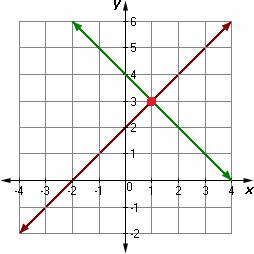
What is the equation for this line?
a)
y = x - 2
b)
y = x + 2
c)
y = 2x
d)
y = -x + 2
2.

Find the solution to the following inequality:

6(x - 5) < 7x - 4

a)

x ≥ 26

b)

x > -26

c)

x < -26

d)

-x > 26

3.
If A = 3x2 - 6x  and B = 12x- 6x2, what is B - A?
a)
-9x2 + 18x
b)
9x2 - 18x
c)
-3x2 + 6x
d)
-3x2
4.
What is another word for zeros?
a)
y-intercepts
b)
roots
c)
vertex
d)
axis of symmetry
5.
Find the difference:
(2x + 7) - 3(5x - 4)
a)
-13x - 5
b)
17x + 5
c)
17x + 5
d)
-13x + 19
6.
What are the zeros of the function f(x) = x2 — 13x — 30? 
a)
—10 and 3
b)
10 and —3
c)
—15 and 2
d)
15 and —2
7.
What is one point that lies in the solution set of the system of inequalities graphed?
a)
(0, 4)
b)
(-4, 1)
c)
(2, 4)
d)
(4, -1)
8.
The function f(x)=3x+10 models the total cost Katie charges to babysit x amount of children. What is the most appropriate domain for the function?
a)
All rational numbers
b)
All integers
c)
All non-negative rational numbers
d)
All non-negative integers
9.
Factor completely.
k2 -2k - 24
a)
(k+4)(k-6)
b)
(k+4)(k+6)
c)
(k+6)(k-1)
d)
(k-4)(k+6)
10.
Factor completely: 2x2+22x+60
a)
(2x+10)(x+6)
b)
(x+5)(x+6)
c)
2(x+1)(x+30)
d)
2(x+5)(x+6)
11.
Factor:x2 - 25
a)
( x + 5 ) ( x - 5 ) 
b)
( x - 5 ) ( x - 5 ) 
c)
( x + 5 ) ( x + 5 ) 
d)
Prime
12.
Factor out the GCF:
12x + 6
a)
6(2x + 1)
b)
3(4x + 2)
c)
6x(2x + 1)
d)
2(6x + 3)
13.
Factor completely.
k2 -2k - 24
a)
(k+4)(k-6)
b)
(k+4)(k+6)
c)
(k+6)(k-1)
d)
(k-4)(k+6)
14.
Factor completely: 2x2+22x+60
a)
(2x+10)(x+6)
b)
(x+5)(x+6)
c)
2(x+1)(x+30)
d)
2(x+5)(x+6)
15.
Factor completely: x2-6x+8
a)
(x-2)(x-4)
b)
(x-1)(x-8)
c)
(x+2)(x+4)
d)
(x+1)(x+8)
16.
Factor completely: x2-13x+40
a)
(x-5)(x-8)
b)
(x+5)(x+8)
c)
(x-4)(x-10)
d)
(x-2)(x-20)
17.
Factor:x2 - 25
a)
( x + 5 ) ( x - 5 ) 
b)
( x - 5 ) ( x - 5 ) 
c)
( x + 5 ) ( x + 5 ) 
d)
Prime
18.
Factor out the GCF:
12x + 6
a)
6(2x + 1)
b)
3(4x + 2)
c)
6x(2x + 1)
d)
2(6x + 3)
19.
Which of the following is a factor of x2-10x+24?
a)
x-4
b)
x+4
c)
x+6
d)
x-2
20.
Which is another way of correctly expressing
 (x  - 3)(x - 3)?
a)
(x2 - 32)
b)
(x2 - 3)
c)
(x + 3)(x - 3)
d)
(x - 3)2
21.
Factor out the GCF:
10x³ - 15x
a)
x(10x² - 15)
b)
5x(2x² - 3)
c)
5(2x³ - 3x)
d)
5x²(10x - 3)
22.
Factor completely.
3x2 - 9x -120
a)
3(x - 8)(x + 5)
b)
3(x + 8)(x - 5)
c)
(3x + 8)(x - 5)
d)
(3x - 8)(x + 5)
23.

one-term polynomial

a)

monomial

b)

binomial

c)

trinomial

d)

polynomial

24.

one-term polynomial

a)

monomial

b)

binomial

c)

trinomial

d)

polynomial

25.

two-term polynomial

a)

monomial

b)

binomial

c)

trinomial

d)

polynomial

26.

three-term polynomial

a)

monomial

b)

binomial

c)

trinomial

d)

polynomial

27.

What is the highest degree among terms in this polynomial?

6x2 + 7x4 + x3 + x

a)

1

b)

2

c)

3

d)

4

28.
Simplify the expression.
(4a3 - 8a - 4a2) + (7a3 - 7 - 6a)
a)
11a3 - 4a2 - 14a - 7 
b)
5a3 - 4a2 - 14a - 7 
c)
5a3 - 4a2 - 20a - 7 
d)
5a3 - 9a2 - 20a - 7
29.
(3x + 4y - 3z) - (2x - 6y + 7z)
a)
x + 10y - 10z
b)
-x +10y - 10z
c)
x -10y - 10z
d)
-x -10y - 10z
30.
(5x4 - 4x3 - 2x2 + x - 19) - (x4 + 5x3 + 8x2 + x + 5)
a)
4x4 - 9x3 - 10x2 - 24
b)
4x4 - 9x3 - 10x2 - 2x - 24
c)
4x4 - 9x3 - 10x2 + 2x - 24
d)
-4x4 - 9x3 - 10x2 - 24
31.
Classify by number of terms:
3x3 – 6x
a)
Monomial
b)
Binomial
c)
Trinomial
d)
4-Term Polynomial
32.
Classify by degree of polynomial:
3x3 – 6x
a)
Constant
b)
Linear
c)
Quadratic
d)
Cubic
33.
Classify by degree of polynomial:
2x – 9
a)
Constant
b)
Linear
c)
Quadratic
d)
Cubic
34.
Classify by number of terms:
3x2 – 8x + 1
a)
Monomial
b)
Binomial
c)
Trinomial
d)
4-Term Polynomial
35.
Classify by degree of polynomial:
3x2 – 8x + 1
a)
Constant
b)
Linear
c)
Quadratic
d)
Cubic
36.
Classify by degree of polynomial:
12
a)
Constant
b)
Linear
c)
Quadratic
d)
Cubic
37.
Classify by number of terms:
7x3 – 8x2 + 9
a)
Monomial
b)
Binomial
c)
Trinomial
d)
4-Term Polynomial
38.
Classify by degree of polynomial:
7x3 – 8x2 + 9
a)
Constant
b)
Linear
c)
Quadratic
d)
Cubic
39.
Classify by number of terms:
9x
a)
Monomial
b)
Binomial
c)
Trinomial
d)
4-Term Polynomial
40.
Classify by degree of polynomial:
9x
a)
Constant
b)
Linear
c)
Quadratic
d)
Cubic
41.
Classify by degree of polynomial:
-2x2 – x
a)
Constant
b)
Linear
c)
Quadratic
d)
Cubic
42.
Classify by degree of polynomial:
7x3 – 8x2 -4x+ 9
a)
Constant
b)
Linear
c)
Quadratic
d)
Cubic
43.
Add the polynomials.
(3x3 + 3x2 – 4x + 5) + (x3 – 2x2 + x – 4)
a)
4x3 + 1x2 – 3x + 1
b)
2x3 + 1x2 - 5x + 9
c)
6x3 + 1x - 1x2 - 3
d)
3x5 +1x - 1x5 - 3x
44.
(2x + 5y - z) + (-6x - 4y + 7z)
a)
-4x +6y + 6z
b)
4x + y + 6z
c)
-4x - y + 6z
d)
-4x + y + 6z
45.

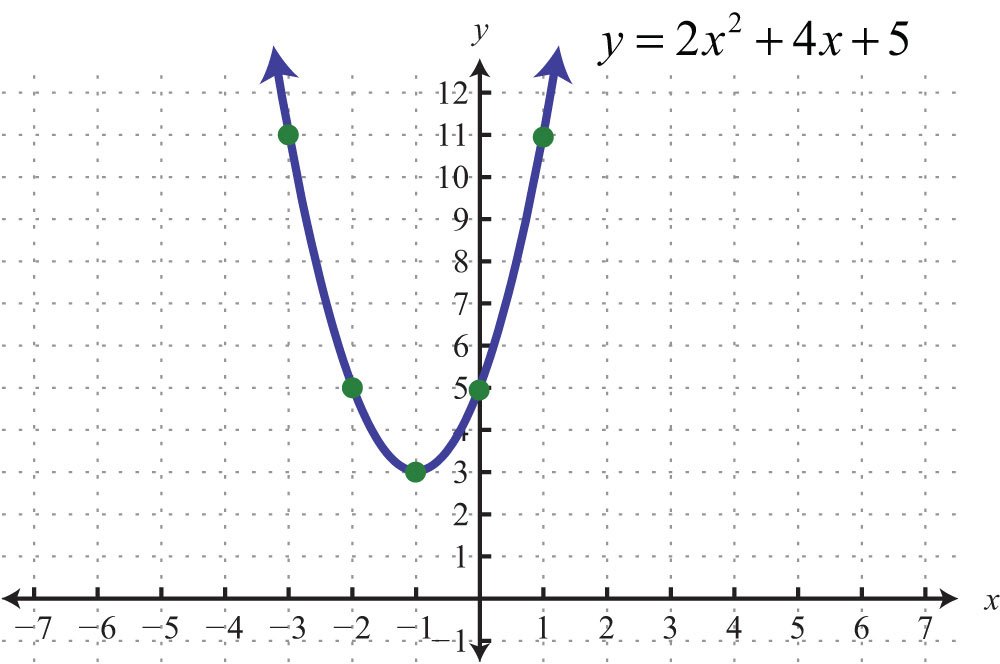
What is the vertex of this quadratic equation?

y = 2(x + 2)2 + 5

a)

(-2,5)

b)

(2,5)

c)

(5,-2)

d)

(-5,-2)

46.

What is the vertex of this quadratic equation?

y = 2(x + 2)2 + 5

a)

(-2,5)

b)

(2,5)

c)

(5,-2)

d)

(-5,-2)

47.
What is the vertex of this parabola?
a)
(−1, 3)
b)
(−3, 11)
c)
(−2, 5)
d)
(0, 5)
48.
What is the y-intercept of this parabola?
a)
(−1, 3)
b)
(−3, 11)
c)
(−2, 5)
d)
(0, 5)
49.
Where is the axis of symmetry for this parabola?
a)
x = −1
b)
x = 0
c)
y = 3
d)
x = −3
50.
What do we call the graph of a quadratic function?
a)
parabola
b)
linear
c)
cubic
d)
sinusoidal
51.
What is the maximum/minimum of a parabola called?
a)
vertex
b)
point
c)
top
d)
bottom
52.
What is the vertex?
a)
(0, - 1)
b)
(0, 0.5)
c)
(-1, 0)
d)
(0.5, 0)
53.
Does the quadratic have a max/min vertex, and does the parabola open up/down?
a)
max/ opens down
b)
min/ opens up
c)
max/ opens up
d)
min/ opens down
54.
How do you know if a parabola has a minimum vertex?
a)
When a is positive there is a minimum
b)
When a is negative there is a minimum
c)
When all the numbers in the equation are negative there is a minimum
d)
When all the numbers in the equation are positive there is a minimum
55.
The axis of symmetry is a line that goes through the...
a)
y-intercept
b)
any random point
c)
vertex
d)
 x-axis or y-axis
56.
Which best describes the vertex of a parabola?
a)
Any point on the parabola.
b)
A point on the x-axis.
c)
The highest or lowest point of a parabola
d)
A point on the y-axis.
57.
Which point is an example of a y-intercept?
a)
(3,4)
b)
(-2,8)
c)
(0,4)
d)
(5,0)
58.
Standard form of a quadratic equation
a)
y=x²
b)
y=ax²+bx+c
c)
y=mx+b
d)
y=x
59.
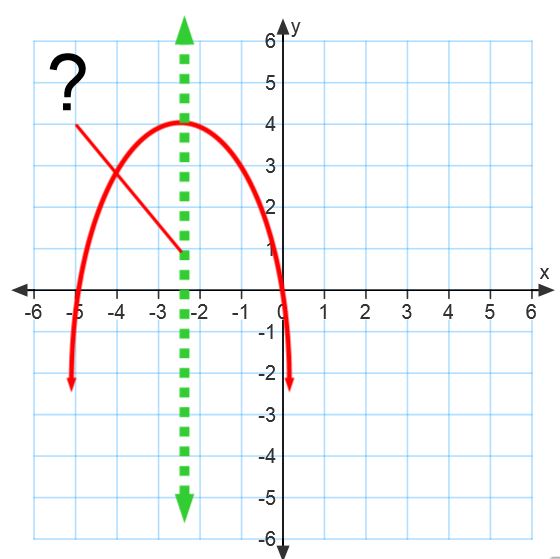
What is the green dashed line called?
a)
roots or x-intercepts
b)
parabola
c)
axis of symmetry
d)
line of dashes
60.
A parabola has a vertex at (-3,2).
Where is the axis of symmetry?
a)
y = -2
b)
x = 3
c)
x = -3
d)
y = 2
61.
What is the y-intercept of 
f(x)=(x - 10)(x + 10)
a)
(0, -100)
b)
(10 , 0) and (-10 , 0)
c)
(0, -10) and (0, 10)
d)
0
62.
An inequality using a > or a < has a ___________ line
a)
invisible
b)
solid
c)
dashed
63.
Is (3,-4) a solution to this system?
a)
yes
b)
no
64.
Pick the ordered pair that is NOT a solution
a)
(0,0)
b)
(1,-1)
c)
(2,0)
d)
(4,-4)
65.
An inequality using a > or a < has a ___________ line
a)
invisible
b)
solid
c)
dashed
66.
Is (3,-4) a solution to this system?
a)
yes
b)
no
67.
Pick the ordered pair that is NOT a solution
a)
(0,0)
b)
(1,-1)
c)
(2,0)
d)
(4,-4)
68.
Consider the function y<2x+3. Which is true?
a)
The line would be solid with shading above.
b)
The line would be dashed with shading above.
c)
The line would be solid with shading below.
d)
None of these.
69.
Match the system to the graph (solution set is on the left)
a)
y ≤ 3x   and  y ≤ -2x + 4
b)
y > 3x   and  y > -2x + 4
c)
y < 3x   and  y > -2x + 3
d)
y > 3x   and  y < -2x + 4
70.
Match the system to the graph (solution set is on the left)
a)
y ≤ 3x   and  y ≤ -2x + 4
b)
y > 3x   and  y > -2x + 4
c)
y < 3x   and  y > -2x + 3
d)
y > 3x   and  y < -2x + 4
71.
Which of the following is not a solution to this system of inequalities?
a)
(0,-1)
b)
(0,3)
c)
(4,0)
d)
(6,-2)
72.
Which point is a solution?
a)
(0, 6)
b)
(-3, 4)
c)
(1, 0)
d)
(-4, 3)
73.
Which of the following is not a solution to this system of inequalities?
a)
(0,-1)
b)
(0,3)
c)
(4,0)
d)
(6,-2)
74.
Which system of inequalities matches the graph?
a)
y > 2x - 4
y < 2
b)
y < 2x - 4
y < 2
c)
y > 2x - 4
y <  2 
d)
y < 2x - 4
y <   -2
75.

Given: y < 4x + 3

Would you draw a solid or dashed line?

a)

Solid

b)

Dashed

76.

Given: y < 4x + 3

Would shade above or below the line?

a)

Above

b)

Below

77.
Which system of inequality is shown?
a)
y > -1/5x - 1/2  
 y ≥ -2x - 4
b)
y > -1/5x - 1/2  
 y ≤ -2x - 4
c)
y ≥ -1/5x - 1/2
 y ≤ -2x - 4
d)
y < -1/5x - 1/2  
y ≥ -2x - 4
78.

Solve the system of inequalities by graphing.

a)
b)
c)
d)
79.
Will my line be solid?
5 ≥ x
a)
Yes
b)
No
80.

Which point is in the overlap (solution) of the shaded region?

a)

(5,0)

b)

(-1,8)

c)

(1,15)

d)

(10,5)

81.

Pick ALL correct answers.

Which are solutions to the system?

a)

(-5,4)

b)

(-5,-2)

c)

(0,10)

d)

(5,10)

e)

(0,-5)

82.

The graph shows which system?

a)


y>23x+1y>\frac{2}{3}x+1

y≤−5x+10y\le-5x+10

b)

y<23x+1y<\frac{2}{3}x+1
y≥−5x+10y\ge-5x+10

c)

y<23x+1y<\frac{2}{3}x+1
y≤−5x+10y\le-5x+10

d)

y>23x+1y>\frac{2}{3}x+1
y≥−5x+10y\ge-5x+10

83.

Which system is graphed?

a)


y>−14x−3y>-\frac{1}{4}x-3  

y>2x+6y>2x+6  

b)

y>14x−3y>\frac{1}{4}x-3  
y≤−2x+6y\le-2x+6  

c)

y≤−2x+6y\le-2x+6  
y<−14x−3y<-\frac{1}{4}x-3  

d)

y≤−2x+6y\le-2x+6  
y>−14x−3y>-\frac{1}{4}x-3  

84.

What is the solution to the system?

a)

(0, 3)

b)

(1, -1)

c)

(-3, 1)

d)

(1, 3)

85.

What is the solution to the system?

a)

(-1, 3)

b)

(-3, 1)

c)

(3, -1)

d)

(-3, -1)

86.

Will the solution (-3, -7) make the following system of equations a true statement?

y = 4x + 5

y = x – 4

a)

YES

b)

NO

87.

What is the solution to this system?

y = 2x + 1

y = 4x - 1

a)

(1,3)

b)

(-1,-3)

c)

(-1,3)

d)

(3,1)

88.
Solve the system by elimination. 
−4x − 4y = 0
4x + 4y = 0 
a)
(−6, −4) 
b)
Infinite number of solutions  
c)
(−6, 10) 
d)
(6, 4) 
89.
When does a system of equations have no solutions?
a)
When the lines cross
b)
When slopes of the lines are different
c)
When the slopes are the same
d)
There is ALWAYS a solution sir!
90.
Which of these is NOT one of the methods I showed you for solving systems of linear equations?
a)
Elimination
b)
Substitution
c)
Graphing
d)
Frustration
91.
Parallel lines have ____ solution(s).
a)
No
b)
One
c)
Many
92.
Intersecting lines have _____ solution(s).
a)
No
b)
One
c)
many
93.
How many solutions will this system have? 
a)
No solution
b)
One Solution
c)
I Don't Know
d)
Infinitely Many Solutions
94.
Explain the error
a)
-1.2 isn't an integer.
b)
-2 isn't a whole number and 3.4 isn't a rational number.
c)
-2 isn't a whole number and -1.2 isn't an integer.
d)
The numbers are graphed correctly.
95.
Does this graphic organizer correctly group the numbers?
a)
Yes
b)
No
96.
-3.5 is an integer
a)
True
b)
False
97.
6 is a rational number
a)
True
b)
False
98.

What is the largest perfect square that you use to simplify

24\sqrt{24}  

a)

1

b)

4

c)

9

d)

16

99.

Simplify

24\sqrt{24}  

a)

464\sqrt{6}  

b)

262\sqrt{6}  

c)

626\sqrt{2}  

d)

646\sqrt{4}  

100.

Simplify:

98\sqrt{98}  

a)

727\sqrt{2}  

b)

272\sqrt{7}  

c)

49249\sqrt{2}  

d)

2492\sqrt{49}  

101.

Simplify:

109610\sqrt{96}  

a)

40640\sqrt{6}  

b)

1606160\sqrt{6}  

c)

961096\sqrt{10}  

d)

601660\sqrt{16}  

102.

Simplify:

31253\sqrt{125}  

a)

75375\sqrt{3}  

b)

858\sqrt{5}  

c)

15515\sqrt{5}  

d)

152515\sqrt{25}  

103.

Simplify:

x15\sqrt{x^{15}}  

a)

x7.5x^{7.5}  

b)

x14xx^{14}\sqrt{x}  

c)

x7xx^7\sqrt{x}  

104.

Simplify:

x2y7\sqrt{x^2y^7}  

a)

xy3xy^3  

b)

xy3yxy^3\sqrt{y}  

c)

xy3xyxy^3\sqrt{xy}  

105.

Simplify:

80x2y4\sqrt{80x^2y^4}  

a)

2xy2202xy^2\sqrt{20}  

b)

4xy254xy^2\sqrt{5}  

106.

Simplify:

224+5542\sqrt{24}+5\sqrt{54}  

a)

7787\sqrt{78}  

b)

19619\sqrt{6}  

c)

767\sqrt{6}  

107.

Multiply:

38×4103\sqrt{8}\times4\sqrt{10}  

a)

128012\sqrt{80}  

b)

7807\sqrt{80}  

c)

242024\sqrt{20}  

d)

48548\sqrt{5}  

108.

What is the largest perfect square that you use to simplify

24\sqrt{24}  

a)

1

b)

4

c)

9

d)

16

109.

Simplify

24\sqrt{24}  

a)

464\sqrt{6}  

b)

262\sqrt{6}  

c)

626\sqrt{2}  

d)

646\sqrt{4}  

110.

Simplify:

98\sqrt{98}  

a)

727\sqrt{2}  

b)

272\sqrt{7}  

c)

49249\sqrt{2}  

d)

2492\sqrt{49}  

111.

Simplify:

109610\sqrt{96}  

a)

40640\sqrt{6}  

b)

1606160\sqrt{6}  

c)

961096\sqrt{10}  

d)

601660\sqrt{16}  

112.

Simplify:

31253\sqrt{125}  

a)

75375\sqrt{3}  

b)

858\sqrt{5}  

c)

15515\sqrt{5}  

d)

152515\sqrt{25}  

113.

Simplify:

x15\sqrt{x^{15}}  

a)

x7.5x^{7.5}  

b)

x14xx^{14}\sqrt{x}  

c)

x7xx^7\sqrt{x}  

114.

Simplify:

x2y7\sqrt{x^2y^7}  

a)

xy3xy^3  

b)

xy3yxy^3\sqrt{y}  

c)

xy3xyxy^3\sqrt{xy}  

115.

Simplify:

80x2y4\sqrt{80x^2y^4}  

a)

2xy2202xy^2\sqrt{20}  

b)

4xy254xy^2\sqrt{5}  

116.

Simplify:

224+5542\sqrt{24}+5\sqrt{54}  

a)

7787\sqrt{78}  

b)

19619\sqrt{6}  

c)

767\sqrt{6}  

117.

Multiply:

38×4103\sqrt{8}\times4\sqrt{10}  

a)

128012\sqrt{80}  

b)

7807\sqrt{80}  

c)

242024\sqrt{20}  

d)

48548\sqrt{5}