
 Worksheets
Final Exercises Literasi English
Total questions: 10
Worksheet time: 21mins
Stretching more than 2.300 kilometers along Queensland's coastline and covering 35 million hectares, the Great Barrier is the world's largest coral reef, and probably the richest. More than 1.500 species of fish, 4.000 species of mollusks, 400 species of sponge and 300 species of hard corals live here. The reef is Queensland's first world heritage area. It is very importance to Aboriginal and Torres Strait Islander people with significant cultural sites on many of its islands. The reef is very important in other ways. The World Heritage Area is worth some $5.4 billion to the Australian economy. As many as $3.5 billion of that amount goes into the local towns and communities bordering the reef. Recent research published by the Australian Institute of Marine Science has found two primary factors that have caused a very significant decline in coral cover over the last 30 years or so. They are extreme weather and the crown-of-thorns starfish. The same research is telling us that coral cover north of Cook town is generally stable, but the southern area is experiencing major losses. The reef's complexities are well described in the 2013 Scientific Consensus Statement. This science contributed to the updated Reef Water Quality Protection Plan (Reef Plan). The plan is a state and federal initiative designed to stop and reverse the decline in reef water quality. The consensus statement confirms that the major cause of coral cover loss is extreme weather events, such as cyclones. Clearly, we are not able to influence such events. The second Great Barrier Reef Report Card confirms that management change and water quality improvements are tracking positively, but more needs to be done. The report was released in July 2013 and based on 2011 Paddock to Reef Monitoring Program data. The Queensland and Australian governments, together with industry, regional bodies, and conservation groups, will continue working hard to maintain progress towards Reef Plan targets. We want to be sure that the reef has the best possible opportunity to recover from cyclone damage and crown-of-thorns starfish attacks.
What can be inferred from the passage ?
The Great Barrier Reef is attracted by cyclone and starfish.
Australian economy is attracted by cyclone and starfish.
The other main resource influencing the reef is seawater quality
Scientists expect the reef has the power to recover naturally.
The decline of the Great Barrier Reef initiates research on climate
Stretching more than 2.300 kilometers along Queensland's coastline and covering 35 million hectares, the Great Barrier is the world's largest coral reef, and probably the richest. More than 1.500 species of fish, 4.000 species of mollusks, 400 species of sponge and 300 species of hard corals live here. The reef is Queensland's first world heritage area. It is very importance to Aboriginal and Torres Strait Islander people with significant cultural sites on many of its islands. The reef is very important in other ways. The World Heritage Area is worth some $5.4 billion to the Australian economy. As many as $3.5 billion of that amount goes into the local towns and communities bordering the reef. Recent research published by the Australian Institute of Marine Science has found two primary factors that have caused a very significant decline in coral cover over the last 30 years or so. They are extreme weather and the crown-of-thorns starfish. The same research is telling us that coral cover north of Cook town is generally stable, but the southern area is experiencing major losses. The reef's complexities are well described in the 2013 Scientific Consensus Statement. This science contributed to the updated Reef Water Quality Protection Plan (Reef Plan). The plan is a state and federal initiative designed to stop and reverse the decline in reef water quality. The consensus statement confirms that the major cause of coral cover loss is extreme weather events, such as cyclones. Clearly, we are not able to influence such events. The second Great Barrier Reef Report Card confirms that management change and water quality improvements are tracking positively, but more needs to be done. The report was released in July 2013 and based on 2011 Paddock to Reef Monitoring Program data. The Queensland and Australian governments, together with industry, regional bodies, and conservation groups, will continue working hard to maintain progress towards Reef Plan targets. We want to be sure that the reef has the best possible opportunity to recover from cyclone damage and crown-of-thorns starfish attacks.
Based on the passage, what does the author's bias deal with?
Collaboration between scientists and the Australian government
Australian geographical heritage in a form of coral reef
National economic value of the Great Barrier Reef
Efforts to save the reef from natural destruction
Benefits of the local people in relation to the reef
Stretching more than 2.300 kilometers along Queensland's coastline and covering 35 million hectares, the Great Barrier is the world's largest coral reef, and probably the richest. More than 1.500 species of fish, 4.000 species of mollusks, 400 species of sponge and 300 species of hard corals live here. The reef is Queensland's first world heritage area. It is very importance to Aboriginal and Torres Strait Islander people with significant cultural sites on many of its islands. The reef is very important in other ways. The World Heritage Area is worth some $5.4 billion to the Australian economy. As many as $3.5 billion of that amount goes into the local towns and communities bordering the reef. Recent research published by the Australian Institute of Marine Science has found two primary factors that have caused a very significant decline in coral cover over the last 30 years or so. They are extreme weather and the crown-of-thorns starfish. The same research is telling us that coral cover north of Cook town is generally stable, but the southern area is experiencing major losses. The reef's complexities are well described in the 2013 Scientific Consensus Statement. This science contributed to the updated Reef Water Quality Protection Plan (Reef Plan). The plan is a state and federal initiative designed to stop and reverse the decline in reef water quality. The consensus statement confirms that the major cause of coral cover loss is extreme weather events, such as cyclones. Clearly, we are not able to influence such events. The second Great Barrier Reef Report Card confirms that management change and water quality improvements are tracking positively, but more needs to be done. The report was released in July 2013 and based on 2011 Paddock to Reef Monitoring Program data. The Queensland and Australian governments, together with industry, regional bodies, and conservation groups, will continue working hard to maintain progress towards Reef Plan targets. We want to be sure that the reef has the best possible opportunity to recover from cyclone damage and crown-of-thorns starfish attacks.
In presenting the ideas, the author starts by.........
describing the landscape of the Great Barrier Ree
explaining the status of the Great Barrier Reef
stating the current problem faced by the reef
detailing demography and value of the reef
reporting the findings of study on the reef
You have invited your frien over for dinner. Your child sees your friend reach for some cookies and says,” Better not take those, or you’ll get even bigger.” You’re embarassed that your child could speak so rudely. However, you should consider that your child may not know how to use the language appropriately in social situation and did not mean harm by the comment. An individual may say word clearly and use long, complex sentences with correct grammar, but still have a communication problem if he or she has not mastered the rule of social language known as pragmatics. Adults may also have difficulty with pragmatics, for example, as a result of a brain injury or stroke. An individual with pragmatic problems may say inappropriate or unrelated things during conversations, tell stories in a disorganized way, or have little variety in language use. It is not unususal to have pragmatic problems in only a few situations. However, if problems in social language use occur often and seem inappropriate considering the child’s age, a pragmatic disorder may exist.
The restatement of the last sentence of the passage is that ....
vocabulary is basic in grammar
language problems are essentially satiric
pragmatic disorders always exist as a single entity
problems such as vocabulary and grammar frequently come along with pragmatic disorders
linguist can solve pragmatic disorders
You have invited your frien over for dinner. Your child sees your friend reach for some cookies and says,” Better not take those, or you’ll get even bigger.” You’re embarassed that your child could speak so rudely. However, you should consider that your child may not know how to use the language appropriately in social situation and did not mean harm by the comment. An individual may say word clearly and use long, complex sentences with correct grammar, but still have a communication problem if he or she has not mastered the rule of social language known as pragmatics. Adults may also have difficulty with pragmatics, for example, as a result of a brain injury or stroke. An individual with pragmatic problems may say inappropriate or unrelated things during conversations, tell stories in a disorganized way, or have little variety in language use. It is not unususal to have pragmatic problems in only a few situations. However, if problems in social language use occur often and seem inappropriate considering the child’s age, a pragmatic disorder may exist.
The topic of the paragraph is ..
pragmatic disorders
inappropriate politics
logics
incorrect grammar
vocabulary problems
You have invited your frien over for dinner. Your child sees your friend reach for some cookies and says,” Better not take those, or you’ll get even bigger.” You’re embarassed that your child could speak so rudely. However, you should consider that your child may not know how to use the language appropriately in social situation and did not mean harm by the comment. An individual may say word clearly and use long, complex sentences with correct grammar, but still have a communication problem if he or she has not mastered the rule of social language known as pragmatics. Adults may also have difficulty with pragmatics, for example, as a result of a brain injury or stroke. An individual with pragmatic problems may say inappropriate or unrelated things during conversations, tell stories in a disorganized way, or have little variety in language use. It is not unususal to have pragmatic problems in only a few situations. However, if problems in social language use occur often and seem inappropriate considering the child’s age, a pragmatic disorder may exist.
The organization of the text is ...
Comparison
problem solving
paradox
exposition
division and classification
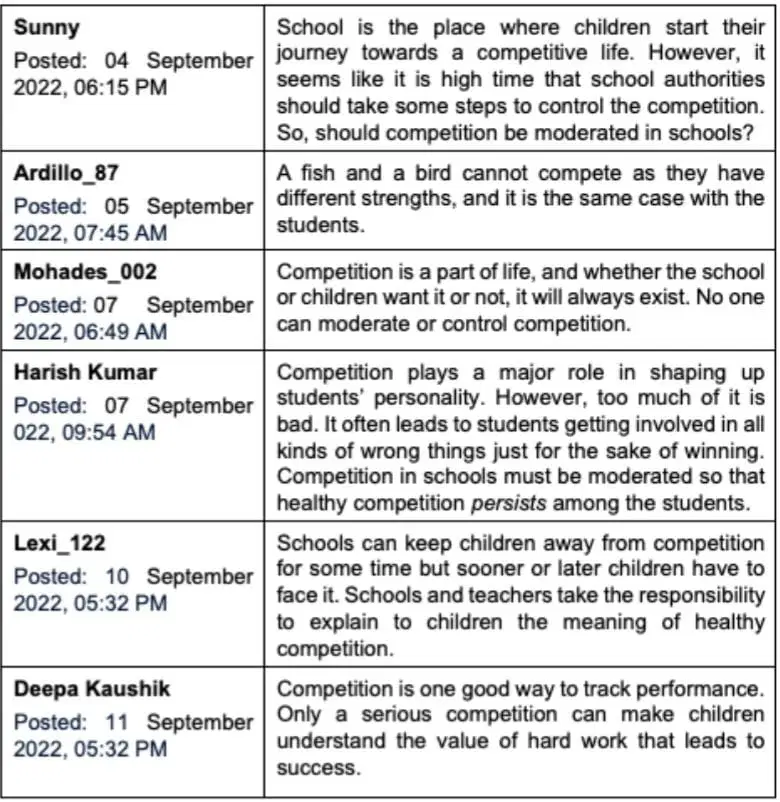
The word "persists" in Harish Kumar's post is closest in meaning to ....
Occurs
Remains
Continues
prevails
stays
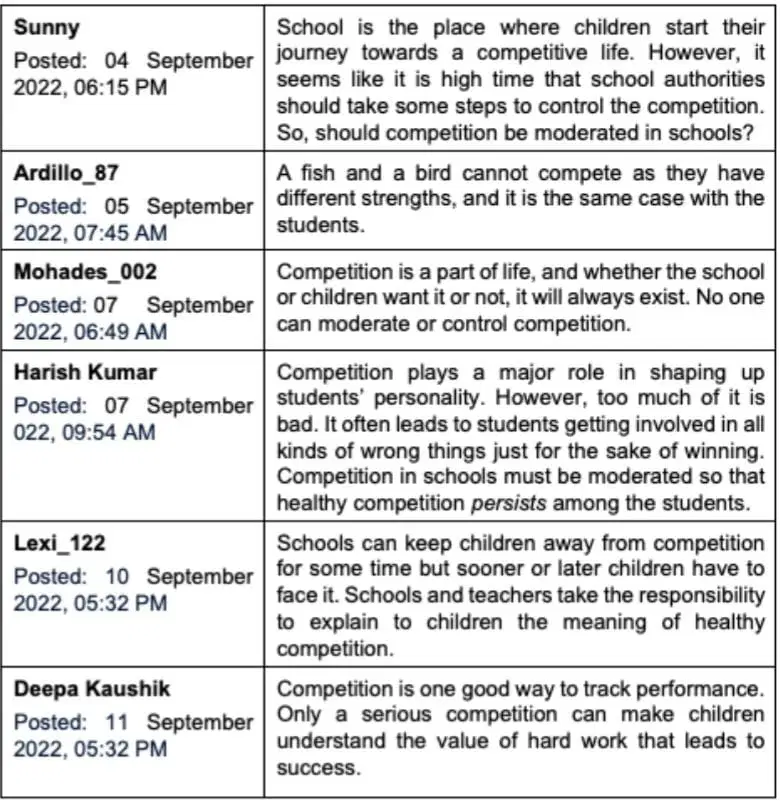
Who suggested moderating the school competition in order to create a healthy one?
Mohades_002
Lexi_122
Ardillo_87
Deepa Kaushik
Harish Kumar
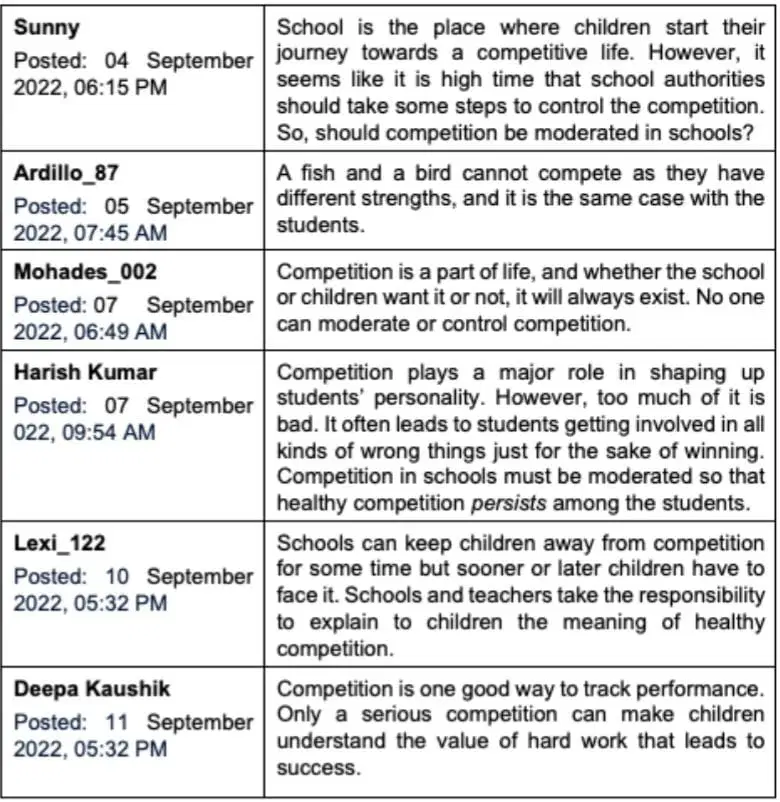
What is the tone of the thread regarding the school competition ?
Encouraging
Passionate
Objective
Biased
Humorous
In 2010, researchers estimated that 8 billion kg of plastic entered the ocean in a single year, and that number would sharply increase by 2025. When it enters the ocean, plastic waste disrupts marine ecosystems, travels to central locations, and forms a trash island which can cover an area of more than 1.6 million square km. These plastics never degrade, but rather break up into smaller sizes. They eventually become microplastics that stay in the environment for hundreds of years.
Scientists at the University of California San Diego have invented a new biodegradable material that is designed to replace the commonly used plastics. The material started to biodegrade in seawater within four weeks. The team found that various marine organisms colonize the material and break it into nutrients for their consumption.
The research of this new plastic is joined by experts in biology, chemistry, and marine science. They have shown that it is possible to make durable plastics that also can degrade in the ocean. Plastics should not be going into the ocean in the first place. But now, if they do, this new plastic can become food for microorganisms and not harmful trash.
Source: Science Daily
Which of the following statements is an opinion from ?
These plastics never degrade, but rather break up into smaller sizes
Recycling plastic not only helps the environment and reduces trash, but it also creates more jobs.
Plastics should not be going into the ocean in the first place
They eventually become microplastics that stay in the environment for hundreds of years
Customers are happy to sleep well and use a product that benefits the environment

