
 Worksheets
Multiplication Properties
Total questions: 91
Worksheet time: 2hrs 36mins
4 x 7
Which breaks down 6x7 correctly?
(6x6)+(6x10)
(6x2)+(6x5)
(6x7)+(6x2)
(2x5)+(3x3)
Find the original multiplication problem: (6x2)+(6x10)
6x2
6x6
6x10
6x12
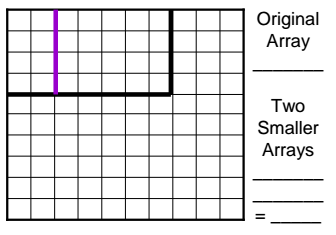
Write 2 equations that match the array.
( 4 x 3) + (4 x 3)
( 3 x 4) + ( 4 x 3)
( 4 x 2 ) + ( 4 x 5)
Select all the expressions that could be used to find the product of 6 × 7.
Select all that apply.
6 + 7
7 x 6
6 x (2+5)
(3 x 7) + (3 x 7)
(3 + 7) + (3 + 7)
Fill in the missing factors in the ☐ to complete the equation.
6 × 8 = (6 ×☐ ) + (6 × ☐)
4, 4
2, 3
3, 5
2, 6
1, 7

Zion has planted a garden with 7 rows of carrots. If he puts 8 carrots plants in each row, how many carrots might he have?
58
56
63
none of these
Maggie bought 56 straws. For___days her family used 7 new straws each day. How many days did it take her family to use all the straws?
8 days
27 days
49 days
63 days
724 + 152 =
776
876
976
875
An equation is written. 42 ÷ 6 = Which other equation can be used to find the quotient?
A. 6 × _ = 42
42 × 6 =
6 + _ = 42
42 – __ = 6
What multiplication property is used in this equation: 7 x 3 = 3 x 7
Commutative
Associative
Property of Zero
What multiplication property is used in this equation: 0 x 9 = 0
Commutative
Associative
Property of Zero
What multiplication property is used in this equation: 8 x 9 = 9 x 8
Commutative
Associative
Property of Zero
What multiplication property is used in this equation: 2 x (3 x 8) = (2 x 3) x 8
Property of Zero
Associative
Commutative
What multiplication property is used in this equation: 5 x 4 = 4 x 5
Associative
Commutative
Property of Zero
What multiplication property is used in this equation: (5 x 9) x 2 = 5 x (9 x 2)
Associative
Property of Zero
Commutative
What multiplication property is used in this equation: 5 x 0 = 0
Associative
Property of Zero
Commutative
Use the multiplication properties to determine the number that belongs (9 x 6)x 4 = 9 x(__ x 4)
9
4
6
54
Use the multiplication properties to determine the number that belongs 5 x __ = 0
5
0
10
2
Use the multiplication properties to determine the number that belongs 5 x 6 = 6 x __
30
5
6
36
Use the multiplication properties to determine the number that belongs: 4 x (2 x 7)=(4 x __)x 7
2
4
7
8
Use the multiplication properties to determine the number that belongs __ x 8 = 0
8
2
0
16
Use the multiplication properties to determine the number that belongs: 3 x __ = 6 x 3
3
6
18
12
Use the multiplication properties to determine the number that belongs: 5 x (2 x 9)=(5 x 2)x ___
2
5
9
19
Which option represents the commutative property?
(10x2)x3
10x(2x3)
4x5=5x4
5+(2x3)
Which equation represent the associative property?
5x3=3x5
2x(8x4)= (2x8)x4
3x2+1
(6+3)x3
Use the Distributive Property to find the missing product.
6 X 5= ( _X 5) + (3 X 5)
1
5
6
3

Which two equations could be used to represent the above picture?
4x9
5x6
3x6
6x3

Use the distributive property to break the array apart.
(7x4)+(7x4)
7+4)+(7+4)
(7x4)+(7x3)
Which factor completes the fact family?
2x___=14
__x2=14
14÷2=7
14÷7=2
7
5
3
2
Use the Distributive Property to find the Missing Factor.
8X6= (5X6) + ( _ X 6)
5
3
4
2
Use the associative property to solve. 2x3x5
(a)
Which factor completes the fact family?
7x6=42
6x7=42
42/7=___
42/___=7
7
42
6
8
Which property does this multiplication problem represent? 2x5=10 is the same as 5x2=10
Associative Property
Commutative Property
Distributive Property
Identity Property
Which property does this represent? 3x(9x1)=(3x9)x1
Commutative Property
Identity Property
Associative Property
Distributive Property
Which problem shows the distributive property of 3x18=
(3x10)+(3x8)
(3x10)x(4x8)
(3+10)+(3+8)
100 x 1 = 100 Which Property?
Associative
Commutative
Identity
45 x 6 = 6 x 45
Associative
Commutative
Identity
33 x 0 = 0
Associative
Commutative
Zero
10 x 9 = 9 x 10
Associative
Commutative
Identity
537 x 1 = 537
Associative
Commutative
Identity
100 x 32 = 32 x 100
Associative
Commutative
Identity
400 x 0 = 0
Zero
Commutative
Identity
73 x 14 = 14 x 73
Associative
Commutative
Identity
Which property does this represent? 0x3=0
Identity Property
Distributive Property
Zero Property
Which property does this multiplication problem represent? 2x5=10 is the same as 5x2=10
Associative Property
Commutative Property
Distributive Property
Which property does this represent? 3x(9x1) = (3x9)x1
Distributive Property
Commutative Property
Associative Property
Which property does this multiplication problem represent? 1x72=72
Identity Property
Zero Property
Commutative Property
Which property does this multiplication problem represent?
8x25 = (8x20)+(8x5)
Distributive Property
Commutative Property
Associative Property
The commutative property says that if 4x6=24, then
3x8=24
4x5=20
6x4=24
Which problem shows the distributive property of 4x18
(4x10)+(4x8)
(4x10)x(4x8)
(4x18)+(4x18)
Which problem does NOT show the zero property
6x0=0
6+0=6
5x0=0
Which problem correctly shows the associative property related to this multiplication problem? 4x(5x6)
6x5+4
(4x5)x6
5x24
Which two problems show the identity property? Choose TWO.
6x1=7
19+1=20
37x1=37
64x1=64
Which number sentence is an example of the associative property?
19+6=5x5
3x9=9+3
3x(2x6)=(3x2)x6
10 x 8 = 8 x 10
Find the missing factor:
6 x 18= (6 x _?_) + (6 x 10)
3
8
11
14
Find the missing factor:
17 x 8= (7 x 8) + (_?_ x 8)
3
8
10
14
Find the missing factors:
6 x 18 = (6 x ___ ) + ( 6 x ___ )
7, 6
10, 4
9, 9
6, 2
2 x (2x5)
20
15
18
21
3 x (2x4)
20
18
24
30
(2x3) x 5
24
20
35
30
5 x (2x6)
65
42
60
50
3 x ____ = 9 x 3
7
9
27
11
What is the missing number?
4 x ____ = 6 x 4
4
6
7
24
___ x 3 x 4 = 24
2 x 5 x ___ = 60
4 x ____ x 3 = 36
(2x3)+(4x3)
18
20
64
72
4x(3x2)
10
20
25
24
(5x3) + (6x4) =
30
42
39
25

Each spider has 8 legs. How many legs do 3 spiders have?
10
24
11
16
What is the zero property of multiplication?
Any number multiplied by zero equals zero.
Any number multiplied by zero equals one.
Any number multiplied by one equals zero.
Any number divided by zero equals zero.
7x7
49
35
14
7
5X6
11
25
29
30
If a = 5 and b = 3, what is the value of a * b using the commutative property?
8
35
12
15
If a = 2, b = 4, and c = 6, what is the value of (a * b) * c using the associative property?
12
24
36
48
If a = 7, b = 2, and c = 3, what is the value of a * (b + c) using the distributive property?
14
35
21
10
If a = 9, what is the value of a * 0 using the zero property?
9
1
18
0
4x0
0
4
40
1

Look at the image and count the bundles. If you add 1 more bundle of 10s. How many straws total will you have?
40
5
50
35

