
 Worksheets
Lesson 5 (Genetics)
Total questions: 32
Worksheet time: 29mins
Who proposed the double-helical model for the structure of DNA?
Erwin Chargaff
Frederick Griffith
Alfred Hershey and Martha Chase
James Watson and Francis Crick
What is the most celebrated molecule of our time?
Carbohydrate
Protein
RNA
DNA
What is the substance of inheritance?
Protein
RNA
DNA
Carbohydrate
Who first worked out the role of DNA in heredity by studying bacteria and viruses?
Alfred Hershey and Martha Chase
Frederick Griffith
Erwin Chargaff
James Watson and Francis Crick
What is the phenomenon called when a cell changes in genotype and phenotype due to the assimilation of external DNA?
Transformation
Replication
Mutation
Transcription
Who performed experiments showing that DNA is the genetic material of a phage known as T2?
James Watson and Francis Crick
Frederick Griffith
Alfred Hershey and Martha Chase
Erwin Chargaff
What did Alfred Hershey and Martha Chase use to trace the fates of the protein and DNA of T2 phages?
Radioactive potassium and calcium
Radioactive sulfur and phosphorus
Radioactive carbon and oxygen
Radioactive nitrogen and hydrogen
What did Erwin Chargaff report in 1947?
That DNA composition varies from one species to the next
That DNA composition is the same in all species
That DNA is not the genetic material
That DNA is composed of three components
Who produced a picture of the DNA molecule using X-ray crystallography?
Maurice Wilkins
Rosalind Franklin
Francis Crick
James Watson
What did Watson and Crick deduce about the structure of DNA?
It is a quadruple helix
It is a triple helix
It is a single helix
It is a double helix
When Frederick Griffith was studying Streptococcus pneumoniae, he worked with two strains of the bacterium (a pathogenic strain and a nonpathogenic strain). What happens to the mouse when it's injected with living R cells?
mouse dies
mouse stays healthy
How many hydrogen bonds form between the base pairs A-T in DNA?
Three
Two
One
Four
What is the primary structure of nucleic acids?
A quadruple helix structure
A single strand of nucleotides
A double helix structure
A triple helix structure
What is the function of messenger RNA (mRNA)?
Transmits information from DNA to make proteins
Carries genetic information from DNA to the ribosomes
Makes up 2/3 of ribosomes
Brings amino acids to the ribosome
What does transfer RNA (tRNA) do?
Transmits information from DNA to make proteins
Carries genetic information from DNA to the ribosomes
Makes up 2/3 of ribosomes
Brings amino acids to the ribosome
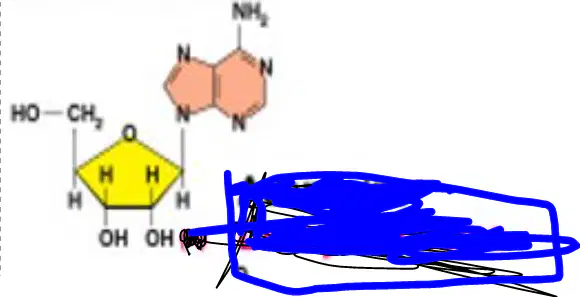
What is the structure of a double helix in DNA?
A single strand of nucleotides
A quadruple helix structure
Two strands of nucleotides that wind together
A triple helix structure
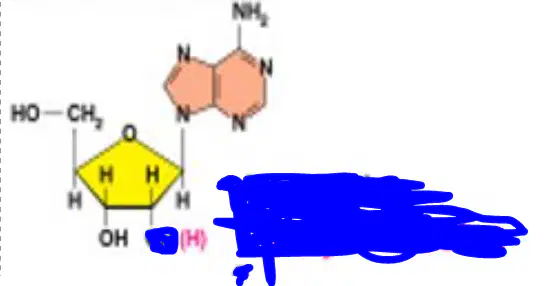
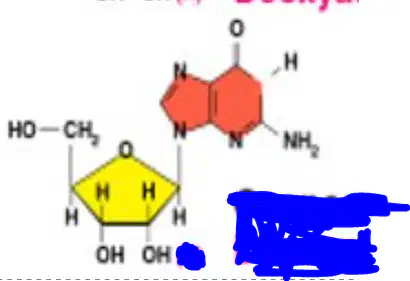
Transfer RNA
brings amino acids to the
ribosome to make the protein.
carries genetic
information from DNA to the ribosomes.
makes up 2/3 of
ribosomes where protein synthesis takes
place.
DNA is linked by phosphodiester bonds between deoxyribose sugars and phosphate groups.
TRUE
FALSE
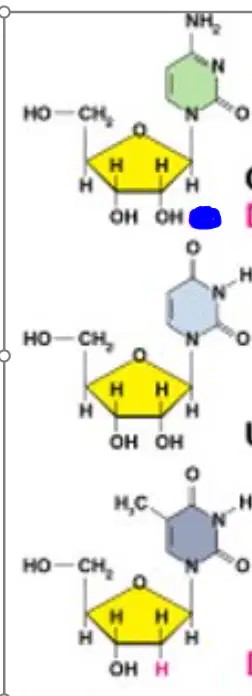
for 3 points
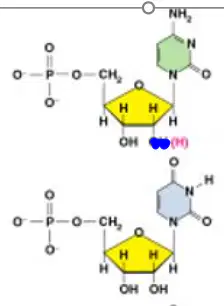
for 2 points
Messenger RNA
brings amino acids to the
ribosome to make the protein.
carries genetic
information from DNA to the ribosomes.
makes up 2/3 of
ribosomes where protein synthesis takes
place.
Write the complementary base sequence for the matching strand in the following DNA section:
—A—G—T—C—C—A—A—T—C—
(a)
Ribosomal RNA
brings amino acids to the
ribosome to make the protein.
carries genetic
information from DNA to the ribosomes.
makes up 2/3 of
ribosomes where protein synthesis takes
place.
In Hershey & Chase's experiment, what phages remained outside the bacteria cells?
Phage Protein
Phage DNA
A nucleic acid
has a free 3’-phosphate group at one end and a free 5’-OH group at the other end.
TRUE
FALSE
RNA is linked by phosphodiester bonds between ribose sugars and phosphate groups.
TRUE
FALSE
In Hershey & Chase's experiment, what phages entered the cells?
Phage Protein
Phage DNA
When Frederick Griffith was studying Streptococcus pneumoniae, he worked with two strains of the bacterium (a pathogenic strain and a nonpathogenic strain). What happens to the mouse when it's injected with a mixture of heat-killed S cells and living R cells?
mouse dies
mouse stays healthy
What has no O atom on carbon 2’?
DNA
RNA

