
 Worksheets
Weathering, Erosion, & Natural Hazards Review
Total questions: 50
Worksheet time: 25mins
Name
Class
Date
1.
What are the surface features of a region, including how the land rises to form mountains and falls to form valleys?
a)
seismology
b)
topography
c)
geography
d)
volcanology
2.
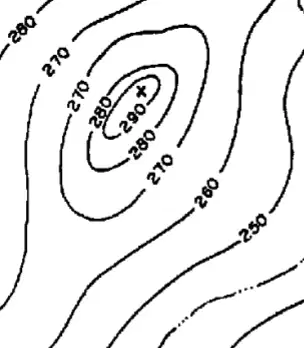
Between which two elevations on the map is the slope the steepest?
a)
250 and 260
b)
260 and 270
c)
270 and 280
d)
280 and 290
3.
What is the process by which rocks are broken down into sediments slowly over time?
a)
erosion
b)
deposition
c)
weathering
d)
abrasion
4.
What is the process of moving broken down sediments to other locations?
a)
erosion
b)
deposition
c)
weathering
d)
abrasion
5.
What is the process when particles stop moving and settle where erosional agents have carried them?
a)
erosion
b)
deposition
c)
weathering
d)
abrasion
6.
What is the scraping of smaller sediments against rocks called?
a)
erosion
b)
deposition
c)
cementation
d)
abrasion
7.
What is the difference between mechanical and chemical weathering?
a)
Mechanical weathering breaks down rocks in a chemical process; chemical weathering breaks down rock in a physical process.
b)
Chemical weather breaks down rocks in a chemical process; mechanical weathering breaks down rock in a physical process.
c)
Mechanical weathering is only done by substances; chemical weathering is done by wind only.
8.
What are the two main agents of mechanical weathering?
a)
chemicals and water
b)
water and solutions
c)
wind and water
d)
wind and solutions
9.
Which of the following is an example of chemical weathering?
a)
A glacier scraping away rock as it moves.
b)
abrasion
c)
rust
10.
How did the Grand Canyon form?
a)
The Colorado river flowed over flat land, the water carved away rock, and created the canyon.
b)
The wind wore away at the rock over millions of years and created the canyon.
c)
Glaciers scraped away the rock and created the canyon.
11.
How can ice (freezing/thawing) affect rocks?
a)
When water freezes, it doesn't affect the rock.
b)
When water freezes, it expands and breaks the rock.
c)
When water freezes, it shrinks and leaves holes in the rock.
12.
What agent of weathering/erosion rips chunks of rock out of the ground and moves them to a new location?
a)
water
b)
wind
c)
chemicals
d)
glaciers
13.
Fill in the blanks: Rocks that are carried long distances by erosion are broken into ___________ pieces and have more __________ edges.
a)
smaller; angular
b)
smaller; rounded
c)
larger; angular
d)
larger; rounded
14.
What are sediments carried by flowing water that pile up around a river’s mouth called?
a)
dune
b)
delta
c)
mountain
d)
canyon
15.
An area has experienced weathering and erosion for many years. Over time, some rock formations have been left behind forming peaks and columns. What process is the reason behind this?
a)
chemical weathering
b)
differential weathering
c)
uniform weathering
16.
What do barrier islands do for coastlines?
a)
protect the coastlines from weathering and erosion
b)
help coastlines rebuild after long storms
17.
Weathering or erosion: Rock shattered by another large rock falling on it.
a)
weathering
b)
erosion
18.
Weathering or erosion: Fragments of rock sliding down a cliff.
a)
weathering
b)
erosion
19.
Weathering or erosion: Desert sand being carried by the wind.
a)
weathering
b)
erosion
20.
Weathering or erosion: Sharp rock in stream slowly being smoothed out and rounded.
a)
weathering
b)
erosion
21.
Weathering or erosion: Rock breaks into smaller pieces when water freezes in the cracks.
a)
weathering
b)
erosion
22.
Weathering or erosion: Soil from a riverbank is carried downstream.
a)
weathering
b)
erosion
23.
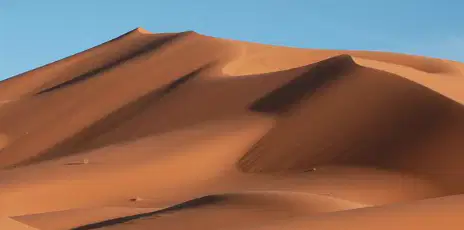
Which geologic feature is pictured?
a)
canyon
b)
delta
c)
dune
24.
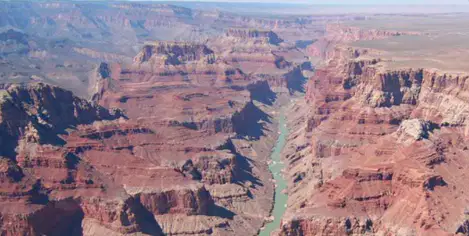
Which geologic feature is pictured?
a)
canyon
b)
delta
c)
dune
25.
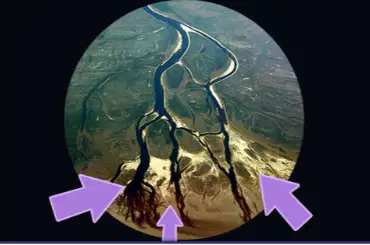
Which geologic feature is pictured?
a)
canyon
b)
delta
c)
dune
26.
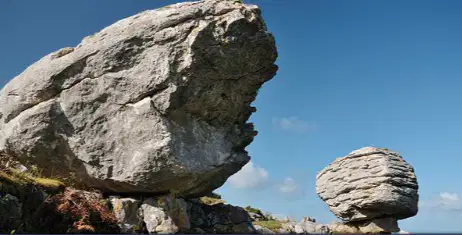
Which agent of weathering/erosion caused the geologic feature pictured by moving these large rocks from where they normally are found?
a)
wind
b)
water
c)
ice
27.
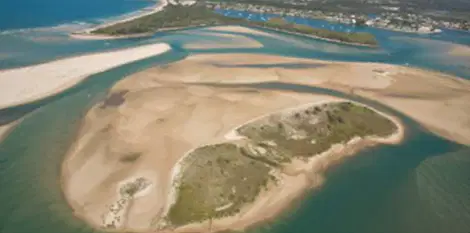
Which agent of weathering/erosion caused the geologic feature pictured?
a)
wind
b)
water
c)
ice
28.

What agent of weathering/erosion caused the geologic feature pictured?
a)
wind
b)
water
c)
ice
29.
What is formed when the land surface above collapses into an empty cavity?
a)
volcano
b)
sinkhole
c)
delta
d)
dune
30.
What type of rock erodes more quickly?
a)
Quartz
b)
Limestone
c)
Obsidian
31.
What is a geologic event that happens naturally and may have a negative effect on humans?
a)
natural resource
b)
natural hazard
c)
geologic incident
d)
geologic action
32.
What is an event in which molten rock spews out of the mantle as ash, lava, and gases?
a)
tsunami
b)
volcanic eruption
c)
earthquake
d)
flood
33.
What is a major event that occurs when plates shift suddenly and release stored energy?
a)
tsunami
b)
volcanic eruption
c)
earthquake
d)
flood
34.
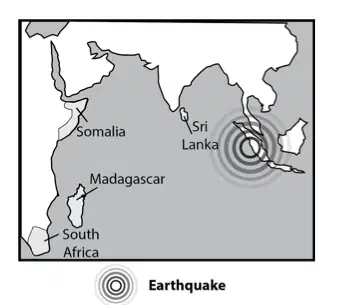
The map shows the location of an earthquake under the ocean. The data on the map would best support a prediction of which of the following events?
a)
an earthquake in South Africa
b)
a tsunami in Sri Lanka
c)
flash floods in Madagascar
d)
a hurricane in Somalia
35.
What type of volcanic eruption do shield volcanoes have?
a)
explosive
b)
nonexplosive
c)
explosive and nonexplosive
36.
What type of volcanic eruption do composite volcanoes (stratovolcanoes) have?
a)
explosive
b)
nonexplosive
c)
explosive and nonexplosive
37.
What type of volcanic eruption do cinder cone volcanoes have?
a)
explosive
b)
nonexplosive
c)
explosive and nonexplosive
38.
What do you call a scientist who studies earthquakes?
a)
quakeologist
b)
seismologist
c)
dermatologist
d)
paleontologist
39.
What type of earthquake waves are the slowest and most destructive?
a)
P waves (primary)
b)
S waves (secondary)
c)
surface waves
40.
What type of earthquake waves arrive first and move the fastest?
a)
P waves (primary)
b)
S waves (secondary)
c)
surface waves
41.
What type of earthquake waves move from side to side and arrive second?
a)
P waves (primary)
b)
S waves (secondary)
c)
surface waves
42.

S waves are represented by which letter on the diagram?
a)
A
b)
B
c)
C
43.
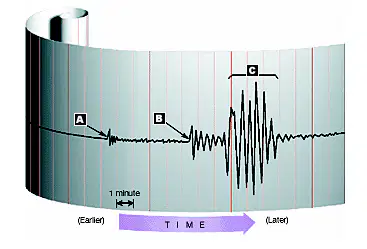
P waves are represented by which letter on the diagram?
a)
A
b)
B
c)
C
44.

Surface waves are represented by which letter on the diagram?
a)
A
b)
B
c)
C
45.
Why does being able to predict natural disasters and knowing when and where they might occur help us?
a)
We can stop them from happening.
b)
We can prepare for them or get people to safety.
c)
We can plan a party before the event.
46.
Julie and Emily perform an experiment using a slinky to model seismic waves. For the p waves, they calculate a speed of 4.43 m/s and for the s waves, they calculate a speed of 3.21 m/s. Which of the following statements is true?
a)
Their results do support what is true of p waves and s waves in real life.
b)
Their results do not support what is true of p waves and s waves in real life.
c)
Their results show how fast surface waves in real life can travel.
47.
When a hurricane hits an area of land, what usually causes the most damage?
a)
flood damage
b)
wind damage
c)
extreme heat damage
48.
Which of the following would NOT be considered a natural hazard?
a)
A wildfire
b)
A tornado
c)
A flood
d)
An oil spill
49.
From the lab, which of the following choices would best represent an explosive eruption?
a)
The film canister with a lid that has a hole in it
b)
The film canister with a lid that doesn't have a hole in it
c)
The film canister with the plastic lid and the plastic wrap on it
50.
Which of the following natural hazards has the best chance of being predicted?
a)
Tsunami
b)
Earthquake
c)
Volcanic Eruption
100 %

